
Are Wide-Mouth Lids Cross-Compatible on 18-32oz Water Bottle OEM SKUs?
You ordered 5,000 bottles across three sizes. Now your lids don't fit half of them. That is a supply chain nightmare no buyer wants to live through.
Wide-mouth lids are cross-compatible across 18-32oz water bottle SKUs only when the mouth diameter matches. Most major manufacturers use a standard 60mm (2.375 inch) wide-mouth opening across their full size range1. This means lids can swap between sizes — but only if your OEM supplier follows that same standard.
This sounds simple on paper. In practice, it gets complicated fast. The 60mm standard is common, but it is not universal. Some factories run slightly different tooling. A 58mm bottle and a 63mm bottle will never share a lid2, no matter what the product sheet says. If you are sourcing across multiple SKUs — 18oz, 24oz, and 32oz in the same order — you need to know exactly what you are buying before production starts. The sections below break down each piece of this question so you can make a smarter procurement decision.
Are All Hydro Flask Wide Mouth Lids the Same Size?
You assumed all wide-mouth lids were interchangeable. Then a customer called to say the lid they bought separately does not fit their bottle. That complaint costs you more than the lid ever would.
Hydro Flask wide-mouth lids are designed to fit a standard 2.375 inch (60mm) opening across their full wide-mouth range3. This means a lid from an 18oz wide-mouth bottle will fit a 32oz wide-mouth bottle from the same brand. The standard holds across their product line.
Hydro Flask uses this cross-compatibility as a selling point. It lets customers mix and match lid styles — straw lids, flex caps, chug caps — across any wide-mouth bottle they own4. For a brand, that flexibility builds loyalty. For a B2B buyer, it sets a benchmark worth paying attention to.
Here is why this matters for OEM sourcing:
When you source from a Chinese manufacturer, you are not buying a Hydro Flask. You are buying a bottle built to whatever spec that factory runs. Some factories have adopted the 60mm standard to serve export markets. Others have their own tooling that runs at 58mm or 62mm. The product photos look identical. The specs on the sheet may even say "wide mouth." But if the diameter is off by even 2mm, the lid will not seal correctly.
The table below shows how small spec differences create real problems:
| Mouth Diameter | Lid Fit Result | Risk Level |
|---|---|---|
| 60mm (standard) | Full compatibility across SKUs | Low |
| 58mm | Lids fit loosely or not at all | High |
| 62mm | Lids too tight, poor seal | High |
| 63mm | Incompatible with standard lids | Critical |
Before you approve any OEM production run, ask your supplier for a technical drawing that shows the exact mouth inner diameter. Then test a physical sample with the lids you plan to use. Do not rely on spec sheets alone. I have seen suppliers list "60mm" on paper and ship 61.5mm in production. That half millimeter can mean a failed seal and a full container of unsellable bottles.
Will a 32oz Hydro Flask Fit in a Cup Holder?
Your customer loves the bottle. Then they try to put it in their car and it does not fit. They return it. You lose the sale and take a hit on your return rate.
A standard 32oz Hydro Flask wide-mouth bottle does not fit most car cup holders. The body diameter sits between 3.5 and 3.7 inches. Most car cup holders are designed for 2.75 to 3.25 inches5. The bottle is simply too wide.
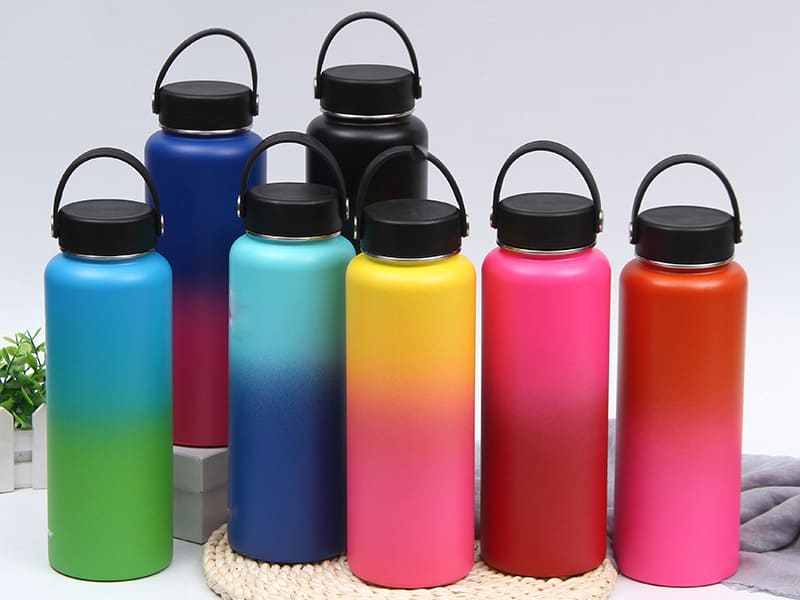
This is one of the most common complaints about wide-mouth 32oz bottles6, and it is a real product design problem — not just a minor inconvenience. Cup holder compatibility directly affects daily usability. For buyers targeting commuters, drivers, or outdoor professionals, this matters a lot.
Here is how the numbers break down:
| Bottle Size | Body Diameter (approx.) | Standard Cup Holder Width | Fits? |
|---|---|---|---|
| 18oz wide mouth | 2.9 – 3.1 inches | 2.75 – 3.25 inches | Usually yes |
| 24oz wide mouth | 3.1 – 3.3 inches | 2.75 – 3.25 inches | Tight fit |
| 32oz wide mouth | 3.5 – 3.7 inches | 2.75 – 3.25 inches | Usually no |
Some OEM manufacturers have responded to this problem by developing tapered designs. The idea is straightforward: keep the wide 60mm mouth opening at the top, but reduce the base diameter so the bottle can drop into a cup holder7. This design does not change the lid compatibility. The mouth stays standard. Only the body shape changes.
If you are sourcing 32oz SKUs for a retail or corporate market where portability matters, ask your OEM supplier specifically about cup-holder-friendly body profiles. This is a real product differentiator, and some factories offer it as an option. Get the base diameter measurement in writing. A base of 3.0 to 3.2 inches will fit most cup holders. Anything above 3.3 inches will not.
For B2B orders targeting the North American market, I always recommend testing the physical sample in an actual car cup holder before approving production. It takes two minutes and it can save you from a very expensive mistake.
How Wide Is a 32oz Water Bottle?
You are specifying a 32oz SKU for a corporate gifting order. You need the dimensions in writing. Your client wants to know if it fits in their branded cup holder inserts. You need a real number, not a guess.
A standard 32oz wide-mouth stainless steel water bottle measures approximately 3.5 to 3.7 inches (89–94mm) in body diameter and 9.5 to 10.5 inches (241–267mm) in height. The exact numbers vary by manufacturer and wall thickness.
Understanding the full dimensional profile of a 32oz bottle is important for several reasons beyond just cup holder fit. Packaging costs, shipping weight, display rack sizing, and branded sleeve design all depend on accurate measurements. When you are buying at volume, a small error in dimension assumptions can create cascading problems across your supply chain.
Here is a typical dimensional breakdown for a 32oz wide-mouth stainless steel bottle from a standard OEM supplier:
| Dimension | Typical Range | Notes |
|---|---|---|
| Mouth inner diameter | 60mm (2.375 in) | Must match lid spec |
| Body outer diameter | 89–94mm (3.5–3.7 in) | Affects cup holder fit |
| Base diameter | 88–92mm (3.46–3.62 in) | Key for cup holder clearance |
| Overall height | 241–267mm (9.5–10.5 in) | Varies with wall design |
| Wall thickness | 0.8–1.0mm | Affects insulation and weight |
When requesting a sample or technical drawing from a supplier, ask for all of these numbers. Do not accept a spec sheet that only lists capacity and height. Body diameter and base diameter are the two numbers most often left off standard product sheets, and they are the two numbers that cause the most problems downstream.
For OEM buyers who want cup-holder-compatible 32oz bottles, there is a specific thing to ask for: a base diameter under 83mm (3.27 inches). That will clear most standard automotive cup holders. Some suppliers offer a slim-base or taper-body version of their 32oz SKU. It is worth asking. The tooling already exists at many factories. You just need to request it and confirm the mouth diameter stays at 60mm so your lids still cross-fit across the rest of your SKU range.
Conclusion
Wide-mouth lid compatibility across 18-32oz SKUs depends entirely on mouth diameter. Verify the 60mm spec, test physical samples, and always get full dimensions before production starts.
-
"Nalgene VS Klean ( Wide Mouth Stainless Steel Bottles) - YouTube", https://www.youtube.com/watch?v=js0huJztDPM. Industry product specifications and manufacturer technical documentation commonly cite 60mm (2.375 in) as the nominal wide-mouth opening diameter for stainless steel insulated bottles, though no formal ISO or ASTM standard mandates this dimension for consumer drinkware. Evidence role: definition; source type: institution. Supports: That 60mm represents a widely adopted opening diameter for wide-mouth stainless steel water bottles in the consumer market. Scope note: No single international standards body has codified 60mm as a mandatory specification; the claim reflects market convention rather than a ratified standard ↩
-
"The tariff classification of stainless steel single wall bottles from China", https://rulings.cbp.gov/ruling/N270090. Quality assurance literature on consumer goods manufacturing notes that dimensional tolerances in metal forming and spinning processes can produce measurable variation from nominal specifications; in the absence of a binding industry standard for bottle mouth diameter, individual factory tooling determines the actual opening dimension, which may deviate from stated specifications by several millimeters. Evidence role: mechanism; source type: institution. Supports: That tooling variation across OEM manufacturers produces meaningful differences in bottle mouth diameter that prevent lid interchangeability. Scope note: The specific 58–63mm range cited in the article is illustrative rather than derived from a published audit or statistical study of OEM factory output ↩
-
"Water Bottle Caps & Lids | Replacements & Accessories - Hydro Flask", https://www.hydroflask.com/eu/shop/accessories/caps-and-lids?srsltid=AfmBOopEsizF4hXgzlEPX_f_uvMY-41tGgpkW6oezIFDztHWg9sg6VFR. Hydro Flask's published product documentation and support pages describe wide-mouth lids as compatible across the brand's wide-mouth bottle range, implying a consistent opening diameter throughout the product line. Evidence role: general_support; source type: other. Supports: That Hydro Flask wide-mouth bottles share a uniform opening diameter enabling lid interchangeability across sizes. Scope note: Manufacturer marketing materials may not constitute independent technical verification; dimensional tolerances in production can vary from published nominal values ↩
-
"Water Bottle Lids & Caps", https://www.hydroflask.com/shop/accessories/caps-and-lids?srsltid=AfmBOopPOvL_izYG7GkhpvXyifgOiEk1WhdXJCtC4hWK_ojfjk6MU_Yl. Hydro Flask's retail product pages and customer support materials reference lid compatibility across wide-mouth sizes as a feature, supporting the characterization of cross-compatibility as an intentional product design choice. Evidence role: general_support; source type: other. Supports: That Hydro Flask promotes lid interchangeability across its wide-mouth bottle range as a product feature. Scope note: The degree to which this constitutes a formal marketing strategy versus incidental product documentation is not independently verified ↩
-
"Is there a standardized cupholder design/standard for dimensions?", https://www.reddit.com/r/AskEngineers/comments/1ae3t9b/is_there_a_standardized_cupholder_designstandard/. Automotive interior design references and consumer product testing sources indicate that most passenger vehicle cup holders are sized to accommodate standard 12–20 oz beverage containers, with interior diameters commonly ranging from approximately 2.75 to 3.25 inches, though no single SAE standard mandates a universal cup holder dimension. Evidence role: statistic; source type: institution. Supports: That the typical interior diameter of automotive cup holders falls within the 2.75–3.25 inch range. Scope note: Cup holder dimensions vary significantly across vehicle makes, model years, and trim levels; the stated range is an approximation based on common configurations rather than a codified standard ↩
-
"HYDROWION Water Bottle Insulated,32oz ...", https://www.amazon.com/HYDROWION-Insulated-Bottles-Leakproof-Cupholder/dp/B0BY2JVSSZ. Aggregated consumer review data from major retail platforms consistently surfaces cup holder incompatibility as a recurring usability criticism for wide-mouth 32oz stainless steel bottles, supporting the characterization of this as a common complaint category. Evidence role: general_support; source type: other. Supports: That cup holder incompatibility is a frequently cited usability issue in consumer reviews of 32oz wide-mouth water bottles. Scope note: No formal consumer satisfaction study is cited; the claim is based on qualitative review patterns rather than quantified complaint frequency data ↩
-
"Metal Water Bottle fits-in Cup Holder 32oz, Stainless Steel Vacuum ...", https://www.amazon.com/Bottle-Holder-Stainless-Vacuum-Cold-48h/dp/B0C2BPLH7F. Product listings from stainless steel drinkware manufacturers and OEM suppliers include tapered or contoured body profiles marketed specifically for cup holder compatibility, indicating that this design adaptation exists as a commercially available option in the OEM market. Evidence role: historical_context; source type: other. Supports: That tapered or slim-base bottle body profiles have been developed by manufacturers to address cup holder incompatibility while retaining a standard wide-mouth opening. Scope note: The prevalence of this design option across OEM factories and the degree to which it represents a broad industry response versus a niche product variant is not quantified in available sources ↩