
Which mug heights trigger dishwasher clearance issues in US and EU models?
Many buyers approve a mug height on paper, then complaints start at home. I see one missed clearance detail turn a strong product into returns.
I treat any mug or bottle taller than nine inches as a US top-rack risk. I treat ten to eleven inches as a common EU upper range. I keep universal wholesale designs around seven to nine inches when I want easy dishwasher messaging across both markets.

I learned this lesson during a sample review for a Canadian buyer who wanted a tall stainless steel bottle with a bold shape. The bottle looked premium. The logo area was large. The color finish was clean. But I placed it beside a normal dishwasher rack sample, and the product suddenly felt risky. The height was not only a design detail. It was a daily-use detail. If a consumer cannot place a mug, tumbler, or bottle into the dishwasher without moving racks, the product feels less convenient. If a distributor prints “dishwasher safe” too freely, the claim can become a support problem. I now treat dishwasher clearance as an early sourcing filter, not a final packaging detail.
Is a BPA free dishwasher safe?
BPA-free sounds safe, and many sales teams stop there. I do not stop there, because a safe material can still fail in heat.
I do not treat BPA-free as equal to dishwasher-safe. BPA-free only says the product does not use BPA1. Dishwasher safety depends on stainless steel grade, coating, plastic type, silicone quality, glue, lid design, and heat resistance2.

How I check dishwasher-safe claims before I accept them
I first separate chemical safety from heat performance. I use this rule because many buyers mix the two points during sourcing. BPA-free is a material safety statement. Dishwasher-safe is a use condition statement. A stainless steel body can be naturally free from BPA, but the lid may still include plastic, silicone, a straw part, or a soft-touch coating. Each part must survive hot water, detergent, and drying heat. I also check the finish method. A plain brushed stainless steel body is usually easier to support than a painted or electroplated body. I ask for clear care instructions by component, because a full product is rarely one material. I prefer wording like “body hand wash recommended” or “lid top rack only” when the design needs limits. This protects the buyer, the brand owner, and the factory. It also reduces arguments after delivery, because the care rule is clear before the purchase order.
| Product area | What I check | What I tell buyers |
|---|---|---|
| Stainless steel body | I check grade, weld quality, and insulation structure | I do not promise dishwasher use without full product testing |
| Plastic lid | I check heat rating and deformation risk | I separate BPA-free from dishwasher-safe |
| Silicone gasket | I check odor, fit, and heat resistance | I accept dishwasher use only for quality silicone |
| Coating or paint | I check peeling, fading, and gloss change | I avoid strong dishwasher claims for delicate finishes |
| Logo method | I check laser, screen print, and powder coat behavior | I match care claims with the weakest decoration |
What cannot be washed in a dishwasher?
Some products look tough, but dishwashers punish weak finishes. I have seen one wrong care claim erase profit from an entire shipment.
I keep painted, electroplated, vacuum-insulated, bamboo, wood, glued, and low-grade plastic parts out of dishwasher claims unless I have clear test proof. I also avoid dishwasher claims for products with delicate logos or coatings.
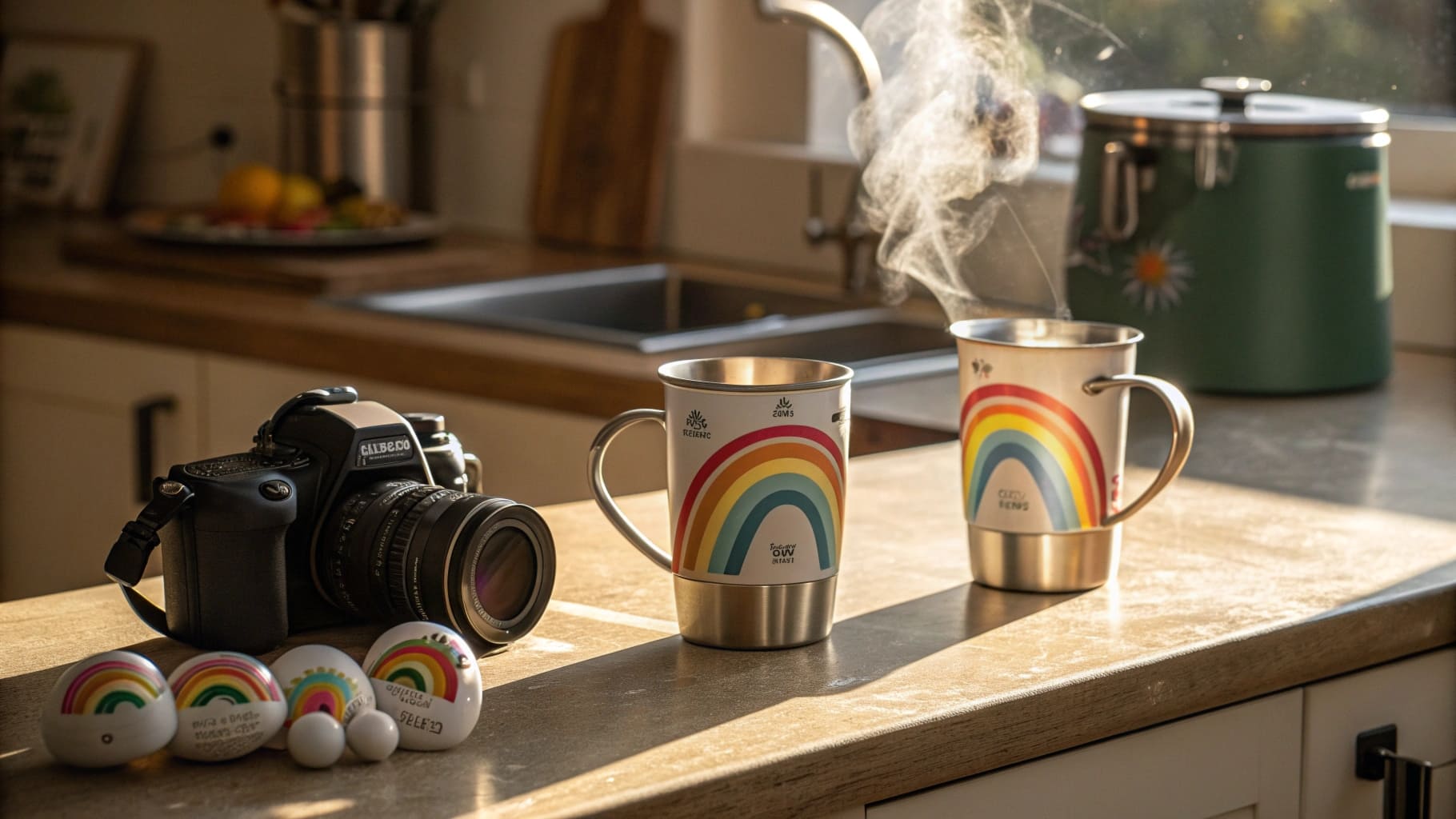
What I exclude from dishwasher claims during product planning
I do not build dishwasher messaging from the strongest part of the product. I build it from the weakest part. This matters a lot for stainless steel water bottles and mugs, because the body may be strong while the lid, coating, or printed logo is more fragile. I become careful when I see glossy paint, rubberized coating, metallic plating, bamboo decoration, leather sleeve, glued badge, or a soft touch surface. These parts can change under heat. They can peel, fade, crack, or trap detergent smell. I am also careful with vacuum-insulated items. Some factories design them for dishwasher use, but I do not assume it. Heat and detergent may affect paint, base pads, lid seals, or printed care labels3. For wholesale buyers, I suggest a conservative claim unless the sample has passed repeated dishwasher cycles. The cost of one failed claim is bigger than the cost of one clear warning on the carton.
| Item or feature | Why I am careful | Safer care message I use |
|---|---|---|
| Painted exterior | I watch for fading, peeling, and surface dullness | I say hand wash recommended |
| Electroplated finish | I watch for color change and spotting | I avoid dishwasher-safe wording |
| Bamboo or wood trim | I watch for swelling and cracking | I say wipe clean or hand wash only |
| Glued badge or sleeve | I watch for glue failure | I keep it away from high heat |
| Delicate printed logo | I watch for scratches and detergent attack | I choose laser marking when possible |
| Low-grade plastic lid | I watch for warping and odor | I ask for material proof before claims |
| Vacuum-insulated body | I watch the coating, base, and seals | I test before I approve dishwasher use |
What happens if you put silicone in the dishwasher?
Silicone feels simple, so buyers ignore it. I do not, because one weak gasket can create leaks, odors, and angry repeat emails.
I usually allow high-quality, heat-resistant silicone gaskets in the dishwasher. I do not trust low-grade silicone. Heat, detergent, and pressure can make weak silicone smell, swell, harden, crack, or lose its seal.

How I judge silicone quality in lids, boots, and seals
I look at silicone as a small part with a large duty. A gasket may cost little, but it controls leakage, drinking comfort, and the consumer’s first feeling of quality. Good silicone can handle normal dishwasher cycles well when the formula is stable and food-grade4. It should stay flexible, keep its shape, and return to the lid groove after washing. Weak silicone may absorb odor from detergent or drinks. It may also become sticky, dry, loose, or uneven after heat exposure. I check the gasket fit after repeated opening and washing. I also smell it after hot water contact, because odor complaints are common in bottle lids. For silicone boots, I check color bleeding, surface dust attraction, and fit around the bottle base. I do not like vague claims such as “safe silicone” without a test report. I prefer clear material data, heat resistance information, and sample testing before bulk order approval.
| Silicone part | What can happen in the dishwasher | What I inspect after washing |
|---|---|---|
| Lid gasket | It can swell, shrink, or lose sealing power | I check leakage and lid fit |
| Straw tip | It can retain odor or become cloudy | I smell it and check softness |
| Silicone boot | It can loosen or collect residue | I check grip and color stability |
| Carry handle grip | It can harden or crack at stress points | I bend it and inspect the edges |
| Stopper seal | It can deform and cause drips | I test closing pressure and water flow |
Conclusion
I treat dishwasher clearance, material limits, and component care as one sourcing decision, because one unclear claim can damage a whole wholesale program.
-
"Bisphenol A (BPA): Use in Food Contact Application", https://www.fda.gov/food/food-packaging-other-substances-come-contact-food-information-consumers/bisphenol-bpa-use-food-contact-application. The US FDA's guidance on bisphenol A addresses its use in food-contact materials and notes that BPA-free designations pertain to the absence of that specific chemical, not to broader performance characteristics such as heat resistance during dishwasher cycles. Evidence role: definition; source type: government. Supports: What a BPA-free designation covers under US FDA or equivalent regulatory guidance. Scope note: FDA guidance focuses on chemical safety rather than thermal durability, so it supports the definitional boundary the article draws but does not directly address dishwasher performance claims. ↩
-
"FINAL Commercial Dishwashers Draft Test Method", https://www.energystar.gov/sites/default/files/specs/Commercial_Dishwashers_Draft_Test_Method_Rev_Jan_2012.pdf. Standards bodies such as NSF International and ASTM have developed protocols for evaluating the dishwasher resistance of household articles that assess the complete product assembly, including lids, seals, coatings, and decorative elements, reflecting the industry consensus that composite product safety cannot be inferred from testing a single component. Evidence role: expert_consensus; source type: institution. Supports: That standardized dishwasher-safety evaluation requires testing of all components and materials in a composite product, not the primary body material alone. Scope note: Specific applicable standards vary by product category, and voluntary compliance with such protocols is not universally required, meaning many consumer products may be labeled without having undergone formal multi-component testing. ↩
-
"Contribution of household dishwashing to microplastic pollution", https://pmc.ncbi.nlm.nih.gov/articles/PMC10076389/. Research on alkaline detergent chemistry documents that high-pH cleaning agents at elevated temperatures accelerate hydrolysis and saponification of organic coatings and adhesives, contributing to delamination, color fade, and seal degradation in consumer products subjected to repeated dishwasher cycles. Evidence role: mechanism; source type: research. Supports: The chemical and thermal mechanisms by which dishwasher detergent and heat degrade surface coatings, seals, and printed labels. Scope note: Specific degradation rates depend on detergent formulation, water temperature, and material composition, limiting direct quantitative extrapolation to any particular product. ↩
-
"Inventory of Food Contact Substances Listed in 21 CFR", https://hfpappexternal.fda.gov/scripts/fdcc/index.cfm?search=silicone&set=IndirectAdditives. FDA regulations under 21 CFR Part 177 specify compositional and testing requirements for silicones intended for repeated food-contact use, including provisions relevant to heat resistance, which provide a regulatory basis for evaluating whether a silicone formulation is suitable for dishwasher exposure. Evidence role: definition; source type: government. Supports: Regulatory definition and thermal performance requirements for food-grade silicone in food-contact applications. Scope note: FDA food-contact approval does not constitute a direct dishwasher-safety certification; actual performance under repeated wash cycles depends on part geometry, detergent type, and water temperature beyond the scope of compositional regulations. ↩