
Which Insulated Coffee Mugs With Handles Keep Flavor Neutral for Office Use?
I see many office mugs fail quietly. Coffee tastes metallic, users complain, and buyers lose trust in a product that looked safe at first.
I choose insulated coffee mugs with handles made from food-grade stainless steel, clean interior finishing, and safe lid parts. The best office mugs keep coffee flavor neutral, resist corrosion, clean easily, and use durable welded handles for daily desk use.
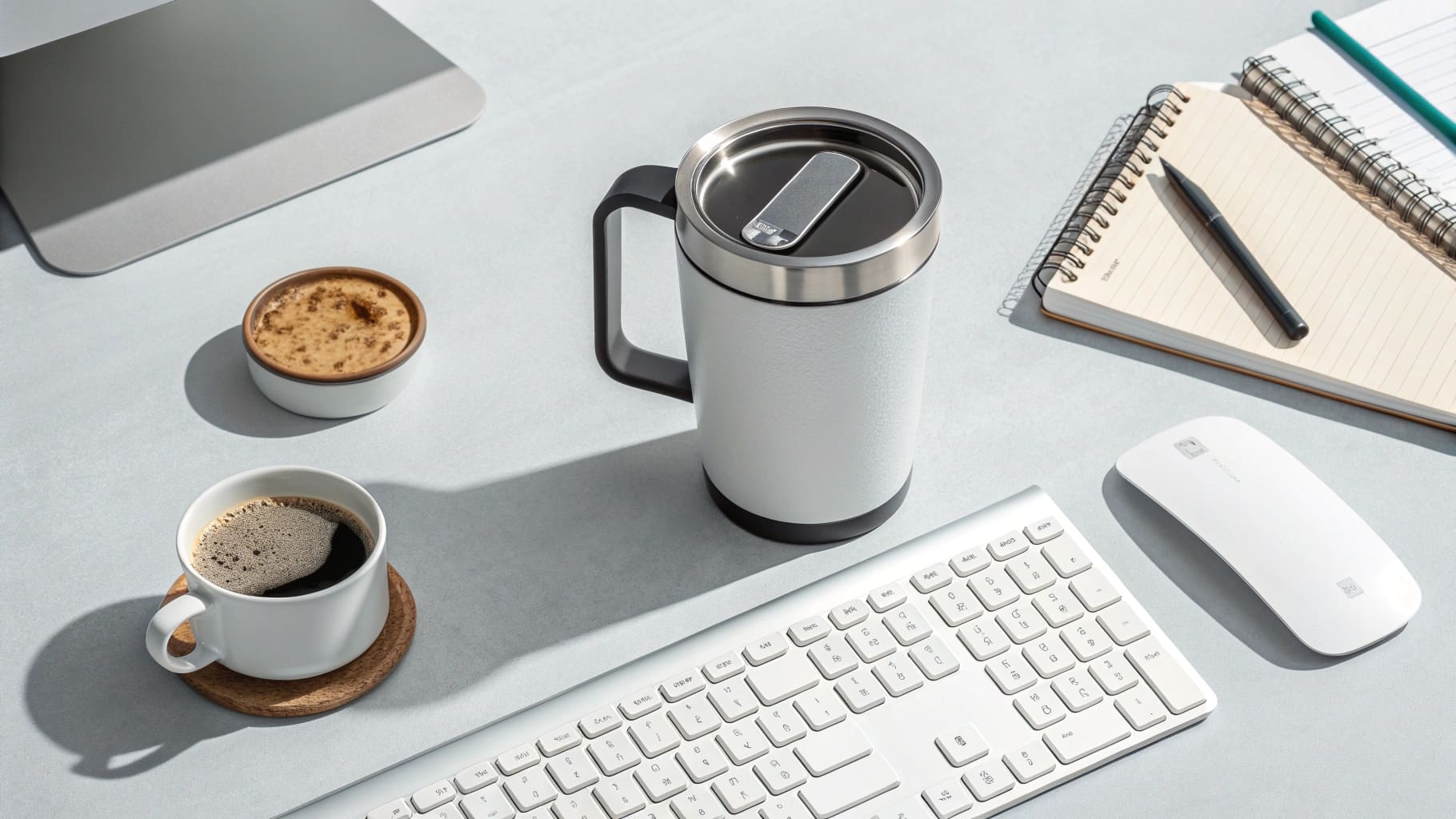
I learned that flavor neutrality is not a marketing word. It is a material and process result. I once checked a sample that looked perfect outside, but hot coffee tasted sharp after ten minutes. That small problem changed the whole order discussion. If I want an office mug to work every day, I must check the steel grade, inner surface, lid seal, handle strength, and coating quality before I trust the sample.
Is Thermos or Contigo Better?
I see buyers compare brand names first. That can create a blind spot. A famous name still may not match the office use case.
I see Thermos as stronger for heat retention and premium positioning. I see Contigo as better for fast office movement and spill control. I choose based on user habits, not only brand reputation.
How I Compare the Two Brands for Office Buyers
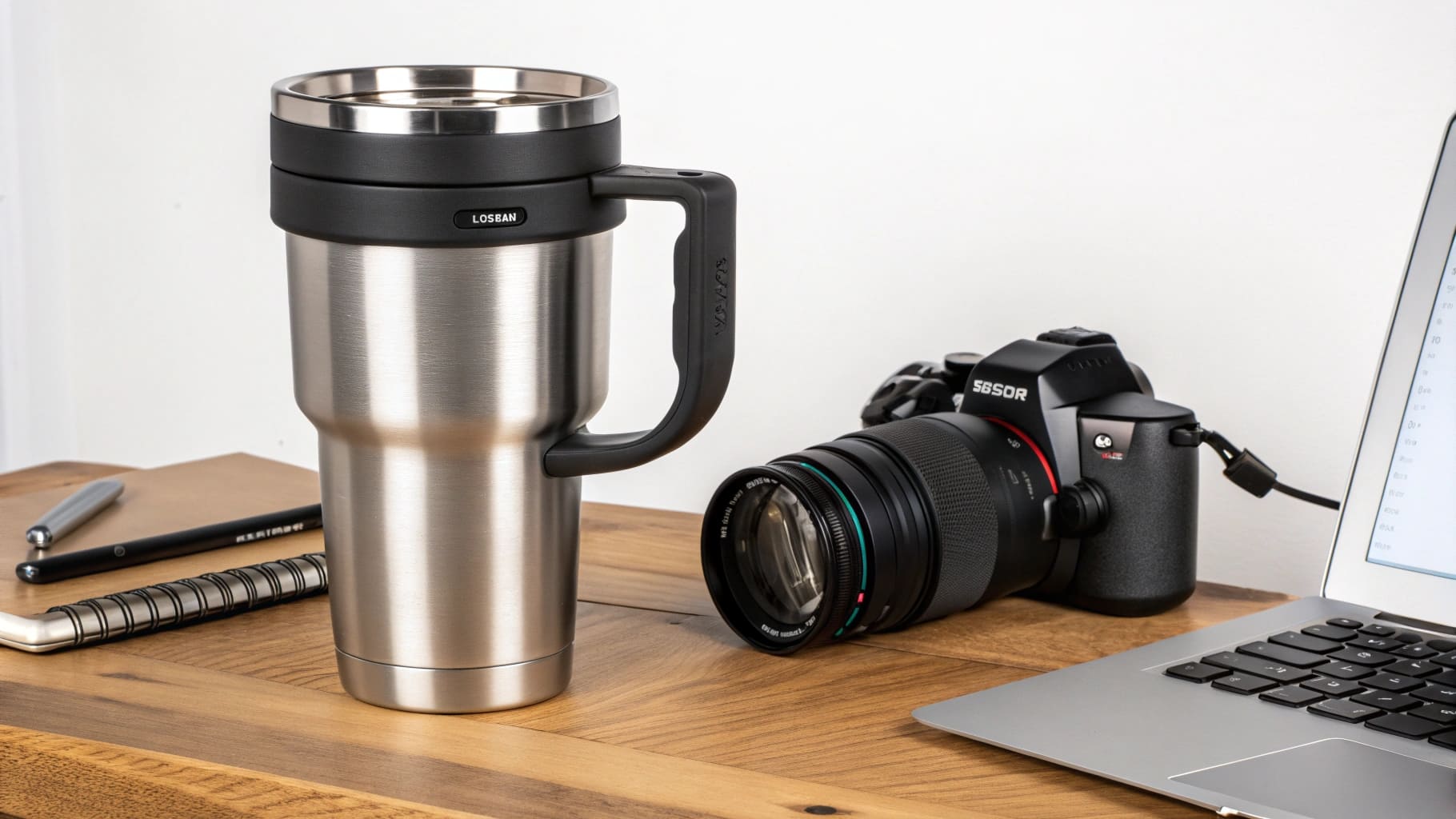
I compare Thermos and Contigo with a simple question in mind. I ask how the mug will be used in a real office. Some users sit at a desk for hours. They care about heat retention, a stable base, and a comfortable handle. Some users walk between meetings. They care more about one-hand drinking, spill resistance, and quick lid operation. Thermos often gives me a more classic insulation story. It fits executive gifts and higher-end office programs. Contigo often gives me a practical daily-use story. It fits busy staff, sales teams, and shared office kitchens.
I do not treat either brand as a complete answer. I still check material grade, interior polish, lid silicone, and handle attachment. A strong brand can reduce risk, but it cannot replace inspection.
| Office need | I usually prefer | My reason |
|---|---|---|
| Long heat retention | Thermos | I see stronger focus on vacuum insulation1 |
| Fast movement | Contigo | I see better focus on spill control |
| Executive gifting | Thermos | I see a more premium image |
| Busy team use | Contigo | I see easier daily handling |
| B2B private label planning | Qualified factory option | I can control logo, color, cost, and testing |
What I Check Beyond the Brand Name
I always check the actual technical details. I look at stainless steel grade first. I prefer food-grade stainless steel such as common premium grades used for drinkware2. I also check if the inside is smooth enough to reduce coffee residue. A rough interior can hold old smell. It can also make cleaning harder. I check the lid because the lid often causes flavor problems before the steel body does. Low-quality plastic, poor silicone, or bad rubber can change the smell of hot coffee.
I also ask for stress testing on the handle. An office mug with a handle looks easy to use, but the handle must survive repeated lifting, washing, and desk impact. I prefer welded handles when the design allows it3. I avoid weak glued handles for corporate orders because one broken handle can damage the buyer’s confidence.
What Is the Healthiest Coffee Mug?
I see health claims everywhere. That worries me. A healthy mug should be proven by material, testing, and clean design, not only by product words.
I consider the healthiest coffee mug to be one made from tested food-grade stainless steel, BPA-free lid parts, food-grade silicone seals4, and a smooth interior that cleans well and resists odor.
How I Define a Healthy Mug for Office Use
I do not define a healthy mug by shape or color. I define it by what touches the drink and what survives daily washing. Coffee is hot and acidic. That means weak materials can show problems faster. I prefer stainless steel interiors that resist corrosion and do not add metallic taste. I also check plastic parts in the lid because hot steam touches them. If the lid smells strange after hot water testing, I treat that as a warning sign.
I also care about the inside finish. A smoother interior surface helps reduce tiny pits where old coffee oil can stay. In an office, users may rinse mugs quickly between meetings. That quick cleaning makes surface quality more important. A healthy mug should not demand perfect cleaning every time to stay fresh.
| Health factor | What I request | Why I care |
|---|---|---|
| Inner body material | I request food-grade stainless steel | I want low odor and low corrosion risk |
| Lid material | I request BPA-free plastic parts | I want safer hot drink contact |
| Seal material | I request food-grade silicone | I want less smell and longer life |
| Interior finish | I request smooth polishing | I want easier cleaning |
| Test proof | I request third-party reports | I want proof, not only promises |
Why Certification Still Needs Careful Reading
I ask for certificates, but I do not stop there. I have seen buyers face certificate fraud in the market. I treat any safety claim as a starting point. I ask the supplier to connect the report with the exact product, exact material, and exact production batch when possible. I also check if the report covers the lid, coating, and silicone parts. A mug body can pass testing while a lid part creates odor or safety concern.
For office projects, I also test samples with hot water and hot coffee. I let the drink sit, then I smell and taste it. This is not a lab test, but it catches many daily-use problems. I also wash the sample several times. If the mug keeps a chemical smell, I reject it. I want office users to trust the mug from the first week, not after many complaints.
Which Brand of Insulated Water Cup Is Better?
I see many buyers ask for the best brand. I think the better question is more practical. Which product system can protect quality, timing, and cost?
I choose the better insulated water cup brand by checking material grade, insulation data, lid seal quality, handle strength, coating durability, certification proof, and supplier communication speed.

How I Judge a Better Brand or Supplier
I judge a brand by repeated performance. A good insulated water cup must keep temperature well, but that is only one part. It must also feel stable in the hand, fit desks and cup holders, clean easily, and keep a professional look after months of use. For office buyers, the mug also carries brand image. A scratched coating or loose handle can make the company logo look cheap.
I also care about communication. I work in B2B supply, so I know that slow replies can become late shipments. A supplier who answers clearly can prevent many problems before production. I prefer suppliers who share drawings, material details, testing plans, packing details, and shipment updates in a direct way. A lower price is not always a lower cost if delays make the buyer miss the sales season.
| Quality area | What I check | What I avoid |
|---|---|---|
| Steel body | I check grade and wall consistency | I avoid unclear material claims |
| Vacuum insulation | I check heat retention data | I avoid vague performance words |
| Lid system | I check silicone seal quality | I avoid rubber smell and weak seals |
| Handle | I check attachment strength | I avoid loose rivets and weak glue |
| Coating | I check scratch resistance | I avoid soft coating that marks quickly |
| Supplier process | I check inspection and communication | I avoid slow and unclear replies |
Why Private Label Can Beat Retail Brands for B2B
I believe private label can be stronger than retail brands when the buyer has clear requirements. A retail brand gives ready-made trust, but it limits design, logo placement, color choice, and margin. A factory-based private label program can match the office market better. I can choose a handle shape that feels natural. I can choose a lid opening that works with office coffee machines. I can place the logo where it looks clean and does not create cleaning trouble.
I also control cost structure better with private label. I can select the right steel grade, coating, lid design, and packaging level for the target market. I do not need to pay for features that the end user does not value. I do need stronger inspection, clear certificates, and better production follow-up. That is the trade-off. For buyers in Canada, America, and Europe, I would not chase the cheapest quote. I would choose the supplier who can show stable samples, clear testing, honest documents, and realistic lead times.
How I Design an Office Mug That Keeps Coffee Neutral
I start with the inside of the mug. I want the drink contact surface to be stainless steel, smooth, and easy to rinse. I avoid inner coatings for coffee mugs when flavor neutrality is the main goal because coatings can chip or hold odor if the process is weak. I then check the lid path. Coffee vapor touches the lid every day. If that path has poor plastic or cheap rubber, users may blame the whole mug.
I also think about the handle as part of flavor trust. A strong handle makes users lift the mug with confidence. A weak handle creates fear, spills, and complaints. For office use, I prefer a handle opening that works with different hand sizes. I also prefer a base that stays stable on a desk. A good mug should feel quiet and reliable. It should not wobble near a laptop. It should not smell after hot coffee. It should not make the user think about the product at all.
Conclusion
I choose flavor-neutral office mugs by checking material, lid safety, handle strength, coating quality, certificates, and supplier discipline before I trust any brand name.
-
"Vacuum flask", https://en.wikipedia.org/wiki/Vacuum_flask. The vacuum flask operates on the principle that evacuating the inter-wall space eliminates gaseous conduction and convection, leaving only radiative heat transfer, which is further suppressed by reflective interior surfaces; this mechanism underlies the heat retention claims made for modern insulated drinkware. Evidence role: mechanism; source type: encyclopedia. Supports: That removing air from the space between double walls reduces heat transfer by conduction and convection, explaining the insulation performance of vacuum-walled drinkware. Scope note: Encyclopedic descriptions cover the general principle; actual retention performance depends on manufacturing quality, seal integrity, and the degree of vacuum achieved. ↩
-
"Stainless Steel (SS) Safety Profile", https://www.fda.gov/media/165146/download. Regulatory frameworks such as those maintained by the U.S. Food and Drug Administration and the European Food Safety Authority define permissible alloy compositions—including grades such as 304 (18/8) and 316—for food-contact metallic materials. Evidence role: definition; source type: government. Supports: Which stainless steel alloy compositions are recognized as suitable for food and beverage contact applications. Scope note: Regulatory definitions vary by jurisdiction; a single source may not cover all markets relevant to global B2B buyers. ↩
-
"A Review of Structural Adhesive Joints in Hybrid Joining ...", https://pmc.ncbi.nlm.nih.gov/articles/PMC8619164/. Mechanical engineering literature on metal joining methods establishes that fusion-welded joints in stainless steel generally exhibit higher tensile and fatigue strength than adhesive bonds under cyclic loading conditions, a property relevant to handle attachment in frequently handled consumer products. Evidence role: mechanism; source type: research. Supports: That welded metal joints provide greater structural integrity and fatigue resistance than adhesive bonds under repeated mechanical loading typical of daily drinkware use. Scope note: Specific failure data for mug handles under office-use conditions is not widely published; the comparison draws from broader structural joining research. ↩
-
"Inventory of Food Contact Substances Listed in 21 CFR", https://hfpappexternal.fda.gov/scripts/fdcc/index.cfm?search=silicone&set=IndirectAdditives. Food-contact silicone materials are subject to regulatory review by bodies including the FDA and EFSA, which assess extractable substances and confirm that compliant silicone formulations exhibit low migration potential under typical hot-beverage conditions. Evidence role: general_support; source type: government. Supports: That silicone materials approved for food contact demonstrate low chemical migration and odor contribution compared to conventional rubber at hot-liquid temperatures. Scope note: Regulatory approval covers compliant formulations; non-certified silicone products may not share these properties, and the article does not distinguish between certified and uncertified grades. ↩
