
Are Kids' Stainless Steel 8oz Cups Compliant with CPSIA and Prop 65 in 2026?
If you source kids' drinkware and get this wrong, your shipment gets blocked. One failed test can cost you a full season's revenue.
Kids' stainless steel 8 oz cups can meet both CPSIA and Prop 65 requirements in 2026, but only when every component — steel body, coatings, gaskets, and lids — is tested and certified1. The steel grade alone is not enough. Full third-party lab reports covering all materials are what make a product truly compliant.

Compliance used to mean picking the right steel grade. That was enough a decade ago. Today, the rules cover everything from the paint on the outside to the plastic ring inside the lid. If you sell into California or source for any brand that does, you need to understand exactly where the risk lives. Miss one component, and you are looking at a recall, a rejected shipment, or a lawsuit. The good news is that this is all manageable — once you know what to check.
Which Stainless Steel Is the Least Toxic?
Most buyers assume all stainless steel is safe. It mostly is — but the grade you choose still matters, and so does where the raw material comes from.
Food-grade 304 and 316 stainless steel are the least toxic options available for kids' cups. Both grades are inherently free of lead and cadmium. These are the two heavy metals that CPSIA and Prop 65 target most aggressively in children's products. Neither grade leaches harmful substances under normal drinking conditions.2
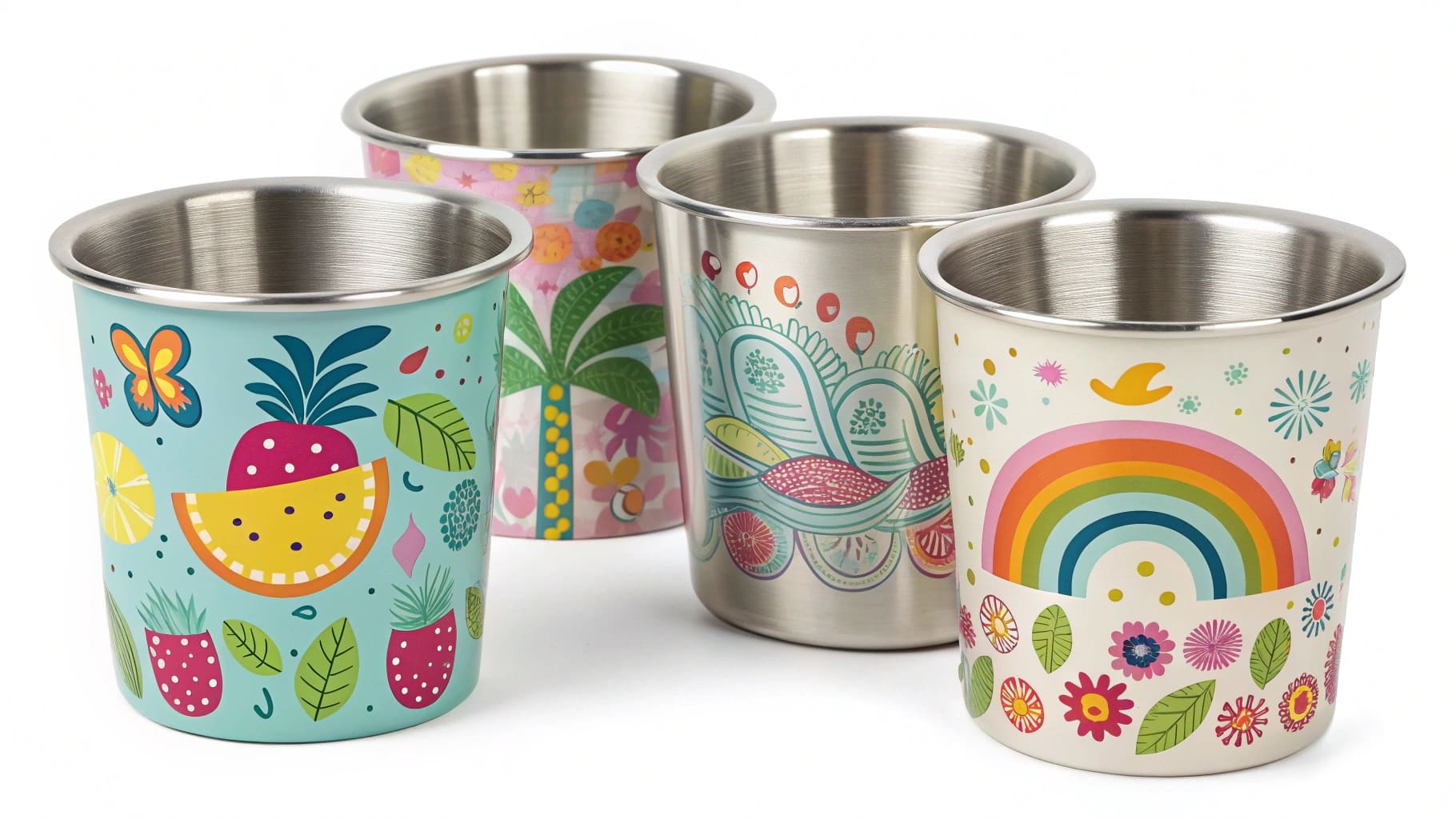
The difference between 304 and 316 comes down to one added element.3 Here is how they compare:
| Feature | 304 Stainless Steel | 316 Stainless Steel |
|---|---|---|
| Chromium Content | 18% | 16–18% |
| Nickel Content | 8% | 10–14% |
| Molybdenum | None | 2–3% |
| Corrosion Resistance | Good | Excellent |
| Cost | Lower | Higher |
| Best For | Standard kids' cups | High-durability or acidic-liquid use |
| Lead Content | None | None |
| Cadmium Content | None | None |
For most 8 oz kids' cups sold in North America, 304 grade is sufficient. It meets CPSIA and Prop 65 material requirements and keeps your unit cost competitive. The 316 grade is worth the premium when parents specifically ask for it or when your brand positioning targets the ultra-premium segment.
However, steel grade alone does not close the compliance question. The bigger risk is the source of the raw material. Some lower-tier suppliers use recycled steel from mixed or unknown sources. Recycled steel can carry trace amounts of heavy metals4 that go beyond the normal stainless steel composition. You cannot see these contaminants by looking at the cup. They only show up in lab tests. This is why I always ask suppliers for a certificate of analysis for the raw steel itself — not just for the finished product. Sourcing from suppliers who use 100% virgin food-grade steel eliminates this risk entirely and gives you clean documentation from the start of the supply chain.
Why Is There a Prop 65 Warning on Everything?
You have probably seen Prop 65 warnings on products that seem perfectly ordinary. Coffee cups, garden hoses, parking garages. It can feel like the warning means nothing. For a B2B buyer, that feeling is dangerous.
Prop 65 warnings appear on so many products because California sets its warning threshold far below the levels that federal regulators consider harmful. A product can be functionally safe and still require a warning under California law. For stainless steel kids' cups, the warning almost never comes from the steel itself. It comes from what gets added afterward.
Here is where the warning risk actually lives in a kids' stainless steel cup:
| Component | Common Risk Source | Why It Triggers Prop 65 |
|---|---|---|
| Exterior paint or coating | Lead-based pigments, cadmium-based colorants | Even trace amounts exceed California's threshold |
| Powder coating | Heavy metals in pigment formulas | Depends on coating supplier's raw material sourcing |
| Plastic straw or lid seal | Phthalates, BPA | Common plasticizers in lower-grade plastics |
| Printed graphics or decals | Ink formulations with restricted metals | Especially a risk with bright or metallic colors |
| Recycled steel body | Unknown trace heavy metals | No way to verify without raw material COA |
From a B2B buyer's standpoint, this creates a real business decision. A product with a Prop 65 warning is not automatically banned.5 It can still be sold in California with the warning label attached. But that label hurts you in two ways. First, it signals risk to end consumers, even when the actual risk is negligible. Second, retail buyers and distributors often refuse products with the warning because it creates liability and damages brand perception. Premium positioning becomes impossible.
The suppliers worth working with have already made the investment to eliminate this problem at the source. They use water-based or powder coatings specifically tested against Prop 65 thresholds. They source BPA-free gaskets and lids as a baseline standard. They test every production batch, not just the initial sample. This investment costs more upfront, but it protects your market access across all 50 states and makes your product far easier to sell.
The broader point is this: Prop 65 compliance is no longer just a California issue. Any brand distributing nationally needs to treat it as a national standard. I treat it that way in my sourcing conversations, and it filters out the suppliers who are not ready for the North American market.
How to Tell If Stainless Steel Is Toxic?
You cannot tell by looking. That is the honest answer. A toxic cup and a safe cup can look identical on a shelf or in a product photo.
The only reliable way to verify that a stainless steel kids' cup is non-toxic is through third-party lab testing.6 The test must cover all materials in the product, not just the steel body. One test report from the initial sample is not enough. You need batch-level testing.
Here is a practical checklist I use when evaluating a supplier's compliance documentation:
| What to Request | Why It Matters |
|---|---|
| CPSIA heavy metals test report (lead, cadmium, phthalates) | Confirms compliance with federal children's product safety law |
| Prop 65 screening report | Confirms compliance with California's chemical list |
| Certificate of analysis for raw steel | Verifies steel grade and confirms no unexpected trace metals |
| Coating or paint test report | Checks for restricted pigments and heavy metals in surface materials |
| BPA-free certification for plastic parts | Covers lids, straws, gaskets, and seals |
| Test lab accreditation | Lab must be recognized (SGS, Intertek, Bureau Veritas, or equivalent) |
| Batch-specific reports, not just sample reports | Confirms consistency across production runs, not just one sample |
The third-party lab piece is non-negotiable. I have seen suppliers provide beautifully formatted certificates that turn out to be self-issued or generated by unaccredited labs. This is one of the most common forms of certificate fraud in the supply chain, and it is a serious problem when you are sourcing from markets where verification systems are less mature. Always confirm that the lab issuing the report is independently accredited. The major accredited labs have publicly searchable databases where you can verify a report's authenticity.
Beyond documentation, there are a few physical checks that can flag lower-quality products before you even request paperwork. A strong chemical smell coming from the coating suggests low-grade paint or solvents. Paint that chips or scratches easily in standard handling suggests the coating system was not properly cured and may leach more readily. Lids or gaskets that feel unusually soft or tacky may contain higher-than-normal plasticizer content. None of these observations replace lab testing, but they help you quickly narrow down which suppliers to scrutinize more closely.
Looking ahead to 2026, the direction of regulation is clear. CPSIA requirements are stable, but Prop 65 adds new chemicals to its list every year. Smart sourcing means choosing suppliers who already exceed today's thresholds — not ones who barely meet them. Suppliers using virgin food-grade steel, certified-clean coating systems, and BPA-free components throughout the product are the ones whose documentation will hold up as requirements tighten. That is the sourcing position I recommend, and it is the standard I apply when evaluating new suppliers at Icobottle.
Conclusion
CPSIA and Prop 65 compliance for kids' 8 oz stainless steel cups in 2026 comes down to full supply chain testing, clean materials, and verified documentation from accredited labs. Steel grade matters, but it is only the starting point.
-
"List of CPSC-Accepted Testing Laboratories", https://www.cpsc.gov/cgi-bin/labsearch/. CPSC guidance on children’s product certification states that covered children’s products require a Children’s Product Certificate based on third-party testing by a CPSC-accepted laboratory, while California OEHHA guidance frames Prop 65 duties around exposure to listed chemicals in product materials. Evidence role: expert_consensus; source type: government. Supports: Kids' stainless steel cups require testing and certification of all relevant components, not merely selection of a steel grade, to substantiate CPSIA and Prop 65 compliance.. Scope note: These sources support the need to evaluate accessible components and chemical exposure pathways, but they do not by themselves prove that any specific cup is compliant. ↩
-
"[PDF] Stainless Steel Leaches Nickel and Chromium into Foods during ...", https://fses.oregonstate.edu/system/files/biblio_docs/Kamerud2013JAFC_SSLeachesNiCrIntoFood.pdf. Studies of metal release from stainless steel food-contact materials generally find low migration under ordinary food or beverage contact conditions, while showing that migration can vary with acidity, contact time, temperature, and alloy condition. Evidence role: mechanism; source type: paper. Supports: 304 and 316 stainless steel generally show low harmful metal migration under ordinary drinking-use conditions.. Scope note: This supports the general safety of properly manufactured stainless steel under normal use, but it is not a substitute for migration testing of a specific finished cup and its coatings or plastic parts. ↩
-
"Corrosion Resistance of Stainless Steels Intended to Come into ...", https://pmc.ncbi.nlm.nih.gov/articles/PMC6471766/. Metallurgical references distinguish 316 stainless steel from 304 chiefly by the addition of molybdenum, which improves resistance to pitting and corrosion in chloride-containing environments. Evidence role: definition; source type: education. Supports: 316 stainless steel differs from 304 primarily by containing molybdenum, contributing to greater corrosion resistance.. Scope note: The statement is a simplified comparison; 304 and 316 also differ in allowable ranges for other elements such as nickel and chromium. ↩
-
"Lost in the shuffle: A taxonomy for the accumulation of unwanted ...", https://pmc.ncbi.nlm.nih.gov/articles/PMC12618735/. Research on steel recycling and scrap metallurgy documents that recycled metal streams may contain residual or tramp elements introduced from mixed scrap sources, requiring compositional control and testing in finished alloys. Evidence role: mechanism; source type: paper. Supports: Recycled steel from mixed sources can contain residual trace elements that require verification through material analysis.. Scope note: The evidence supports the plausibility of trace-metal variability in recycled inputs, not that all recycled stainless steel used in drinkware exceeds safety thresholds. ↩
-
"Proposition 65 - OEHHA - CA.gov", https://oehha.ca.gov/proposition-65. OEHHA explains that Proposition 65 is principally a right-to-know warning law requiring businesses to provide clear and reasonable warnings before exposing individuals to listed chemicals, rather than a general ban on products containing those chemicals. Evidence role: definition; source type: government. Supports: A Prop 65 warning does not automatically prohibit sale of a product in California.. Scope note: Some chemicals or products may also be subject to separate federal, state, or local restrictions outside Prop 65. ↩
-
"Third Party Testing Guidance | CPSC.gov", https://www.cpsc.gov/Business--Manufacturing/Testing-Certification/Third-Party-Testing. CPSC guidance requires third-party testing by CPSC-accepted laboratories for many children’s products subject to children’s product safety rules, supporting the role of independent laboratory testing in substantiating compliance. Evidence role: expert_consensus; source type: government. Supports: Independent laboratory testing is the appropriate way to verify safety compliance for children’s stainless steel cups.. Scope note: The source supports regulatory compliance verification, but the phrase “non-toxic” is broader than CPSIA testing and may require additional toxicological or migration assessments depending on product materials. ↩
