
Insulated Travel Mugs With Handles: MOQ, Lead Time, and Pantone Control 2026?
Ordering insulated travel mugs with handles sounds simple. It never is. Hidden quality gaps, cup holder problems, and supplier delays can kill your margins before peak season even starts.
Insulated travel mugs with handles require MOQs of 1,000–5,000 units depending on the handle design, lead times of 45–75 days in 2026, and Pantone color approval adding 7–10 extra days. Choosing the right manufacturer tier is the single biggest factor in protecting your brand and margins.
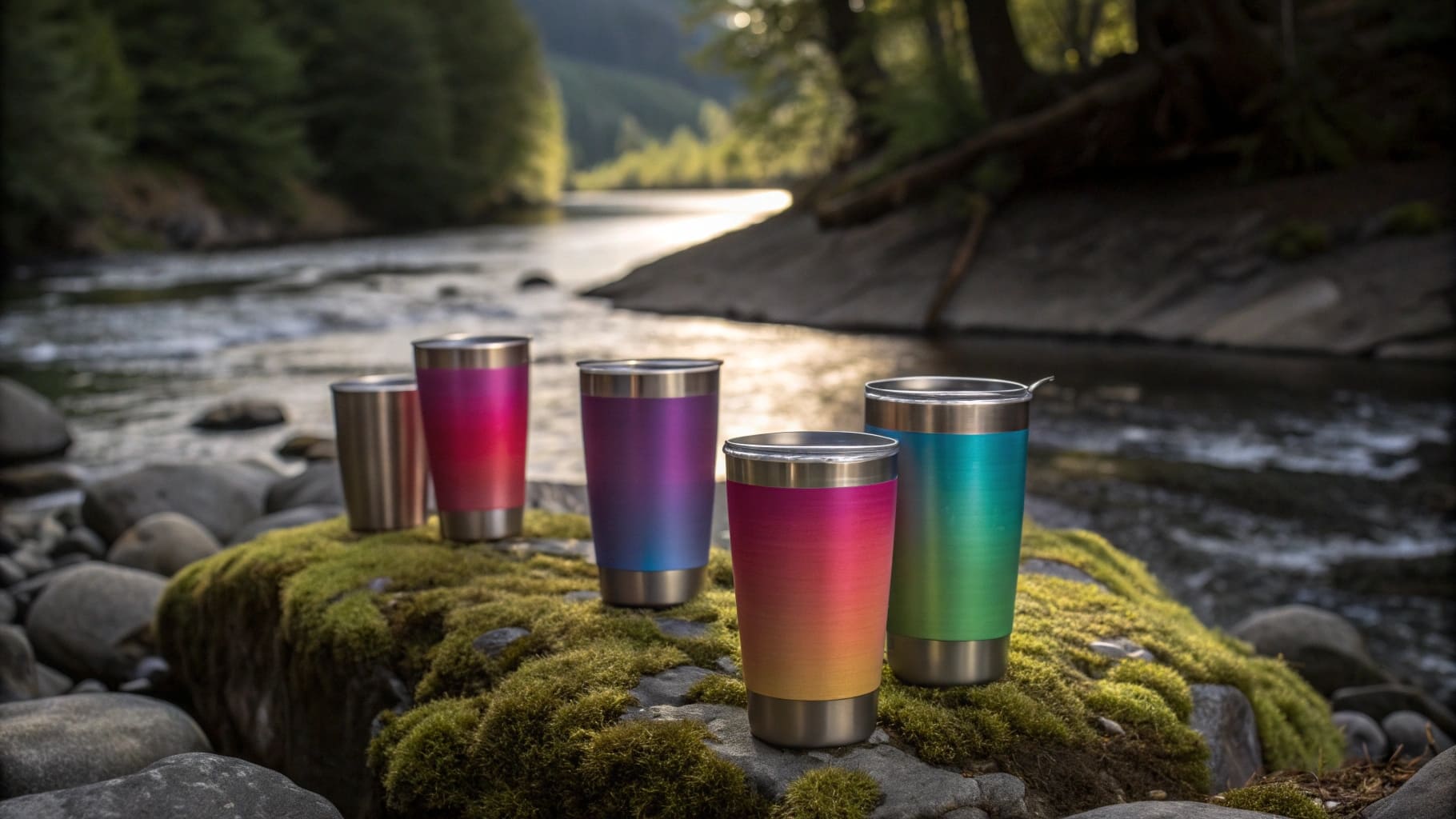
Most buyers focus on price per unit. That is the wrong place to start. The real cost comes later, in customer returns, missed deadlines, and color inconsistency across reorders. I have seen it happen more times than I can count. The sections below break down each decision point so you can avoid the most common mistakes before you place your 2026 orders.
Which Travel Mug Keeps Drinks Hot the Longest?
You ask your supplier how long their mug keeps drinks hot. They say 12 hours. You believe them. Three months later, your customers are complaining the coffee goes cold in two hours.
A properly made double-wall vacuum travel mug keeps drinks hot for 6–8 hours1. Poor vacuum sealing drops that to around 3 hours. Lid design accounts for up to 40% of heat loss. Internal copper or ceramic coatings can improve hot retention by 20–30%2 over standard stainless steel interiors.
The marketing number and the real number are almost never the same. Here is why that gap exists, and how to close it before you place a bulk order.
What Actually Controls Heat Retention?
There are three factors that matter most. Most suppliers will not bring them up unless you ask directly.
Vacuum insulation quality
Wall thickness is not the main factor. The vacuum between the two walls is what does the work3. A properly sealed vacuum slows heat transfer far better than a thick wall with weak or partial vacuum. The problem is that vacuum quality is invisible. You cannot see it from the outside. A mug with a compromised vacuum seal looks identical to one without. The only way to know is to test it or trust the supplier's process.
Lid seal integrity
The lid is where most heat escapes. This gets worse in mugs with handles. The handle attaches to the body at a fixed point, and that attachment creates a small thermal bridge. Heat travels through that connection and escapes faster than it would on a handle-free mug. The lid design and seal material determine how much heat the lid lets out. A loose-fitting lid or a thin silicone gasket will drain heat fast regardless of how good the vacuum is.
Internal coating
Standard stainless steel interiors are functional but not optimal. Copper-coated interiors reflect heat back into the liquid. Ceramic coatings do the same and also reduce flavor transfer. Both options add cost, but they add measurable performance. If you are selling into a market where buyers compare mugs by heat retention time, this is worth specifying.
| Factor | Impact on Heat Retention | What to Request from Supplier |
|---|---|---|
| Vacuum insulation quality | High | ASTM test data, hour-by-hour temperature charts |
| Lid seal design | Up to 40% heat loss | Pre-production lid sample with seal gasket |
| Internal coating | +20–30% improvement | Specify copper or ceramic coating in RFQ |
Always ask for actual test data. Ask which testing protocol the factory uses. Ask if they follow ASTM standards. A good manufacturer will hand you a temperature chart. A supplier who cannot provide one is telling you something important.
Which Travel Mug Fits the Cup Holder Best?
You approve the sample. The mug looks great. Then your retail buyer tells you it does not fit in any car cup holder. Now you have 5,000 units and a refund request.
Standard automotive cup holders are 2.75–3.2 inches in diameter4. A travel mug handle adds 1–2 inches to the total width. Most handle designs are incompatible with compact car cup holders and nearly all European vehicle cup holders.
This is one of the most common return triggers in branded drinkware orders, and it is almost always preventable at the design stage.
How to Solve the Cup Holder Problem Before It Becomes a Return Problem?
The issue is not the handle itself. The issue is how the handle is engineered relative to the base diameter.
Base diameter is the key measurement
The base of the mug is what sits inside the cup holder. If the base stays under 2.9 inches, the mug will fit in most standard holders5. The handle sits above the cup holder rim and does not need to fit inside it. Many buyers do not realize this and reject otherwise good designs based on the wrong measurement.
Folding and rotating handle designs
Some manufacturers offer handles that fold flat or rotate against the mug body. This solves the cup holder problem entirely because the mug can be placed handle-side up if needed. The trade-off is cost and complexity. These designs require a more complex mold, which increases tooling fees and usually raises the MOQ. For 2026, expect custom rotating handle designs to require MOQs of 3,000–5,000 units compared to 1,000–2,000 for standard fixed handles.
Ordering both handle and handle-free versions
A common strategy I recommend to buyers targeting multiple retail segments is to order both versions in the same purchase. One SKU with a handle for desk and travel use. One without for strict cup holder compatibility. Because the body is the same, the factory can often combine the volume toward a single MOQ threshold. This lowers your overall commitment while giving you two products to sell.
| Design Type | Base Diameter | Cup Holder Fit | MOQ Range (2026) |
|---|---|---|---|
| Standard fixed handle | Varies | Often incompatible | 1,000–2,000 units |
| Slim base fixed handle | Under 2.9 inches | Compatible with most holders | 2,000–3,000 units |
| Folding or rotating handle | Under 2.9 inches | Fully compatible | 3,000–5,000 units |
| Handle-free version | Under 2.9 inches | Fully compatible | 1,000–2,000 units |
Specify cup holder compatibility in your RFQ. Do not wait until sampling. Changing the base diameter or handle geometry after a mold is cut adds 30–45 days to your lead time and increases tooling costs.
Who Makes the Best Travel Mugs?
You find a supplier with low MOQs and a fast turnaround. You place the order. The mugs arrive with handles that wobble, lids that leak, and colors that do not match your brand guide.
The best travel mug manufacturers for B2B orders in 2026 operate in three clear tiers. Each tier has different MOQs, lead times, Pantone accuracy levels, and quality consistency profiles.
Choosing the wrong tier for your order size is one of the most expensive mistakes a procurement buyer can make. Here is how each tier actually performs.
How Do the Three Manufacturer Tiers Compare?
Top-tier manufacturers
These are the factories supplying major outdoor and lifestyle brands. Their MOQs run from 5,000 to 10,000 units. Their vacuum quality is consistent. Their Pantone color matching holds to Delta E 2.0 or better, which means the color you approve on screen will match the color on the mug. For 2026 orders, their lead times are currently 60–75 days, and that includes the Pantone approval cycle. If you are building a brand where color consistency across reorders matters, this tier protects that investment.
Mid-tier manufacturers
MOQs at this level run from 2,000 to 3,000 units. Lead times are 45–55 days. Color matching is less precise, typically Delta E 3.0 to 4.0. That difference is visible to a careful eye, especially if you are comparing mugs from two different production runs side by side on a retail shelf. Handle attachment quality is generally good but less consistent than top-tier. For buyers with strong volume but tighter budgets, this tier is workable if you build tighter quality inspection into your process.
Bottom-tier suppliers
These factories advertise MOQs as low as 500 units and promise 30-day turnarounds. Some deliver acceptable products. Many do not. The failure points cluster in three places: handle attachment strength, lid seal integrity, and vacuum quality. These are exactly the three things that generate customer complaints and returns. I do not recommend this tier for branded orders where quality directly affects your reputation.
| Manufacturer Tier | MOQ | Lead Time (2026) | Pantone Accuracy | Key Risk |
|---|---|---|---|---|
| Top-tier | 5,000–10,000 | 60–75 days | Delta E ≤ 2.0 | High upfront commitment |
| Mid-tier | 2,000–3,000 | 45–55 days | Delta E 3.0–4.0 | Color variance across reorders |
| Bottom-tier | 500–1,000 | 30 days | Inconsistent | Handle and lid failure |
Pantone control in 2026
The Pantone approval process adds 7–10 days to any lead time at any tier. The best factories run Pantone-certified spray booths and send you a physical color sample before production starts. That physical sample should include the handle, the lid, and the body, because each component goes through a different coating process. Color can shift between components even when the same Pantone code is used. Always ask for a full assembly pre-production sample, not just the body.
When to place your 2026 orders
Peak season for most markets runs March through August. Factories typically raise MOQs by 15–20% during that window because demand fills their capacity. If you place your orders now for Q2 or Q3 delivery, you lock in lower MOQs and protect your lead time buffer. Waiting until February to order for a May launch is a gamble I have watched buyers lose repeatedly.
Conclusion
Heat retention, cup holder fit, and manufacturer tier selection are the three decisions that determine whether your 2026 travel mug order protects your brand or costs you money.
-
"Any evidence that double walled glass keeps coffee hot longer?", https://www.reddit.com/r/Coffee/comments/gpq7z0/any_evidence_that_double_walled_glass_keeps/. A heat-transfer or consumer-product testing source should support that double-wall vacuum insulation substantially reduces conductive and convective heat transfer and can maintain beverage temperature for multiple hours under controlled test conditions. Evidence role: mechanism; source type: paper. Supports: A properly made double-wall vacuum travel mug keeps drinks hot for 6–8 hours.. Scope note: Exact retention duration depends on initial liquid temperature, ambient temperature, lid design, fill volume, and test protocol. ↩
-
"Enhanced Thermal Insulation with Colorful Low-Emissivity ...", https://techfinder.stanford.edu/technology/enhanced-thermal-insulation-colorful-low-emissivity-paints-game-changing-solution-energy. A materials or heat-transfer source should support that low-emissivity reflective interior surfaces can reduce radiative heat transfer inside insulated containers, while ceramic coatings may alter surface heat-transfer and interaction characteristics. Evidence role: mechanism; source type: paper. Supports: Internal copper or ceramic coatings can improve hot retention by 20–30% over standard stainless steel interiors.. Scope note: The source may support the heat-transfer mechanism but may not directly validate the exact 20–30% improvement for commercial travel mugs. ↩
-
"Vacuum Flask - HyperPhysics Concepts", http://hyperphysics.phy-astr.gsu.edu/hbase/thermo/vacfla.html. A physics or engineering source should explain that a vacuum layer suppresses conduction and convection between the inner and outer walls of a flask, leaving radiation and residual contact paths as the main heat-transfer mechanisms. Evidence role: definition; source type: education. Supports: The vacuum between double walls is the main reason a vacuum-insulated mug slows heat transfer.. Scope note: This supports the insulation principle generally, not the specific performance of any individual mug model. ↩
-
"Vehicle Driver and Passenger Ergonomics Research", https://mreed.umtri.umich.edu/mreed/research_ergonomics.html. An automotive ergonomics, standards, or design reference should document common passenger-vehicle cup-holder dimensions or dimensional ranges used in interior design. Evidence role: statistic; source type: institution. Supports: Standard automotive cup holders are commonly about 2.75–3.2 inches in diameter.. Scope note: Cup-holder dimensions are not globally uniform and vary by automaker, market, vehicle class, and model year. ↩
-
"Does 20oz tumbler diameter affect cup-holder fit and gasket ...", https://icobottle.com/does-20oz-tumbler-diameter-affect-cup-holder-fit-and-gasket-tolerances/. A source comparing common cup-holder diameters with drinkware base dimensions should support that containers with bases below roughly 2.9 inches are more likely to fit typical automotive cup holders. Evidence role: general_support; source type: institution. Supports: A travel mug with a base under 2.9 inches will fit most standard automotive cup holders.. Scope note: Fit also depends on holder depth, taper, insert shape, handle clearance, and vehicle-specific geometry, so this is a probabilistic compatibility claim. ↩