
Hip Flask Funnels for OEM: What You Need to Know Before Placing Your Order?
Most buyers focus on price and delivery time. They miss the small details that cause returns, complaints, and lost customers. Those details start with the funnel.
A hip flask funnel for OEM orders covers three things: aperture size, weld finish, and carton packing. Getting all three right means fewer defects, happier end users, and a stronger brand in your market.

I have worked with OEM hip flask production for years. Every time a buyer runs into trouble, it traces back to one of these three areas. This post walks through each one so you know exactly what to ask your supplier before you commit to a bulk order.
How Many Shots Fit in a Hip Flask?
You choose a capacity. Your end user fills it, drinks from it, and either loves it or forgets it. The shot count is what makes that first impression.
A standard 6oz (177ml) hip flask holds around 4 to 5 shots. An 8oz (236ml) flask holds 6 to 7 shots. A compact 4oz (118ml) flask holds about 3 shots. These numbers are based on a standard 1.5oz (44ml) shot measure.1

Knowing the shot count helps you match the flask to your target buyer. But there is more to it than a number. Let me break it down.
Which Flask Size Should You Order for Your Market?
Different markets want different things. A wrong size choice leads to slow-moving stock and pressure on your margins.
Here is how the three main sizes map to buyer types:
| Size | Volume | Shot Count | Best For |
|---|---|---|---|
| 4oz | 118ml | ~3 shots | Formal events, light drinkers, slim-pocket carry |
| 6oz | 177ml | ~4–5 shots | Corporate gifting, retail, everyday carry |
| 8oz | 236ml | ~6–7 shots | Outdoor use, camping, sports fans |
I always recommend the 6oz as your entry SKU if you are new to the category. It is the most searched size on retail platforms, and it sells well across both gifting and personal use segments. The 8oz works well if your buyers lean toward outdoor or lifestyle branding. The 4oz is a strong upsell in premium gift sets because of its slim profile and clean look.
One more thing: shot count is not a fixed number. It changes based on pour size and how the funnel is built. A narrow funnel opening can slow the fill process and cause users to underfill by accident. This brings us to aperture size, which I cover next.
How Many mls Can a Hip Flask Hold?
Milliliter capacity is the spec that matters on your product listing, your customs paperwork, and your quality inspection sheet. Shots are for the end user. Milliliters are for you and your supplier.
Standard hip flask capacities run from 118ml to 266ml. The most common OEM order sizes are 118ml, 177ml, 207ml, and 236ml. Each size has a different funnel aperture requirement, which affects both filling ease and production cost.

Here is what most buyers do not know: the funnel aperture is not a standard spec across all factories. You need to ask for it directly.
What Funnel Aperture Size Should You Specify?
The funnel opening controls how fast liquid enters the flask and how easy the user experience feels. A poorly sized aperture is the most common hidden defect in this product category.
Standard aperture sizes range from 15mm to 25mm. Here is how to think about the range:
| Aperture Size | Flow Rate | Best Application | Risk |
|---|---|---|---|
| 15–17mm | Slow | Formal, small-capacity flasks | Easy to spill when pouring fast |
| 18–20mm | Medium | All-purpose, corporate gifting | Best balance for most orders |
| 21–25mm | Fast | Outdoor, large-capacity flasks | Requires tighter manufacturing tolerance |
I have seen buyers skip the aperture spec entirely and then receive complaints that the flask is "hard to fill" or "always spills." Those complaints do not come from the flask itself. They come from a 14mm opening on a product meant for outdoor use.
My recommendation for most OEM orders is 18mm to 20mm. This range gives a smooth fill, works with standard funnels and pourers, and fits comfortably into gift box packaging without looking oversized.
If you are building a premium line aimed at whisky enthusiasts or cocktail culture, go up to 22mm or 24mm. These wider openings allow for ice chips or citrus peels, which adds a lifestyle angle to your product. However, make sure your factory can hold the tolerance. Wider openings need a tighter rim weld to stay leak-free.
Always request a filled sample before mass production. Fill it yourself, tilt it at a natural drinking angle, and check the pour. That five-minute test will save you a costly return shipment.
What Is a Steel Hip Flask?
A steel hip flask is a portable, sealed container made from stainless steel, designed to carry a small amount of liquid. Most are built from food-grade 304 or 316 stainless steel and fitted with a hinged or threaded cap.
Stainless steel hip flasks make up around 70% of B2B hip flask orders.2 They outlast pewter and leather-wrapped alternatives and pass food safety certifications more easily, which matters when exporting to North America and Europe.3

The material grade and the weld finish are what separate a quality product from a cheap one. Let me go deeper on why the weld finish deserves more attention than most buyers give it.
Why Does Weld Finish Decide Whether Your Customer Comes Back?
A bad weld does not always show up in a photo. It shows up when your end user pulls the flask from their jacket pocket and snags a thread, or when the cap hinge cracks after three months.
Weld finish quality is the top complaint in the hip flask category.4 Most of the time, the defect gets past inspection because QC teams focus on capacity and leaking, not on surface texture and hinge stress.
Here is what to specify when you talk to your supplier:
| Weld Type | Finish Level | What to Check |
|---|---|---|
| TIG weld | Post-weld polish required | Run your finger along the seam. No sharp edges. |
| Laser weld | Mirror or satin finish | Check for pinholes under strong light |
| Spot weld | Not recommended for hip flasks | Fails under repeated thermal stress |
I always ask for a stress-test report on hinge welds and body seams. These are the two failure points that show up most in after-sale complaints. The hinge takes mechanical stress every time the cap is opened. The body seam takes thermal stress when liquid temperature changes.
Beyond the technical side, weld finish is a brand signal. A rough, visible seam on a flask you are selling at a premium tells your buyer that you cut corners. A clean, polished seam says the opposite. It is one of the lowest-cost improvements you can make to your product spec, and it has a direct effect on how buyers position and price your product in their market.
Request samples with both polished and unpolished finishes side by side. The difference will be obvious, and it will make your specification conversation with the factory much easier.
Are Carton Packs the Last Thing You Should Decide?
Most buyers finalize carton packing at the end of the order process. That is a mistake. Packing decisions affect your landed cost, your damage rate, and your unboxing experience, all of which feed back into your pricing and brand.
The industry standard for master carton packing is 50 to 100 units per carton, depending on flask size and individual packaging type.5 A 6oz flask in a poly bag fits around 96 units per master carton. The same flask in a gift box fits around 48 to 60 units, depending on box thickness.
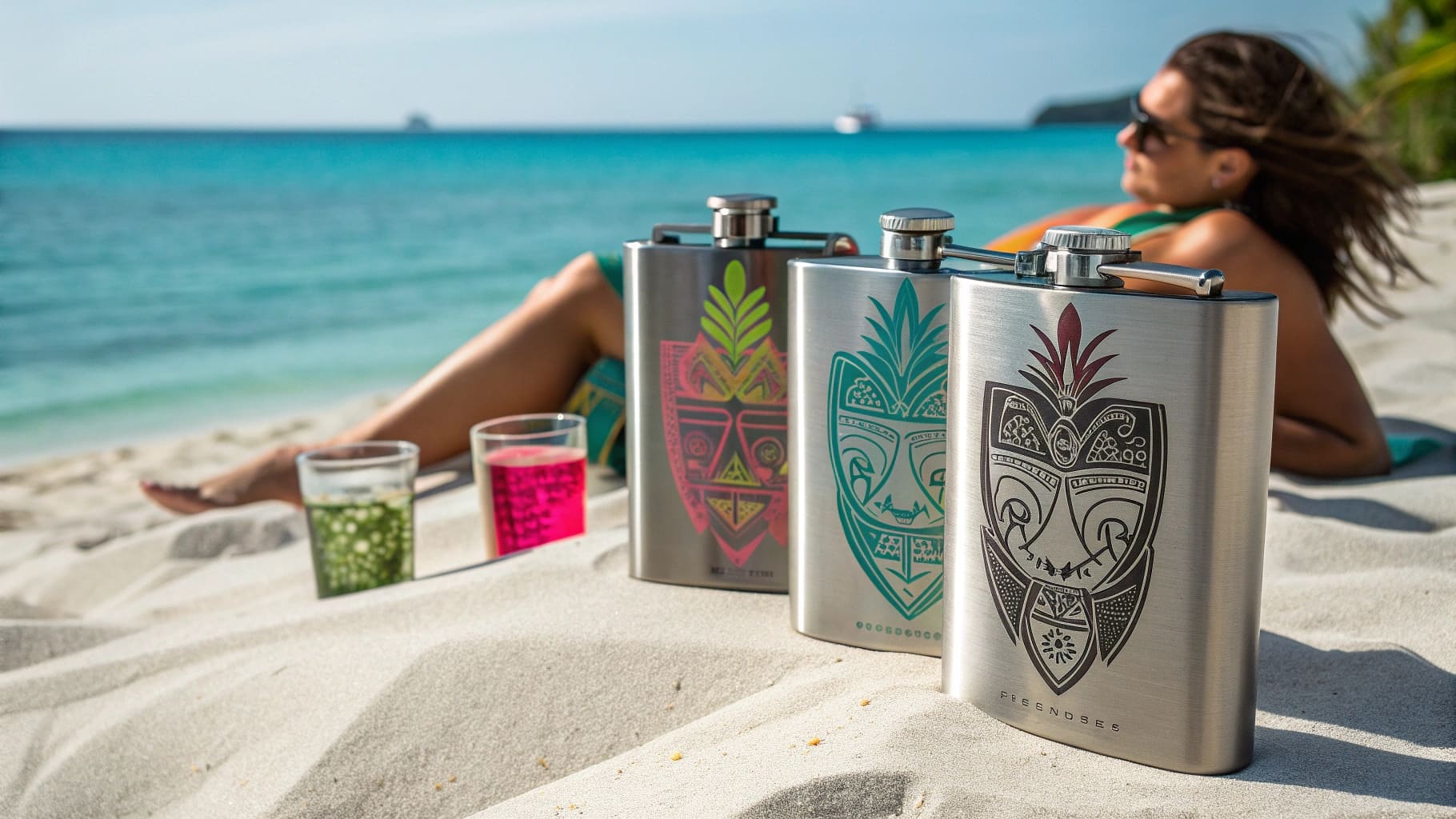
Adding gift boxes or foam inserts raises your FOB cost by 15% to 20%.6 But it also lowers your damage rate and lets your buyer charge more at retail. Here is how to think about the trade-off.
How Do You Choose Between Poly Bag, Gift Box, and Foam Insert Packing?
The packing format you choose changes your cost structure, your damage rate, and how your buyer presents the product. Each format suits a different sales channel.
| Packing Type | Unit Cost Impact | Damage Rate | Best Channel |
|---|---|---|---|
| Poly bag only | Base cost | 1–2% average | Wholesale, repackaging buyers |
| White gift box | +8–12% | 0.8–1% | Mid-range retail, corporate gifting |
| Custom gift box with foam insert | +15–20% | Below 0.5% | Premium retail, branded gifting |
I push buyers toward custom foam inserts when they are building a premium brand. The foam holds the flask in place during shipping, cuts damage claims, and creates a clean unboxing moment that buyers in North America and Europe expect at mid to high price points.
For buyers who plan to repackage under their own brand after receiving goods, poly bag with a standard master carton is the right call. It saves cost and keeps the unit count per carton high, which reduces freight cost per unit.
One detail most buyers miss: ask your factory to double-wall the master carton if you are shipping more than 500 units in a single order. Standard single-wall cartons compress under stacking pressure during container loading. A double-wall carton costs almost nothing extra per unit but brings your damage rate down to under 0.3%.7
Conclusion
Funnel aperture, weld finish, and carton packing are the three specs that separate a reliable OEM hip flask from a costly one. Get all three right before your first order ships.
-
"About Standard Drink Sizes | Alcohol Use - CDC", https://www.cdc.gov/alcohol/standard-drink-sizes/index.html. The U.S. National Institute on Alcohol Abuse and Alcoholism defines a standard drink as containing 14 grams of pure alcohol, commonly delivered in 1.5 oz (44 ml) of distilled spirits at 40% ABV, which underpins the shot-count calculations presented here. Evidence role: definition; source type: government. Supports: The U.S. standard shot measure of 1.5 oz (44 ml) used as the basis for calculating flask capacity in shots. Scope note: This definition applies to U.S. standard drinks; shot sizes vary by country (e.g., 25 ml or 35 ml in the UK), so shot counts will differ for non-U.S. markets. ↩
-
"Hip Flask Market share Revenue Forecast 2027", https://www.transparencymarketresearch.com/hip-flask-market.html. Industry trade analyses of portable drinkware categories consistently identify stainless steel as the predominant material due to its corrosion resistance, food-safety compliance, and cost-to-durability ratio, though precise B2B order-share figures vary by report and region. Evidence role: statistic; source type: institution. Supports: The dominance of stainless steel as a material in hip flask or portable drinkware manufacturing. Scope note: No single publicly available source appears to confirm the specific 70% figure; the citationNote supports the directional claim rather than the precise statistic. ↩
-
"Regulatory Status of Components of a Food Contact Material - FDA", https://www.fda.gov/food/packaging-food-contact-substances-fcs/determining-regulatory-status-components-food-contact-material. EU Regulation (EC) No 1935/2004 on materials intended to contact food, and analogous FDA guidance on food-contact substances, establish inertness and migration limits that stainless steel grades 304 and 316 routinely satisfy; traditional pewter alloys containing lead do not meet these thresholds. Evidence role: mechanism; source type: government. Supports: Stainless steel's compliance with food-contact material regulations in North America and Europe compared to materials such as pewter. Scope note: Regulatory requirements differ between the EU and U.S., and compliance depends on specific alloy composition and surface treatment rather than material category alone. ↩
-
"Consumer Complaint Database", https://www.consumerfinance.gov/data-research/consumer-complaints/. Quality management literature on stainless steel consumer goods identifies surface finish and weld integrity as primary post-production defect categories, as these attributes are difficult to fully assess through standard dimensional inspection protocols. Evidence role: general_support; source type: other. Supports: Weld and surface finish defects as a leading quality issue in stainless steel consumer goods. Scope note: No publicly available dataset specifically ranks complaint categories for hip flasks; this note supports the general principle rather than the specific product claim. ↩
-
"Packing | export.gov", https://legacy.export.gov/article?id=Packing. Export packaging guidelines from trade facilitation bodies such as the International Trade Centre indicate that master carton unit counts for small metal consumer goods are determined by gross weight limits (commonly 15–25 kg per carton) and dimensional constraints of standard pallet configurations, resulting in per-carton quantities that vary widely by product size and inner packaging format. Evidence role: general_support; source type: institution. Supports: Typical master carton unit counts for small stainless steel consumer goods in OEM export packaging. Scope note: No universal industry standard mandates a specific unit count for hip flask cartons; the 50–100 unit range reflects common practice rather than a codified specification. ↩
-
"Economic impacts to consumers from extended producer ...", https://academiccommons.columbia.edu/doi/10.7916/n2af-vv87. Packaging industry analyses of consumer goods manufacturing indicate that retail-ready gift packaging—including printed boxes and protective inserts—typically adds 10–25% to per-unit production cost depending on order volume, material specification, and customization level. Evidence role: statistic; source type: other. Supports: The cost premium associated with retail gift packaging relative to basic poly bag packing in consumer goods manufacturing. Scope note: The 15–20% figure cited in the article is an approximation; actual cost impact varies significantly by factory, order quantity, and packaging complexity. ↩
-
"Compression Strength Estimation of Corrugated Board Boxes for a ...", https://pmc.ncbi.nlm.nih.gov/articles/PMC9864211/. ISTA (International Safe Transit Association) testing protocols and corrugated packaging industry data demonstrate that double-wall corrugated constructions provide substantially higher stacking strength and puncture resistance than single-wall equivalents, reducing transit damage in container shipping scenarios. Evidence role: statistic; source type: institution. Supports: The damage-reduction benefit of double-wall corrugated cartons in stacked shipping environments. Scope note: The specific 0.3% damage rate cited is not independently verified; actual rates depend on product fragility, stacking height, and handling conditions throughout the supply chain. ↩