
Do 30oz insulated tumblers meet US/EU holder diameters and base grip tests?
I see buyers approve sleek tumblers, then face cup holder complaints. That hurts reorders, so I test holder fit before I confirm production.
I consider a 30oz insulated tumbler acceptable for US and EU holders only when the base stays near 2.75 to 3.0 inches, the body clears holder walls, and the cup passes vertical stability and side shake tests under real driving movement.
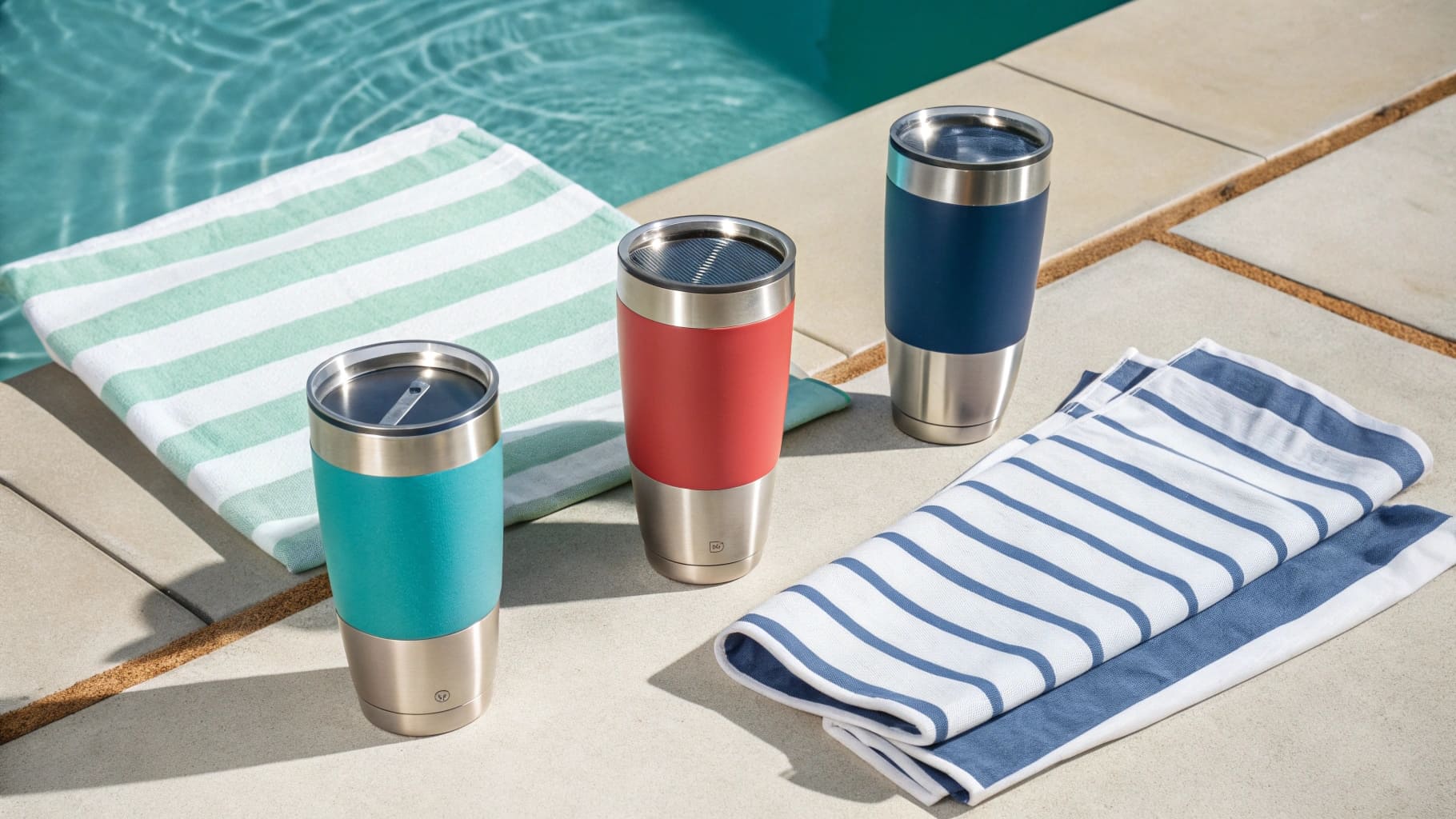
I do not treat a 30oz tumbler as only a capacity item. I treat it as a fit item, a grip item, and a brand item. In my work with wholesale buyers, I often see one simple mistake. The buyer checks the volume, logo area, and lid style, but the buyer forgets the base. That base decides if the tumbler sits well in a US truck holder, a Canadian sedan holder, or a compact European car holder. I also know one more problem. A tumbler can fit in a holder but still shake during movement. That is why I ask my team to check both holder diameter and base grip before I move a sample into bulk production, and the details below are where I usually start.
What size wrap for a 30oz tumbler?
I have seen fine logo wraps arrive short by a few millimeters. The gap looks cheap, so I measure before I price decoration.
I usually plan a 30 oz tumbler wrap around 10.5 to 11 inches at the widest body point1, then I adjust for taper, seam overlap, coating thickness, and the exact artwork position that my buyer wants.
Why I do not use one wrap size for every 30 oz tumbler
I do not use capacity as my only guide for wrap size. A 30 oz tumbler can have a straight wall, a narrow base, or a wide shoulder. Each shape changes the wrap fit. I usually start with the widest body point because that is where many full wraps fail first. If I work with a tapered cup, I also ask for a test cut. A flat rectangle can wrinkle when the wall narrows toward the base. I have seen this happen on glossy powder coating, and it makes the finish look poor even when the print is sharp2.
| What I check | Common value I see | Why I care |
|---|---|---|
| Widest body circumference | 10.5 to 11 inches | I use this to set the main wrap width |
| Middle body circumference | Slightly smaller | I use this to judge taper and artwork stretch |
| Base circumference | Often much smaller | I use this to avoid wrinkles near the lower wall |
| Seam overlap | About 0.1 to 0.25 inch | I use this to prevent a visible gap |
| Coating type | Powder, paint, or raw steel | I use this to plan adhesion and cut pressure |
I also ask buyers to think about logo reading distance. A large Canadian retail brand may want a bold front logo, while a corporate gift buyer may prefer a clean, small mark. Both choices need different wrap planning. I prefer to confirm the decoration file after I have the physical tumbler sample, not before. That saves time, reduces remake risk, and helps me protect the buyer’s launch schedule.
How to measure the circumference of a tumbler?
I cannot guess circumference from capacity. A small error can distort a logo, so I measure the actual sample in my hand.
I measure tumbler circumference with a soft tape at the widest body, middle body, and base. I keep the tape level, hold it flat, and record the value at room temperature so my wrap and quality file match the production sample.
How I measure without creating a false number
I measure circumference with a flexible tape because a hard ruler cannot follow the round wall. I keep the tape straight and level. I do not let the tape climb upward on one side. That small angle can change the reading and create a wrong wrap file. I also avoid measuring over a raised logo, a silicone boot, or a thick sticker. I want the actual stainless steel body size or the finished coated body size, depending on what the buyer will decorate.
| Place I measure | My method | My reason |
|---|---|---|
| Widest body | I wrap the tape around the largest visible section | I need the maximum print width |
| Middle body | I measure halfway between shoulder and base | I need to understand taper |
| Base area | I measure above the bottom edge, not on the curve | I need the usable lower wrap size |
| Lid seat area | I check near the upper body if artwork goes high | I need to avoid lid contact |
| Finished sample | I measure after coating when possible | I need the real production size |
I also record the temperature when I prepare a technical file. Stainless steel movement is small, but I still prefer a steady room condition. I do this because B2B buyers need repeatable information. Mark, a buyer like many I work with, may not need the engineering detail, but he does need a clear final spec. He needs to know that the wrap will fit the shipped goods, not only the first sample on my desk. I also keep the measurement photo in the order file. If a later batch has a complaint, I can compare the new sample with the approved record.
How circumference connects with cup holder fit
I do not measure circumference only for decoration. I also use it to understand how the tumbler shape may behave in a holder. US vehicle cup holders often accept wider bases, usually around 3.0 to 3.5 inches3. European holders can be tighter, often around 2.75 to 3.25 inches. A 30oz tumbler with a base near 2.75 to 3.0 inches can work in many holders, but I still treat it as a test point, not a promise.
| Market I consider | Holder opening I often see | My fit concern |
|---|---|---|
| US market | 3.0 to 3.5 inches | I check wobble in wider holders |
| EU market | 2.75 to 3.25 inches | I check tight entry and base clearance |
| Compact cars | Narrower openings | I check if the base binds |
| Trucks and SUVs | Wider and deeper holders | I check side movement |
| Desk and office use | Flat surfaces | I check bottom stability |
I prefer a base that enters the holder easily but does not float inside it. If the base is too narrow, the tumbler may rattle. If the base is too wide, it may not fit compact cars. This is why I test vertical stability and side shake. I place the tumbler in the holder, add water weight, and move it side to side. I want the buyer to see that the tumbler is not only beautiful. I want the buyer to see that it can survive normal daily use.
What size straw for 30oz stanley tumbler?
I have seen buyers order the right tumbler and the wrong straw. That small mismatch creates returns, so I check the lid first.
For a 30oz Stanley-style tumbler, I normally use a 10mm outer diameter straw. I confirm the lid opening first, because many lids accept 0.4 to 0.5 inch openings, and some smoothie designs need up to 12mm straws.
Why I check the lid before I confirm the straw
I do not choose the straw by tumbler capacity alone. I choose it by lid opening, drink use, and buyer preference. A 10mm straw is common for water, iced coffee, tea, and most daily drinks. A 12mm straw can work better for smoothies or thicker drinks, but it needs a larger opening and a matching stopper if the lid uses one. If the straw is too thin, it can move too much and feel cheap. If the straw is too thick, it can scratch the opening or fail to enter the lid.
| Straw item I check | Common spec I use | Why I check it |
|---|---|---|
| Outer diameter | 10mm | I use this for most 30oz Stanley-style lids |
| Larger option | Up to 12mm | I use this for smoothie-style products |
| Lid opening | 0.4 to 0.5 inch | I use this to confirm straw fit |
| Straw shape | Straight or bent | I use this to control cost and packing |
| Straw material | Stainless steel or plastic | I use this to match market needs |
| Cleaning brush | Matched to straw inner size | I use this to reduce user complaints |
I also ask if the buyer wants the straw packed inside the tumbler, beside the tumbler, or in a separate accessory bag. This affects carton packing and damage risk. A stainless steel straw can mark the coating if the packing is loose. A plastic straw can bend if the carton pressure is high. These small details matter for wholesale orders. A buyer may focus on unit price, but I also need to protect the final selling condition. If the product arrives with scratched cups or bent straws, the low price no longer looks good.
How I connect straw choice with certification and logistics
I treat the straw as part of the full product, not as a small extra. If a buyer asks for food contact certification4, I include the straw, lid, gasket, and coating in the document check. I have met buyers who worry about certificate fraud, and I understand that concern. I prefer to provide clear test item names and matching photos, so the buyer can see that the certificate covers the same product that ships.
| Buyer concern I hear | My control point | My result goal |
|---|---|---|
| Food contact safety | I match test reports with actual materials | I reduce certificate doubt |
| Shipment delay | I lock accessory specs before mass production | I avoid late packing changes |
| MOQ pressure | I confirm straight or bent straw early | I reduce surprise cost changes |
| Quality inspection | I add straw fit to the inspection list | I catch lid mismatch before shipping |
| Rebranding | I confirm logo, color, and accessory set together | I support a cleaner market launch |
I know many company owners understand sales very well, but they do not always want deep technical talk. I keep the process simple. I show the lid opening. I show the straw diameter. I show the packing method. Then I connect those points to inspection. This helps the buyer make a faster decision without losing control of quality.
Conclusion
I treat the 30oz tumbler as a system. Holder fit, wrap size, circumference, straw size, and base grip must pass together.
-
"Classification of Glass Containers: Heading 7010 versus 7013", https://www.dhs.gov/medialibrary/assets/video/46081. Container dimensions are determined by the relationship between volume, height, and radius, with circumference varying based on design choices for wall thickness, taper, and aspect ratio. Evidence role: mechanism; source type: research. Supports: the geometric relationship between container volume and body circumference. Scope note: Actual dimensions depend on specific design parameters rather than volume alone ↩
-
"Powder coating", https://en.wikipedia.org/wiki/Powder_coating. Powder coating application on complex geometries can result in thickness variation and surface defects when coating material accumulates unevenly, particularly at recessed areas or sharp contour changes, requiring careful application parameters. Evidence role: mechanism; source type: research. Supports: challenges in applying uniform coatings to non-uniform geometries. Scope note: Specific outcomes depend on coating formulation, application method, and substrate preparation ↩
-
"Cup holder", https://en.wikipedia.org/wiki/Cup_holder. Automotive interior design research documents common cup holder opening dimensions across vehicle segments, though manufacturers retain discretion in sizing decisions. Evidence role: statistic; source type: research. Supports: typical diameter ranges found in North American vehicle cup holders. Scope note: Represents typical ranges rather than mandated standards ↩
-
"Food Packaging & Other Substances that Come in Contact ...", https://www.fda.gov/food/food-ingredients-packaging/food-packaging-other-substances-come-contact-food-information-consumers. Materials intended for food contact are regulated by agencies such as the U.S. FDA under the Federal Food, Drug, and Cosmetic Act and the EU under Regulation (EC) No 1935/2004, which establish safety requirements but not universal certification processes. Evidence role: general_support; source type: government. Supports: regulatory frameworks governing materials intended for food contact. Scope note: Specific testing requirements vary by material type, intended use, and jurisdiction ↩