
Are Your Handled Water Bottles Actually FBA-Proof?
FBA returns hurt your margins fast. One bad batch of leaking bottles can flood your seller account with negative reviews. Here is what you need to know before your next order.
The short answer is this: handled stainless steel water bottles survive FBA only when they pass drop tests from 1.2 meters, vibration tests under ISTA 3A standards, and pressure seal tests at 2–3 PSI for 3 minutes. Bottles that skip these checks fail somewhere between the warehouse and your customer's door.
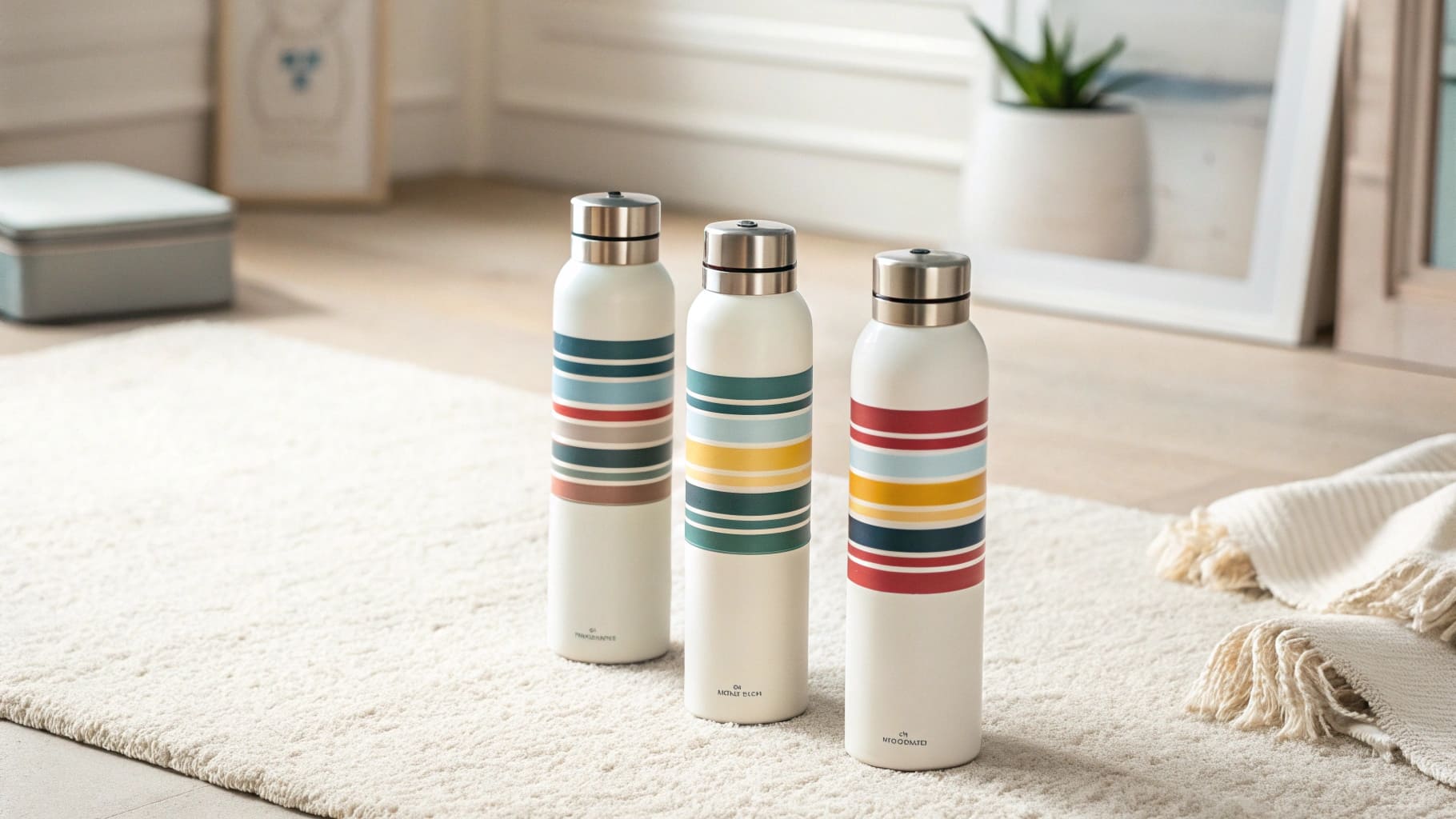
Most buyers I talk to think factory quality checks are enough. They are not. FBA is a different world. Your bottles go through 6 to 8 handling points before they reach a customer. Each point is a chance for something to go wrong. I want to walk you through what actually matters — from seal design to handle attachment — so you stop losing money on returns you never saw coming.
What Is the Best Spill Proof Water Bottle?
I have seen hundreds of bottles with "spill proof" printed on the label. Most of them are not spill proof at all. That label means nothing without the test data behind it.
The best spill proof water bottles for FBA use three things together: a precision-cut silicone gasket, a multi-thread locking lid, and a pressure-equalization valve. Without all three working together, the bottle will eventually leak under real shipping conditions.
What makes a gasket actually work?
A gasket is the rubber ring inside your lid. It presses against the rim of the bottle and creates a seal. But not all gaskets are equal. Here is what separates a gasket that works from one that fails after a few drops:
The material matters first. You want food-grade silicone with a Shore A hardness between 40 and 601. Shore A hardness is just a measurement of how firm the rubber is. Too soft and it deforms under pressure. Too hard and it does not press tightly enough against the bottle rim.
The groove matters next. The gasket sits inside a small channel cut into the lid. That channel needs to be machined with exact dimensions. If the groove is too wide, the gasket shifts during a drop. If it is too shallow, the gasket pops out.
Compression is the third factor. When you close the lid, the gasket should be compressed by 10 to 15 percent of its original thickness.2 Less than that and the seal is loose. More than that and the gasket wears out quickly.
| Gasket Factor | Acceptable Range | What Happens If Wrong |
|---|---|---|
| Shore A Hardness | 40 – 60 | Too soft: deforms. Too hard: poor contact |
| Groove Depth | Matched to gasket diameter | Too shallow: gasket ejects on drop |
| Compression Rate | 10% – 15% | Under: leaks. Over: premature wear |
| Material | Food-grade silicone | Non-food grade degrades and smells |
What does a multi-thread lid do differently?
A standard single-thread lid needs only a quarter turn before it starts to loosen. A multi-thread lid engages more contact points across the full rotation.3 This means a harder hit is needed to move the lid off its seat. For FBA bottles, I always ask suppliers for at least a double-start thread design.
The torque spec for closing the lid also matters. Most quality manufacturers target 2 to 3 Newton-meters for standard caps. Too loose and the seal is incomplete. Too tight and the threads strip after repeated use. Ask your supplier if they use a torque tester during final inspection. If they do not, that is a red flag.
Why Are Soda Water and Soft Drink Bottles Sealed Under Pressure?
This question seems off-topic at first. But the answer tells you a lot about how good seals actually work. Pressure sealing is one of the most reliable methods ever used in packaging.
Soda bottles are sealed under internal pressure because that pressure pushes the gasket outward against the sealing surface.4 The fizz inside the bottle is doing the sealing work. The higher the internal pressure, the tighter the contact between gasket and rim.

How does this apply to stainless steel water bottles?
Water bottles do not have carbonation. There is no internal pressure holding the seal in place.5 This means the seal depends entirely on the mechanical fit between the lid, the gasket, and the bottle rim. That is a harder problem to solve than it looks.
Here is how good manufacturers borrow the same logic from soda bottle design without using gas pressure:
They control the fit tolerance between the lid and the bottle neck. When the lid is closed, the geometry of the parts creates a small amount of compression. This compression acts like a substitute for internal gas pressure. It pushes the gasket against the rim consistently every time the bottle is closed.
They also use the lid thread pitch to control how much compression is applied at full closure. A finer thread pitch gives more control. A coarser thread pitch closes faster but gives less precision over the final seal force.
| Sealing Method | Used In | How It Works |
|---|---|---|
| Gas pressure sealing | Soda bottles | Internal CO2 pushes gasket outward |
| Mechanical compression | Reusable water bottles | Lid geometry compresses gasket on closure |
| Torque-controlled closure | Premium stainless bottles | Thread pitch controls final seal force |
| Heat fusion | Industrial single-use containers | Permanent bond, not reusable |
One more thing worth knowing: temperature changes affect this mechanical seal. A bottle filled with cold water and then exposed to heat will expand slightly. A bottle filled hot and then cooled will contract.6 These cycles stress the gasket over time. The best suppliers test their bottles through thermal cycling before running drop tests. They fill the bottle, run it from room temperature to 60 degrees Celsius and back, then drop it. If it still holds, the design is solid.
How to Permanently Seal a Bottle?
This question comes up often from buyers who have had leak problems. The instinct makes sense — just seal it forever and the problem goes away. But for FBA products, permanent sealing is the wrong goal.
Your customers need to open and refill the bottle hundreds of times. A permanently sealed bottle is not a water bottle. It is a paperweight.

What can industrial sealing techniques teach us?
Even though permanent sealing does not apply to reusable bottles directly, the techniques used in industrial sealing teach us what makes a seal last. There are three main permanent sealing methods used in manufacturing:
Ultrasonic welding uses high-frequency vibration to fuse two pieces of plastic or metal together at the molecular level.7 The joint is stronger than either original material. This technique is used in medical devices and food packaging.
Heat fusion melts the surfaces of two parts and presses them together. When cooled, they bond as one piece. This is used in plastic containers and some insulated flask bodies.
Adhesive bonding uses industrial-grade compounds to join two parts permanently. The bond strength depends on surface preparation and adhesive selection.
None of these work for a reusable lid. But the lesson from all three is the same: seal quality depends on surface contact area, consistent compression, and resistance to fatigue over repeated stress cycles.
| Technique | Used For | Lesson for Reusable Lids |
|---|---|---|
| Ultrasonic welding | Medical, food packaging | Molecular-level contact = best seal |
| Heat fusion | Plastic containers, flask bodies | Surface prep determines bond quality |
| Adhesive bonding | Industrial parts | Consistency of contact matters most |
| O-ring compression | Reusable caps, valves | Mimics permanent seals through precise fit |
For FBA water bottles, the closest thing to permanent sealing in a reusable design is the precision O-ring system I described earlier. A Shore A 40–60 silicone O-ring, sitting in a machined groove with 10 to 15 percent compression, will hold through hundreds of open-close cycles without losing integrity. That is what you are paying for when you buy from a quality manufacturer. That is also what you are not getting when you buy on price alone.
The handle is a weak point most buyers ignore
I want to add one thing here that almost nobody talks about. Handled bottles have an extra failure mode that handle-free bottles do not.
The handle attachment point is a stress concentration zone. When the bottle hits a hard surface handle-first, the impact force travels through the handle directly to the bottle body. That force can shift the lid, compress one side of the gasket unevenly, and break the seal — even if the lid threads and gasket are perfect.
When you request drop tests from a supplier, ask them specifically to include handle-first drops. Many suppliers only test base drops and lid drops. That is not enough for handled designs.
Also check how the handle is attached. Welded handles with full penetration welds are stronger than riveted or molded-on handles. Ask for weld inspection records or photos. A handle that pulls off during FBA sorting does not just cause a leak — it causes a safety complaint.
Conclusion
Leak-proof FBA performance comes down to gasket precision, thermal cycling tests, multi-thread lids, and handle-first drop testing. Get the specs right before you place the order.
-
"Monitoring Shore A hardness of silicone facial elastomers - PubMed", https://pubmed.ncbi.nlm.nih.gov/25006900/. Elastomer sealing references explain that Shore A hardness is a standard measure of rubber firmness and that silicone elastomers in moderate Shore A ranges are widely used for gaskets and seals; this supports the material-property rationale, although it does not prove that 40–60 Shore A is optimal for every water-bottle lid. Evidence role: definition; source type: education. Supports: Food-grade silicone gasket performance depends partly on Shore A hardness, with moderate hardness ranges commonly used in sealing applications.. Scope note: Contextual support: the exact optimal hardness depends on gasket geometry, compression, and use conditions. ↩
-
"[PDF] Characteristics of Elastomer Seals Exposed to Space Environments", https://ntrs.nasa.gov/api/citations/20080012742/downloads/20080012742.pdf. O-ring and elastomer-seal design literature treats controlled compression, often expressed as percentage squeeze, as central to static sealing performance and durability; this supports the importance of a defined compression range, although the exact 10–15 percent value may be specific to the lid and gasket geometry. Evidence role: mechanism; source type: research. Supports: A gasket requires controlled compression to create a reliable seal without excessive wear.. Scope note: Contextual support: general O-ring design guidance may not directly specify this range for stainless-steel water-bottle lids. ↩
-
"Multi-start threads in contrast to single-start threads - BAER Tools", https://baer.tools/en/blog/multi-start-thread-unlike-other-threads?srsltid=AfmBOopyrK3slzQ3aOrTFdBnSxDO55f3xldc6T6NrsM87NXEAeYsaUvg. Mechanical-design sources describe multi-start threads as thread forms with multiple helices that can increase engagement behavior and alter lead for a given rotation; this supports the distinction from single-start threads, although resistance to loosening also depends on torque, friction, pitch, and thread geometry. Evidence role: definition; source type: education. Supports: A multi-thread or multi-start lid differs mechanically from a single-thread lid by engaging multiple thread starts.. Scope note: Contextual support: multi-start thread geometry alone does not prove better leak resistance in a finished bottle. ↩
-
"6 Closure Types For Glass Soda Bottles - Roetell", https://www.roetell.com/6-closure-types-for-glass-soda-bottles/. Food-packaging and carbonation references explain that dissolved carbon dioxide creates internal pressure in sealed beverage containers and that closures must maintain a seal against this pressure; this supports the role of internal pressure in closure sealing, although the exact force distribution depends on the closure and liner design. Evidence role: mechanism; source type: education. Supports: Carbonated beverage bottles contain internal pressure that closure systems must seal against.. Scope note: Contextual support: not all soda closures use a gasket in the same way as reusable bottle lids. ↩
-
"Seal (mechanical) - Wikipedia", https://en.wikipedia.org/wiki/Seal_(mechanical). Fluid and packaging principles distinguish non-carbonated containers, which generally lack CO2-generated internal pressure, from carbonated beverage containers that are pressure-retaining systems; this supports the comparison, though filled reusable bottles may still experience small pressure changes from temperature and headspace effects. Evidence role: mechanism; source type: education. Supports: Reusable non-carbonated water bottles rely primarily on mechanical closure compression rather than carbonation pressure for sealing.. Scope note: Contextual support: non-carbonated bottles can still develop pressure or vacuum due to temperature changes, filling conditions, or altitude. ↩
-
"94 Thermal Expansion of Solids and Liquids", https://openbooks.lib.msu.edu/collegephysics1/chapter/thermal-expansion-of-solids-and-liquids-2/. Thermodynamics references document thermal expansion of liquids and materials, and container-closure studies treat temperature cycling as a source of dimensional and pressure changes; this supports the physical basis for seal stress, although the magnitude depends on fill volume, headspace, bottle material, and temperature range. Evidence role: mechanism; source type: education. Supports: Temperature changes can alter liquid volume, container dimensions, and closure stresses in a filled bottle.. Scope note: Contextual support: the source may establish the mechanism without directly measuring stainless-steel water-bottle leakage after cycling. ↩
-
"Ultrasonic welding - Wikipedia", https://en.wikipedia.org/wiki/Ultrasonic_welding. Manufacturing references describe ultrasonic welding as a joining process that uses high-frequency mechanical vibration under pressure to create a solid-state or fused joint, especially in plastics and some metals; this supports the process description, although the phrase “molecular level” is a simplified explanation rather than a formal engineering criterion. Evidence role: definition; source type: encyclopedia. Supports: Ultrasonic welding joins materials using high-frequency vibration and pressure.. Scope note: Contextual support: ultrasonic welding mechanisms differ between plastics and metals, and “molecular level” may need careful wording. ↩