
Are Insulated Coffee Mugs With Lids Dishwasher-Safe Under Retail Tests?
You ordered a container of insulated mugs. Your retail partner loved them. Then the returns started — ruined finishes, leaking lids, and angry end users.
Most insulated coffee mugs with lids are not fully dishwasher-safe. The vacuum seal, lid gaskets, and exterior coating are the three weak points. High heat and harsh detergents attack all three. Only mugs built with tested materials and verified through 100+ wash cycles can pass real retail dishwasher-safe standards.

This question matters more than most buyers expect. A mug that fails in the dishwasher does not just disappoint one customer. It comes back to you as returns, warranty claims, and a damaged brand. I have seen this happen more than once. The rest of this article breaks down exactly why it happens, what the damage looks like, and what to check before you place your next order.
Why Are Some Coffee Mugs Not Dishwasher Safe?
You asked your supplier. They said dishwasher-safe. The lab report said otherwise. This gap between supplier claims and actual test results is where most import problems start.
Some mugs fail in dishwashers because of three structural weak points. The vacuum seal between the double walls breaks down under heat. Silicone gaskets in the lid degrade with strong detergents1. Painted or powder-coated finishes chip under high-pressure water jets. These are manufacturing issues, not user errors.
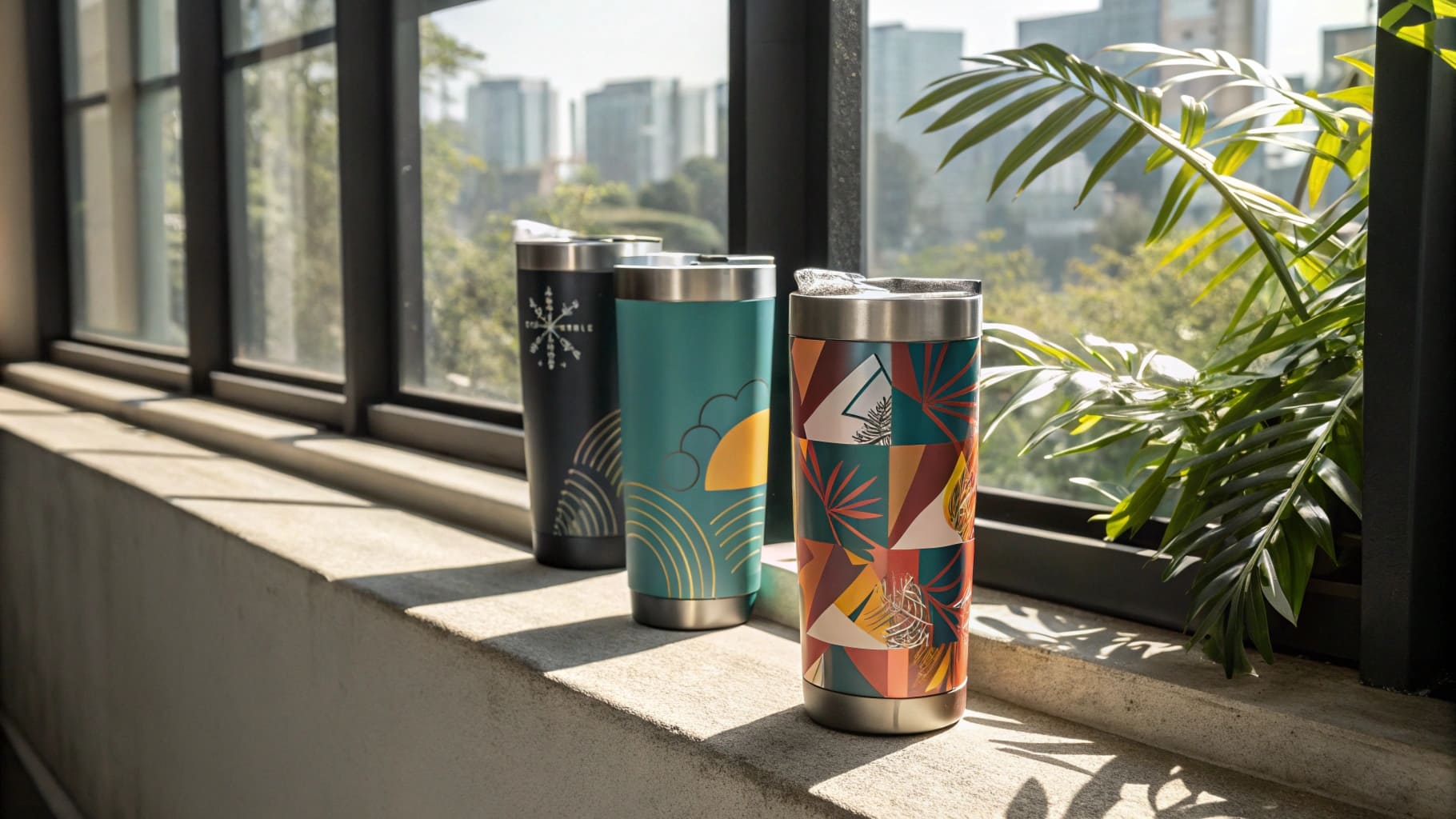
The dishwasher environment is more aggressive than most people think. Water temperature inside a dishwasher cycle can reach 140°F or higher2. Detergents are alkaline, which means they are chemically harsh on coatings and rubber parts3. The water jets push out at pressures up to 25 psi. Most decorative finishes on mugs were not designed to handle all three of these at once.
Here is how each weak point breaks down:
| Component | Why It Fails | What It Looks Like |
|---|---|---|
| Vacuum seal | High heat stresses the weld and expands the air gap | Mug feels warm on the outside and no longer insulates |
| Silicone gasket | Alkaline detergents break down the material over time | Lid starts to leak after a few washes |
| Powder coat / paint | High-pressure jets exceed the adhesion limit of the coating | Finish chips, fades, or discolors |
The vacuum seal issue is the most serious one for insulated mugs. Once the seal is gone, you no longer have a double-wall vacuum product. You have a single-wall container that you paid a double-wall price for. The end user sees this as a defective product. They return it. They leave a review. That costs you more than the mug itself.
From a sourcing perspective, I always ask suppliers to tell me the specific materials used in the lid gasket and the coating type used on the exterior. These two details tell me a lot about whether the mug can handle repeated dishwasher cycles. A supplier who cannot answer those two questions clearly is a supplier who has not tested the product properly. That is the real warning sign.
What Happens If You Put a Non-Dishwasher Safe Mug in the Dishwasher?
Most end users do not read the care instructions. They put the mug in the dishwasher. The damage starts right away — and it does not stop after one cycle.
Putting a non-dishwasher-safe mug in the dishwasher causes vacuum seal failure, lid warping, and finish degradation. The insulation can fail within 5 to 10 wash cycles4. Plastic lid threads and flip-top parts crack or warp. Logos and coatings fade or peel, which damages brand appearance at the retail level.

The damage does not always appear after the first wash. That is what makes it a difficult problem for brand owners to catch early. The mug looks fine after one cycle. After five cycles, the finish starts to dull. After ten cycles, the vacuum seal is gone and the lid no longer seals properly.
Here is a typical failure timeline based on what I have seen from customer feedback and product testing data:
| Wash Cycle Range | Damage Type | Impact on User |
|---|---|---|
| Cycle 1–3 | Minor coating dullness | Not noticeable to most users |
| Cycle 4–7 | Logo fading, gasket softening | User notices a quality drop |
| Cycle 8–10 | Vacuum seal loss, lid starts to leak | User considers returning the product |
| Cycle 10+ | Structural warping on lid parts | Product is no longer functional |
For B2B buyers, this timeline has a direct business impact. If your mugs carry a one-year warranty and your customer uses the dishwasher daily, you will see claims within the first two months. That is a fast return cycle for a product with a long warranty window.
The aesthetic damage is just as costly as the functional damage. Your brand logo is on that mug. When the finish chips or the logo fades, that degraded product is still out in the market with your name on it. Every time someone sees that mug, they are seeing your brand at its worst. That kind of damage is very hard to measure in dollars, but it is very real.
Lid components deserve special attention here. Most insulated mug lids combine PP plastic threads, silicone seals, and sometimes a flip-top or straw mechanism. Each of these parts responds differently to dishwasher heat and detergents. PP plastic softens at sustained high temperatures. When it softens and then cools repeatedly, it warps slightly each time. After enough cycles, the threads no longer fit the mug body cleanly. The lid leaks. The user blames the product, not the dishwasher.
This is why I always tell buyers to request dishwasher durability testing data before finalizing any mug specification. Ask your supplier for a wash cycle report that covers at least 100 cycles. Check the lid seal performance, the vacuum retention, and the coating adhesion. If the supplier cannot provide that report, treat it as a red flag and move on.
Can Stainless Steel Coffee Mugs Go in the Dishwasher?
Stainless steel sounds tough. And it is. But the material alone does not determine whether a mug is dishwasher-safe. The full product assembly does.
Stainless steel itself handles dishwashers well. However, vacuum-insulated mugs have more than just steel in them. The vacuum seal, lid components, and exterior finish all add risk. Only mugs built with the right materials and assembly methods — and verified through actual wash cycle testing — are genuinely dishwasher-safe.

This is the part that catches a lot of buyers off guard. They see 304 stainless steel on the spec sheet and assume the whole product is dishwasher-safe. That assumption is technically wrong. The steel body may survive just fine. But the product is never just the steel body.
Here is a clear breakdown of how different construction methods affect dishwasher compatibility:
| Construction Type | Dishwasher Safe? | Why |
|---|---|---|
| Single-wall laser-welded stainless | Yes, generally | No vacuum seal to fail, no coating risk if unfinished |
| Double-wall vacuum with soldered seal | Risky | Heat can stress the solder joint and compromise the vacuum |
| Double-wall vacuum with TIG weld | Better | Stronger seal that holds under thermal stress |
| Powder-coated exterior | Risky | Coating adhesion often fails under high-pressure jets |
| Ceramic-based exterior coating | Better | Higher adhesion strength and heat resistance |
| PP plastic lid with silicone gasket | Risky | Both materials degrade under repeated heat and detergent exposure |
| BPA-free Tritan lid | Better | More stable under repeated dishwasher cycles |
The key takeaway here is that dishwasher compatibility is an assembly question, not a material question. A mug made from 316 stainless steel with a poor soldered seal and a standard powder coat is less dishwasher-safe than a 304 stainless mug built with a TIG-welded seal, a ceramic coating, and a Tritan lid.
For buyers sourcing from China or other manufacturing regions, this distinction is critical. Many suppliers list "stainless steel" as the material and mark the product as dishwasher-safe without testing the full assembly. The honest answer is that the steel part is safe. The rest of the product may not be.
When I evaluate suppliers on this point, I ask two direct questions. First, what is the welding method used on the vacuum chamber? Second, what third-party lab has tested the full product through dishwasher cycle testing, and how many cycles were completed? A supplier with a clean answer to both questions is a supplier who takes product integrity seriously. That is the kind of supplier worth building a relationship with.
For retail channels, dishwasher-safe claims on packaging carry legal weight in markets like the United States and Canada5. If your product label says dishwasher-safe and the product fails at cycle eight, you carry the liability. That is why factory claims are not enough. You need third-party lab reports that cover vacuum retention after 100+ cycles, coating adhesion data, and lid component performance. Those documents protect your brand and your warranty budget at the same time.
Conclusion
Dishwasher safety in insulated mugs depends on the vacuum seal, lid materials, and exterior coating — not just the steel. Verify with lab-tested data before you commit to any order.
-
"Gut epithelial barrier damage caused by dishwasher detergents and ...", https://pubmed.ncbi.nlm.nih.gov/36464527/. Polymer chemistry studies on silicone elastomers indicate that while silicone exhibits broad chemical resistance, prolonged exposure to strongly alkaline solutions can promote hydrolysis of siloxane backbone bonds, leading to surface degradation, swelling, and loss of sealing performance in gasket applications. Evidence role: mechanism; source type: paper. Supports: The chemical mechanism by which alkaline dishwasher detergents degrade silicone elastomer gaskets over repeated exposure cycles. Scope note: Degradation rate is highly dependent on silicone grade, detergent concentration, temperature, and exposure duration; not all silicone formulations degrade at the same rate under dishwasher conditions ↩
-
"Do-It-Yourself Savings Project: Lower Water Heating Temperature", https://www.energy.gov/energysaver/do-it-yourself-savings-project-lower-water-heating-temperature. U.S. Department of Energy and NSF International standards indicate that residential dishwasher wash cycles commonly operate between 120°F and 150°F, with sanitize cycles reaching the higher end of this range to meet hygiene requirements. Evidence role: statistic; source type: government. Supports: Typical residential dishwasher wash cycle temperatures, including sanitize cycles that can reach 140°F–150°F. Scope note: Exact temperatures vary by appliance model and cycle selection; the cited figure represents a commonly cited upper range rather than a universal standard ↩
-
"Performance Characteristics of Silicone Rubber for Use in Acidic ...", https://pmc.ncbi.nlm.nih.gov/articles/PMC10489667/. Studies on automatic dishwasher detergent formulations document pH values commonly ranging from 9 to 12, and materials science literature confirms that sustained alkaline exposure accelerates hydrolytic degradation of silicone gaskets and reduces adhesion strength in polymer-based coatings. Evidence role: mechanism; source type: paper. Supports: The alkaline pH of automatic dishwasher detergents and the chemical mechanism by which alkaline solutions degrade silicone elastomers and organic coatings. Scope note: The rate of degradation depends on detergent concentration, cycle frequency, and specific material formulations; general findings may not map precisely to every product configuration ↩
-
"Dishwasher Stops Mid-Cycle? 6 Fixes That Actually WORK ...", https://www.youtube.com/watch?v=HpolCushQqM. Product durability testing protocols for insulated drinkware, such as those referenced in consumer product evaluation literature, indicate that vacuum seal integrity in non-rated double-wall containers can degrade measurably within a small number of high-temperature wash cycles, though the precise cycle count varies with construction quality and dishwasher operating conditions. Evidence role: statistic; source type: research. Supports: The number of dishwasher cycles at which vacuum seal failure becomes measurable in double-wall insulated drinkware not designed for dishwasher use. Scope note: The 5–10 cycle figure cited in the article appears to be based on observational feedback rather than a published controlled study; actual failure points vary significantly by product ↩
-
"Complying with the Made in USA Standard", https://www.ftc.gov/business-guidance/resources/complying-made-usa-standard. The U.S. Federal Trade Commission's guidelines on environmental and performance claims, and Canada's Competition Act provisions on misleading representations, establish that product labeling claims such as 'dishwasher-safe' must be substantiated by competent and reliable evidence; unsubstantiated claims may expose importers and retailers to regulatory action and civil liability. Evidence role: general_support; source type: government. Supports: That product performance claims on consumer packaging are subject to truth-in-advertising and consumer protection regulations in the United States and Canada. Scope note: The article does not specify the exact legal mechanism; liability exposure depends on jurisdiction, claim specificity, and the nature of consumer harm, which varies by case ↩
