
Are Insulated Coffee Mugs With Handles LFGB/FDA Safe for Retail Buyers?
You source mugs for resale. A single safety scandal can destroy your brand overnight. So the question is not just about compliance — it is about survival.
LFGB and FDA certifications confirm that insulated coffee mugs with handles meet food contact safety standards in Germany and the United States.1 When a supplier holds both, it means their materials have been tested and cleared for direct food and drink contact. This is the baseline your retail buyers expect.
Safety certifications matter, but they do not tell the whole story. A certificate on paper and a safe product in hand are two different things. If you are sourcing mugs at scale, you need to understand exactly what is covered, where the real risks hide, and how to check both. Let me walk you through it.
How Do I Know if My Mug Has Lead?
You cannot see lead. You cannot smell it. By the time a customer complains, the damage is done — to them and to your business.
The most direct way to know if a mug contains lead is to request a third-party lab report that tests all components for heavy metals, including lead, cadmium, and chromium2. This report should cover the stainless steel body, the exterior coating, the gaskets, and any printed or painted decorations.

A certificate from a supplier's internal lab means very little. What you want is a report from a recognized independent testing body — SGS, Intertek, or TUV are the most widely accepted. These labs test physical samples against strict chemical thresholds. If a supplier hesitates to share these reports, or only shows you a one-page certificate with no test data behind it, treat that as a red flag.
Beyond paperwork, physical inspection gives you useful clues. Here is what I look at when I evaluate a mug sample:
| Inspection Point | What to Look For | Why It Matters |
|---|---|---|
| Exterior coating | Even finish, no flaking or bubbling | Flaking coatings can contain lead-based pigments |
| Printed logos or patterns | Sharp edges, no smearing, smooth to touch | Low-quality inks may use heavy metal pigments |
| Handle attachment | Flush joints, no rough weld marks | Poor welds indicate low production standards overall |
| Gaskets and seals | Firm texture, neutral smell | Chemical odor suggests low-grade rubber or silicone |
| Interior surface | Brushed or smooth, no dark spots | Discoloration may indicate low-grade steel |
I have seen suppliers send beautifully polished samples that fail lab tests on coating chemicals. A good sample is the starting point, not the finish line. Always follow up with test documentation before placing a production order.
Do Stainless Steel Mugs Contain Lead?
You have probably heard that stainless steel is safe. That is mostly true — but only for the steel itself. The full picture is more complicated.
High-quality food-grade stainless steel, specifically 304 or 316 grade, does not contain lead as part of its composition.3 These grades use iron, chromium, and nickel as their main components. When a supplier says their mugs are made from 304 stainless steel, the metal body itself is not where the lead risk comes from.
The risk sits in other parts of the mug. Three specific areas are worth your attention when sourcing insulated mugs for resale.
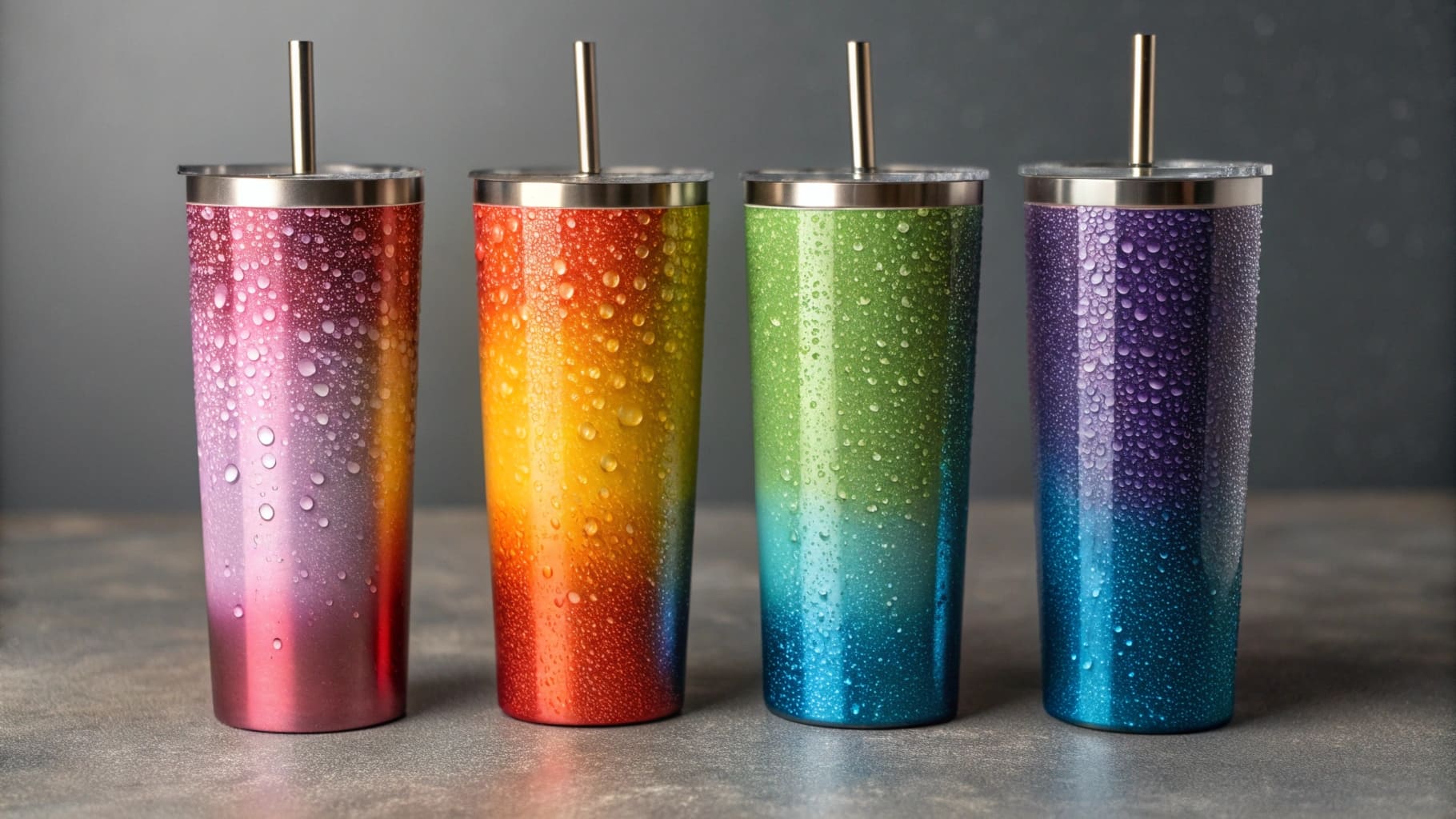
Exterior coatings and powder finishes are the most common risk point. Colorful mugs — especially those with bright reds, yellows, or oranges — may use powder coatings that contain lead-based pigments.4 This is more common among suppliers cutting costs on raw materials. The exterior of a mug touches a person's lips during drinking, so any migration of lead from a coating becomes a direct health concern.
Printed decorations and logos carry a similar risk. Screen-printed or pad-printed designs use inks that may contain heavy metals if sourced cheaply. If your retail product involves branded mugs with printed artwork, the ink formulation needs to be tested, not assumed safe.
Gaskets and sealing rings are the third risk area. The silicone or rubber rings that seal the lid on insulated mugs can be made from low-grade materials that contain plasticizers or other compounds that fail LFGB or FDA standards. A mug can pass a steel test and still fail on its gasket.5
| Component | Lead Risk Level | What to Request |
|---|---|---|
| 304/316 stainless steel body | Low | Material certificate confirming grade |
| Powder-coated exterior | Medium to High | Heavy metal migration test on coating |
| Printed logos or patterns | Medium | Ink safety report, heavy metal content |
| Silicone or rubber gaskets | Medium | Food contact compliance test for gasket material |
| Plastic components (if any) | Medium | FDA or LFGB food contact report |
Understanding where the risk actually lives helps you ask the right questions when talking to a supplier. Most procurement problems I see come from buyers who only checked the steel grade and assumed the rest was fine.
Do Yeti Coffee Mugs Have Lead?
Yeti is one of the most recognized drinkware brands in North America. When retail buyers ask about Yeti and lead, they are usually asking a bigger question: can I trust any premium-looking mug to be safe?
Yeti has built its reputation on strict material selection and testing across all product components. Their mugs go through multi-stage quality checks and are tested for chemical compliance in their target markets. That said, even Yeti faced scrutiny in the past over lid components containing certain materials, which shows that no brand is automatically beyond question.

For B2B buyers like you, the real lesson from brands like Yeti is not about the brand name itself. It is about the process behind the product. What makes Yeti mugs reliable is not magic — it is the documentation trail, the supplier relationships, and the batch testing that sits behind every SKU.
When you source from an OEM manufacturer in China, you can access the same level of quality if you build your sourcing process correctly. Many factories that produce for premium Western brands are available for OEM orders. The key is knowing how to verify them.
| What Premium Brands Do | What You Can Require From Your Supplier |
|---|---|
| Use certified 304 or 316 steel | Request material certificates with each order |
| Test coatings for heavy metal migration | Require third-party coating test reports |
| Conduct batch-level quality control | Ask for production batch test records, not just one-time certificates |
| Use food-grade silicone for gaskets | Request gasket-specific compliance reports |
| Verify supplier factories regularly | Visit the factory or use a third-party audit service |
I always tell buyers that a supplier willing to share full documentation is already telling you something important about how they operate. Transparency is a signal. When a factory resists sharing batch reports or deflects questions about raw material sourcing, that resistance has meaning.
The certification on a catalog page only reflects what was tested once. What protects your customers and your business is what the factory does on every production run.
Conclusion
LFGB and FDA certifications are your starting point, not your endpoint. Real safety comes from knowing where risk hides, asking for the right documents, and choosing suppliers who test every batch.
-
"Food Packaging & Other Substances that Come in Contact with Food", https://www.fda.gov/food/food-ingredients-packaging/food-packaging-other-substances-come-contact-food-information-consumers. The cited government or institutional source should explain that LFGB governs food-contact materials in Germany and that FDA regulations govern food-contact substances in the United States, supporting the jurisdictional compliance framing. Evidence role: definition; source type: government. Supports: LFGB and FDA certifications indicate food-contact compliance frameworks for Germany and the United States.. Scope note: This supports the regulatory meaning of LFGB/FDA compliance, not the safety of any individual mug model unless its specific test report is reviewed. ↩
-
"Assessment of heavy metals migrated from food contact plastic ...", https://pmc.ncbi.nlm.nih.gov/articles/PMC10558900/. The cited food-contact testing standard or regulatory guidance should support that heavy-metal migration or content testing can include substances such as lead, cadmium, and chromium and should be performed on relevant food-contact components. Evidence role: mechanism; source type: government. Supports: Third-party testing of mug components for heavy metals is an appropriate verification step for food-contact safety.. Scope note: The exact metals and limits vary by material, jurisdiction, and test method. ↩
-
"SAE 304 stainless steel - Wikipedia", https://en.wikipedia.org/wiki/SAE_304_stainless_steel. The cited materials standard or metallurgical reference should list the nominal composition of AISI 304 and 316 stainless steels and show that lead is not a specified alloying element. Evidence role: definition; source type: institution. Supports: 304 and 316 stainless steels do not specify lead as an alloying component.. Scope note: Trace contamination is a manufacturing-quality issue and is not excluded solely by the nominal grade composition. ↩
-
"Time to Ban Lead in Industrial Paints and Coatings - PMC", https://pmc.ncbi.nlm.nih.gov/articles/PMC4434842/. The cited public-health or environmental source should show that lead compounds have been used as pigments in brightly colored paints and coatings, particularly in red, yellow, and orange color families. Evidence role: mechanism; source type: government. Supports: Brightly colored coatings can be a risk area because some lead pigments are associated with red, yellow, and orange paints.. Scope note: This supports a potential risk factor, not the presence of lead in modern compliant powder coatings generally. ↩
-
"Regulatory Status of Components of a Food Contact Material - FDA", https://www.fda.gov/food/packaging-food-contact-substances-fcs/determining-regulatory-status-components-food-contact-material. The cited food-contact compliance guidance should establish that finished articles may contain multiple materials and that each relevant component or material must meet applicable food-contact requirements. Evidence role: general_support; source type: government. Supports: Passing a stainless-steel material test does not establish that non-steel components such as gaskets are compliant.. Scope note: This supports the component-by-component compliance principle rather than documenting a specific mug failure case. ↩
