
What type of flask is best for liquor storage? 304 vs 316, welds, and seals
I once received a complaint from a Canadian buyer. His customer returned a flask because the whiskey tasted metallic after three months. The problem was not the whiskey. It was the flask material. This taught me that choosing the right flask matters more than most buyers realize.
For liquor storage, 316 stainless steel outperforms 304 due to superior corrosion resistance against acidic spirits.1 However, weld quality and seal integrity matter equally. The best flask combines proper material grade with seamless construction and food-grade gaskets.
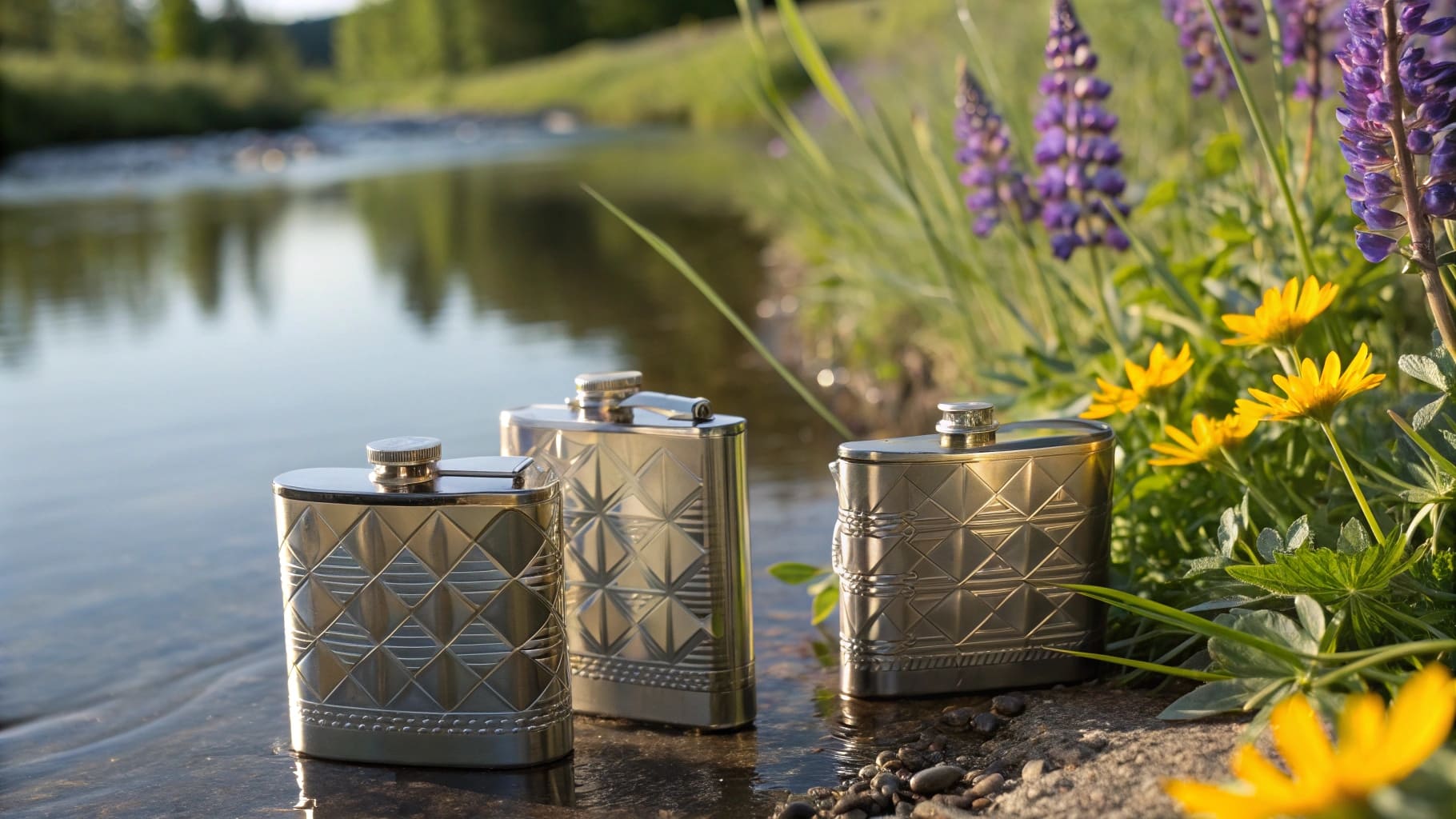
Most buyers focus only on material specifications. They ignore welding and seals. But I have seen perfectly graded 316 flasks fail because of poor manufacturing. The material is important. The construction quality is just as critical. This combination determines whether your liquor stays pure or turns problematic.
What is the difference between 304 and 316 thermos?
Your customer stores soup in a thermos for lunch. Another customer stores coffee. A third customer stores liquor. All three expect the same performance. But they should not expect the same material. The difference between 304 and 316 affects what you can safely store and for how long.
The main difference is molybdenum content. 316 stainless steel contains 2-3% molybdenum while 304 contains none.2 This addition makes 316 more resistant to chlorides, acids, and salt exposure.3 For thermos applications, this means better durability in harsh conditions.

I work with buyers who purchase both grades. The choice depends on their target market and product positioning. 304 thermos works perfectly for hot water, tea, and coffee. The material resists normal beverage acidity. It meets all food safety standards. Most importantly, it keeps costs reasonable for mass market products.
But 316 becomes necessary for specific scenarios. Coastal regions expose thermos to salt air. Some customers store acidic fruit juices or soups with high salt content. Medical facilities need maximum hygiene standards. In these cases, the molybdenum in 316 prevents pitting and corrosion that would eventually compromise the container.4
The price difference is about 20-30% higher for 316. This affects your profit margin. But it also affects product lifespan and customer satisfaction. I always ask buyers where they plan to sell. What will customers store? How long do they expect the product to last? These questions determine which grade makes business sense.
| Feature | 304 Stainless Steel | 316 Stainless Steel |
|---|---|---|
| Molybdenum Content | 0% | 2-3% |
| Corrosion Resistance | Good | Excellent |
| Salt Resistance | Moderate | High |
| Price Point | Standard | Premium (+20-30%) |
| Best Applications | Tea, Coffee, Water | Acidic Drinks, Coastal Areas, Liquor |
Is 304 or 316 water bottles better?
A startup founder contacted me last year. He wanted to launch a premium water bottle brand in California. He asked if 304 was good enough. I told him it depends on his brand promise. Premium positioning requires premium materials. Your customers may never know the difference. But you will know. That knowledge affects how you market and price your product.
For pure water storage, 304 performs excellently and meets all safety requirements. However, 316 offers superior longevity and corrosion resistance, making it preferable for premium brands, coastal markets, or customers who add acidic beverages like lemon water to their bottles.
Water is the least corrosive beverage. It does not contain acids, salts, or sugars that attack stainless steel. This means 304 grade provides complete protection for water storage. The material passes FDA standards. It resists bacterial growth. It maintains water taste without any metallic flavor. For standard water bottle applications, 304 delivers everything customers need at a competitive price point.
But market positioning changes the equation. Premium brands compete on perception and quality. Using 316 allows you to market superior corrosion resistance and longer product life. This justifies higher retail prices. Customers in beach communities face salt air exposure. Their bottles need extra protection. Some customers add lemon slices or electrolyte powders to their water. These additives increase acidity. The citric acid slowly corrodes 304 over years of use.5 316 handles these conditions without degradation.
I have shipped both grades to North American buyers. The 304 bottles go to value brands and promotional products. The 316 bottles go to premium outdoor brands and corporate gift programs. Each grade serves its market segment effectively. The key is matching material choice to brand strategy and customer expectations. Your material decision sends a message about your product quality. Choose the grade that supports your market position.
What is the difference between 304 and 316 stainless steel tumblers?
Last month I received photos from a buyer. His customer used a tumbler for morning orange juice. After six months, the interior showed small pits near the bottom. The buyer asked why. I explained that orange juice is highly acidic. His 304 tumbler could not handle daily citric acid exposure. This is why material choice matters for different beverage types.
Both grades work well for coffee and tea. The key difference emerges with acidic drinks, cocktails, or long-term liquor storage. 316 contains molybdenum that resists pitting from acids and chlorides. For tumblers used with varied beverages, 316 provides better protection against corrosion and flavor contamination.
Tumblers face more diverse beverage challenges than water bottles. Customers use them for coffee in the morning. Smoothies at lunch. Wine in the evening. Each beverage has different acidity levels and chemical compositions. Coffee is mildly acidic. Wine is moderately acidic. Citrus-based cocktails are highly acidic. This variety stresses the material in different ways.
The welding quality becomes critical for tumblers. Most tumblers use double-wall construction for insulation. This requires welding the inner and outer walls together. Poor welds create gaps where liquids penetrate and bacteria grow.6 I inspect weld seams carefully during production. Smooth, continuous welds without gaps ensure liquid cannot seep between walls. This matters more for alcoholic beverages because alcohol can dissolve certain adhesives or contaminate insulation materials.
Seal quality deserves equal attention. The lid gasket contacts your liquor every time you drink. Food-grade silicone gaskets maintain their integrity with alcohol exposure.7 Cheaper rubber gaskets degrade over time. They release odors. They affect taste. For B2B buyers sourcing liquor tumblers, I recommend specifying BPA-free, food-grade silicone for all sealing components. This small detail prevents major customer complaints later.
| Component | Why It Matters for Liquor | Quality Indicator |
|---|---|---|
| Material Grade | Resists alcohol acidity | 316 preferred for extended storage |
| Weld Quality | Prevents seepage | Smooth, continuous seams |
| Lid Gasket | Direct contact with liquid | Food-grade silicone, BPA-free |
| Interior Finish | Affects taste | Proper passivation treatment |
The business decision balances cost against application. For promotional tumblers used mainly for coffee, 304 works perfectly and keeps costs competitive. For premium bar accessories or branded cocktail tumblers, 316 justifies the higher investment. The material choice should align with how customers actually use your product and what they expect from your brand.
Conclusion
Choose 316 for premium liquor flasks where quality matters most. Prioritize seamless welds and food-grade seals regardless of material grade. Match your material choice to customer use cases and brand positioning for optimal results.
-
"Study of the Corrosion Behavior of Stainless Steel in Food Industry", https://pmc.ncbi.nlm.nih.gov/articles/PMC11012613/. Metallurgical references and corrosion studies generally show that Type 316 stainless steel has greater resistance than Type 304 in chloride-containing and some acidic environments; this supports the material-selection rationale, although it does not directly test whiskey stored in flasks. Evidence role: general_support; source type: paper. Supports: 316 stainless steel is more suitable than 304 for acidic liquor storage because it has superior corrosion resistance.. Scope note: Contextual support from corrosion behavior rather than a direct liquor-flask storage trial. ↩
-
"SAE 316L stainless steel - Wikipedia", https://en.wikipedia.org/wiki/SAE_316L_stainless_steel. Standard stainless-steel composition tables list Type 316 as containing about 2.0-3.0% molybdenum and Type 304 as having no intentional molybdenum addition; minor trace variation may occur depending on specification and melt chemistry. Evidence role: definition; source type: institution. Supports: The compositional distinction between 304 and 316 stainless steel is that 316 includes molybdenum while 304 generally does not.. Scope note: Composition ranges are grade specifications, not performance data. ↩
-
"Studies on the Cooperative Influence of Cr and Mo on the Pitting ...", https://pmc.ncbi.nlm.nih.gov/articles/PMC10707140/. Corrosion literature explains that molybdenum additions improve the pitting and crevice-corrosion resistance of austenitic stainless steels, especially in chloride-bearing environments; evidence for all acidic liquors is indirect and depends on concentration, pH, and exposure time. Evidence role: mechanism; source type: paper. Supports: Molybdenum in 316 stainless steel improves resistance to chlorides, acids, and salt exposure compared with 304.. Scope note: Strongest for chloride and localized corrosion; acid resistance varies by acid type and conditions. ↩
-
"Combined role of molybdenum and nitrogen in Limiting corrosion ...", https://pmc.ncbi.nlm.nih.gov/articles/PMC10875432/. Studies of stainless-steel localized corrosion show that molybdenum increases pitting resistance in chloride-containing media, supporting the rationale for 316 in salt-exposed or high-chloride uses; the evidence indicates reduced risk rather than absolute prevention. Evidence role: mechanism; source type: paper. Supports: Molybdenum in 316 reduces pitting and corrosion risk that can compromise containers in harsh environments.. Scope note: Molybdenum reduces susceptibility but does not guarantee prevention under all chloride, temperature, or cleaning conditions. ↩
-
"Study of the Corrosion Behavior of Stainless Steel in Food Industry", https://pmc.ncbi.nlm.nih.gov/articles/PMC11012613/. Corrosion studies on stainless steel in organic acids, including citric acid, can support the principle that acidity and repeated exposure may affect 304 stainless steel; the long-term rate in consumer bottles depends on concentration, temperature, oxygen, chlorides, and cleaning practices. Evidence role: mechanism; source type: paper. Supports: Citric acid exposure can contribute to corrosion of 304 stainless steel over extended use.. Scope note: Direct evidence for years of lemon-water bottle use may be limited; laboratory corrosion rates may not match consumer conditions. ↩
-
"[PDF] usda guidelines for the sanitary design and fabrication of dairy ...", https://www.ams.usda.gov/sites/default/files/media/DairyEquipmentReviewGuidelines.pdf. Hygienic-design guidance for food equipment identifies cracks, crevices, and rough or incomplete welds as sites where residues and microorganisms can be retained, supporting the contamination-risk mechanism; it does not quantify risk for every flask weld design. Evidence role: mechanism; source type: institution. Supports: Poor welds can create crevices that trap liquid and allow bacterial growth.. Scope note: Supports the general sanitary-design mechanism, not a measured contamination rate for flasks. ↩
-
"21 CFR 177.1210 -- Closures with sealing gaskets for food containers.", https://www.ecfr.gov/current/title-21/chapter-I/subchapter-B/part-177/subpart-B/section-177.1210. Chemical-compatibility references and food-contact regulations can support that properly formulated silicone elastomers are commonly suitable for food-contact sealing and have compatibility with ethanol under specified conditions; suitability depends on formulation, alcohol concentration, temperature, and exposure duration. Evidence role: general_support; source type: government. Supports: Food-grade silicone gaskets are generally appropriate for contact with alcoholic beverages when specified for that use.. Scope note: Food-grade status and alcohol compatibility must be verified for the specific silicone formulation and use conditions. ↩