
What Do You Really Need to Know Before Sourcing 18oz–20oz Insulated Coffee Mugs?
You source the wrong mug. Your customer complains. Your brand takes the hit. Getting the technical details right before you place a bulk order saves you from all of that.
The 18oz–20oz insulated coffee mug is one of the most competitive products in the B2B drinkware market. To source it well, you need to understand three things: handle ergonomics, quality inspection standards, and the functional specs your buyers actually care about. Getting these right separates a good product from a refund request.
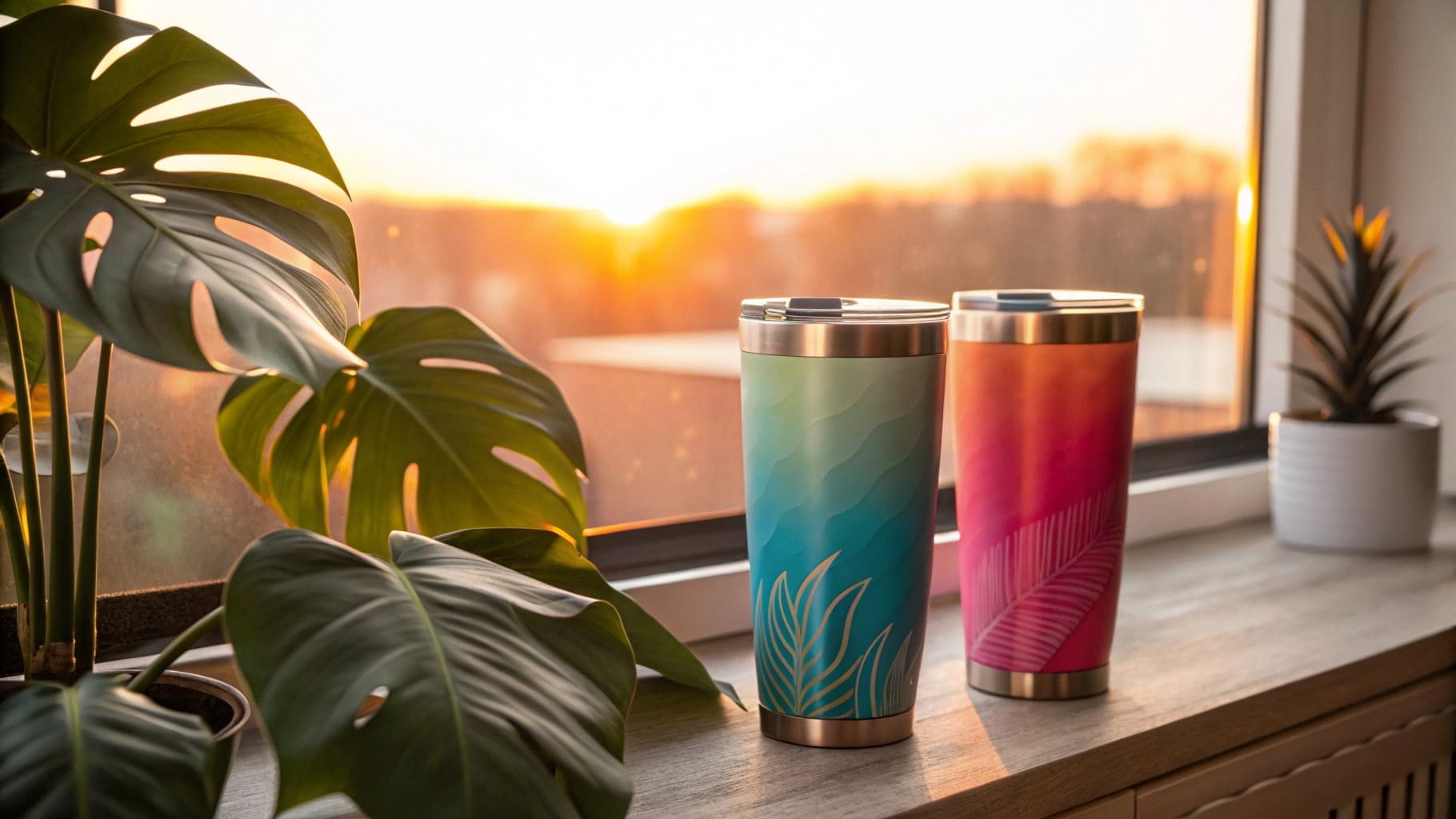
I have worked with buyers across North America for years. The ones who do well are not just chasing the lowest price. They ask the right questions before the order ships. In this article, I will walk you through the key questions that come up most often, and I will give you the direct answers you need to make smarter sourcing decisions.
Can You Put a Stainless Steel Coffee Mug in the Dishwasher?
You tell your customer it is dishwasher safe. The coating peels off after three cycles. Now you have a return on your hands and a damaged brand. This is a common mistake and it is easy to avoid.
A stainless steel coffee mug body made from 304 or 316 grade steel can handle dishwasher cycles1. The problem is the full assembly. Powder-coated finishes, vacuum seals, and plastic or silicone components on the lid often cannot. For B2B buyers, the safe answer is to label the product "hand wash recommended" unless you have tested every component under commercial dishwasher conditions.
Here is what most buyers get wrong. They assume the material rating covers the whole product. It does not. There are three separate parts to think about when you evaluate dishwasher compatibility.
The outer finish
Powder coating looks great on a retail shelf. It also degrades fast in a high-heat dishwasher environment.2 The color fades. The coating chips. Customers notice. If your product line uses powder coating, hand-wash labeling is not optional — it is a protection for your brand.
The vacuum seal
Vacuum insulation works because air has been removed from the space between the inner and outer walls.3 When a mug goes through repeated dishwasher cycles, extreme temperature swings can stress the seal over time. A compromised vacuum seal means the mug no longer holds temperature. This is a functional failure, not just a cosmetic one.
The lid assembly
Most lids on insulated mugs include silicone gaskets, plastic sliders, or metal hinges. These parts behave differently under heat and detergent exposure.4 Some silicone gaskets hold up fine. Others warp. You need to test the specific lid model you are ordering, not assume it matches a general spec.
| Component | Dishwasher Safe? | Risk if Exposed |
|---|---|---|
| 304/316 Stainless Body | Yes | Minimal |
| Powder-Coated Finish | No | Peeling, fading |
| Vacuum Insulation Seal | No | Loss of insulation |
| Silicone Lid Gasket | Depends on grade | Warping, cracking |
| Plastic Lid Parts | No | Warping, discoloration |
My recommendation is simple. Do not market your mug as fully dishwasher safe unless you have run your exact product through a full cycle test. If you are ordering from a supplier, ask for the test report. If they cannot provide one, take that as your answer.
What Is the Temperature Regulating Coffee Mug?
Standard insulated mugs keep drinks hot or cold for hours. But your customer pours in boiling coffee and still burns their mouth. A temperature regulating mug solves that problem. Is it worth the extra cost?
A temperature regulating coffee mug uses phase-change materials, or PCM, built into the inner wall. These materials absorb heat when the drink is too hot and release it back as the drink cools. The result is a beverage that stays within a comfortable drinking range longer than a standard vacuum-insulated mug.

This is a growing category in the premium drinkware segment. I want to break down what this technology actually means for a B2B buyer so you can decide if it fits your product line.
How PCM technology works
Phase-change materials are substances that shift between solid and liquid states at specific temperatures. When hot liquid enters the mug, the PCM absorbs the excess heat energy and changes state. As the liquid cools, the PCM releases that stored energy back. The net effect is a narrower temperature range over a longer period of time.
The optimal drinking temperature for coffee is roughly between 57°C and 65°C5. A standard vacuum mug will keep coffee above that range for a while, then drop below it. A PCM mug works to hold the liquid closer to that range throughout the drinking window.
What this means for your sourcing process
When you source a PCM mug, you are adding complexity. You need to verify the following from your supplier.
| Specification | Why It Matters |
|---|---|
| PCM temperature activation range | Confirms it works for the intended beverage |
| Duration of temperature maintenance | Sets accurate marketing claims |
| PCM material safety certification | Required for food-contact products |
| Effect on total product weight | Impacts shipping cost and user experience |
| Compatibility with dishwasher use | PCM adds another layer of wash risk |
The cost difference is real. A PCM mug will cost more than a standard vacuum mug at the same size. But the price premium it can command at retail is also real. In market segments where end consumers compare mug performance side by side, this technology is a clear differentiator.
My experience is that this product works best for buyers targeting premium gifting, corporate wellness programs, or specialty coffee retail. If your buyer is primarily looking for an affordable promotional mug, a standard vacuum mug at a competitive price point will serve them better.
Are Any Insulated Coffee Mugs Made in the USA?
Your buyer asks for a USA-made mug. You want to say yes. But do you actually know what that claim means and whether you can back it up?
True domestic manufacturing of insulated stainless steel mugs in the USA is rare. A small number of brands market their mugs as USA-made, but in most cases this refers to final assembly or branding work done in the USA using imported components. Full domestic manufacturing — raw material to finished product — carries a price premium of two to three times the cost of an imported equivalent.

This is a topic where the details matter a lot. Getting it wrong exposes you to regulatory risk and damages customer trust. I want to walk through what you actually need to check before you make any USA-origin claim.
What "made in USA" actually requires
The US Federal Trade Commission has a standard for unqualified "made in USA" claims. The product must be all or virtually all made in the United States. This means the final assembly and all significant parts and processing must be domestic. A stainless steel mug where the steel coil, the inner vessel, the outer shell, and the insulation process all happen outside the USA does not qualify — even if a logo is printed in the USA.
If your supplier tells you their mugs are USA-made, ask for documentation. A credible supplier will provide a full component sourcing breakdown and manufacturing location records. If they cannot, the claim is not safe to use in your marketing.
The qualified claim option
Some buyers successfully use language like "assembled in the USA" or "customized in the USA from imported components." These qualified claims are legally safer and can still support a domestic-origin positioning in certain market segments.
| Claim Type | What It Requires | Risk Level |
|---|---|---|
| "Made in USA" (unqualified) | All or virtually all domestic | High if unverified |
| "Assembled in USA" | Final assembly is domestic | Lower if accurate |
| "Customized in USA" | Logo/branding work is domestic | Low |
| No origin claim | No domestic requirement | No origin risk |
Who this positioning works for
Some end consumers and corporate buyers do pay a premium for domestic origin. Government procurement contracts sometimes require domestic sourcing under the Buy American Act. Certain retail channels in the USA use domestic origin as a selling point. If your buyer operates in one of these segments, the premium cost may be justified.
For most standard B2B orders, imported mugs with full quality documentation, proper certifications, and verified factory audits offer a better cost-to-quality ratio. The key is to know your buyer's end market and set expectations accurately from the start.
Handle ergonomics and AQL: the two things buyers overlook
Before I close, I want to mention two things that come up in sourcing discussions but rarely get enough attention.
Handle design in the 18oz–20oz range matters more than buyers expect. A mug at this capacity holds significant weight when full.6 A poorly engineered handle creates fatigue on the hand and raises the risk of drops. When I audit factories, I always request filled-mug grip tests across different hand sizes. Look for C-shaped handles with a defined thumb rest and a textured inner grip surface. These features reduce the load on the fingers and improve control.
On quality standards, AQL 2.5 is the accepted benchmark for critical defects in insulated mugs. This covers vacuum seal integrity and handle attachment strength. For premium retail lines, many buyers now apply AQL 1.5 for visible surface defects. The tighter standard costs more at inspection but reduces the rate of customer complaints after delivery.
| Defect Category | Recommended AQL Level |
|---|---|
| Vacuum seal failure | 2.5 |
| Handle attachment strength | 2.5 |
| Visible surface scratches | 1.5 (premium lines) |
| Lid leak under pressure | 2.5 |
| Logo print quality | 1.5 (premium lines) |
These two areas — handle ergonomics and AQL standards — directly affect the end user experience and your rate of returns. They are worth building into your sourcing checklist from the start.
Conclusion
Sourcing 18oz–20oz insulated coffee mugs well means understanding the product, not just the price. Check dishwasher claims, verify PCM specs, confirm origin documentation, and set the right AQL levels before your order ships.
-
"Stainless steel in contact with food and bevarage - Academia.edu", https://www.academia.edu/96148159/Stainless_steel_in_contact_with_food_and_bevarage. A materials or standards source should document that AISI 304 and 316 stainless steels are corrosion-resistant austenitic grades commonly used in food-contact and wet-service environments, supporting the claim that the steel body itself is generally robust under washing conditions. Evidence role: general_support; source type: education. Supports: 304 or 316 stainless steel mug bodies can generally withstand dishwasher exposure better than coatings, seals, or lid components.. Scope note: This supports stainless steel corrosion resistance generally; it does not prove that every finished mug assembly is dishwasher safe. ↩
-
"Detergency mechanisms and cellulosic surfaces: A review", https://bioresources.cnr.ncsu.edu/resources/detergency-mechanisms-and-cellulosic-surfaces-a-review/. A coatings or appliance-testing source should show that dishwasher heat, alkaline detergents, and mechanical exposure can degrade some organic coatings, providing contextual support for caution around powder-coated drinkware finishes. Evidence role: mechanism; source type: research. Supports: Powder-coated mug finishes may fade, chip, or peel under high-heat dishwasher conditions.. Scope note: Evidence may address powder coatings or dishwasher exposure generally rather than the exact coating formulation used on a specific mug. ↩
-
"Vacuum flask", https://en.wikipedia.org/wiki/Vacuum_flask. A thermodynamics or encyclopedia source should explain that vacuum flasks reduce heat transfer by removing most gas between double walls, supporting the mechanism described for vacuum insulation. Evidence role: definition; source type: encyclopedia. Supports: Vacuum-insulated mugs reduce heat transfer because the space between their walls is evacuated.. Scope note: This supports the operating principle of vacuum insulation, not the durability of any particular mug seal. ↩
-
"[PDF] Medical Device Polymers - Steven Saliterman's", https://saliterman.umn.edu/sites/saliterman.umn.edu/files/2022-07/Medical%20Device%20Polymers.pdf. A polymer or food-contact-materials source should show that elastomers and plastics vary in heat resistance and chemical resistance, supporting the need to evaluate lid materials separately. Evidence role: mechanism; source type: research. Supports: Lid components made from silicone, plastic, or metal can respond differently to dishwasher heat and detergent exposure.. Scope note: This supports material-dependent behavior generally; it does not identify the performance of a particular gasket, slider, or hinge design. ↩
-
"What Temperature of Coffee Exceeds the Pain Threshold? Pilot ...", https://pmc.ncbi.nlm.nih.gov/articles/PMC6025158/. A sensory-science or food-temperature study should report preferred or acceptable coffee drinking temperatures near this range, supporting the stated target range for comfortable consumption. Evidence role: statistic; source type: paper. Supports: The comfortable or preferred drinking temperature for coffee is approximately 57°C to 65°C.. Scope note: Preferred drinking temperature varies by individual, beverage style, serving culture, and study method. ↩
-
"Units", https://chemed.chem.purdue.edu/genchem/topicreview/bp/ch1/index.php. A standards or educational source on water density and unit conversion can substantiate that 18–20 fluid ounces of liquid weighs roughly 0.53–0.59 kg before adding the mug’s own weight, supporting the ergonomic concern. Evidence role: general_support; source type: education. Supports: An 18oz–20oz mug carries substantial total weight when filled, which can affect handle ergonomics and user comfort.. Scope note: The exact filled weight depends on beverage density and the empty mug’s construction weight. ↩