
Kids Bottles in 2026: Sippy vs Straw Lids, Choke Tests, and AQL Sampling — What Should You Know?
Wrong lid choice on a kids' bottle costs you more than a return shipment. It costs you a brand's trust. Here is what I know after years of sourcing kids' bottles.
Stainless steel bottles with straw or flip-top lids are the safest, most practical choice for kids in 2026. They pass choke tests more reliably, meet FDA and LFGB standards, and hold up in schools and daycares. AQL sampling focused on small-part detachment is the key quality check buyers must request.
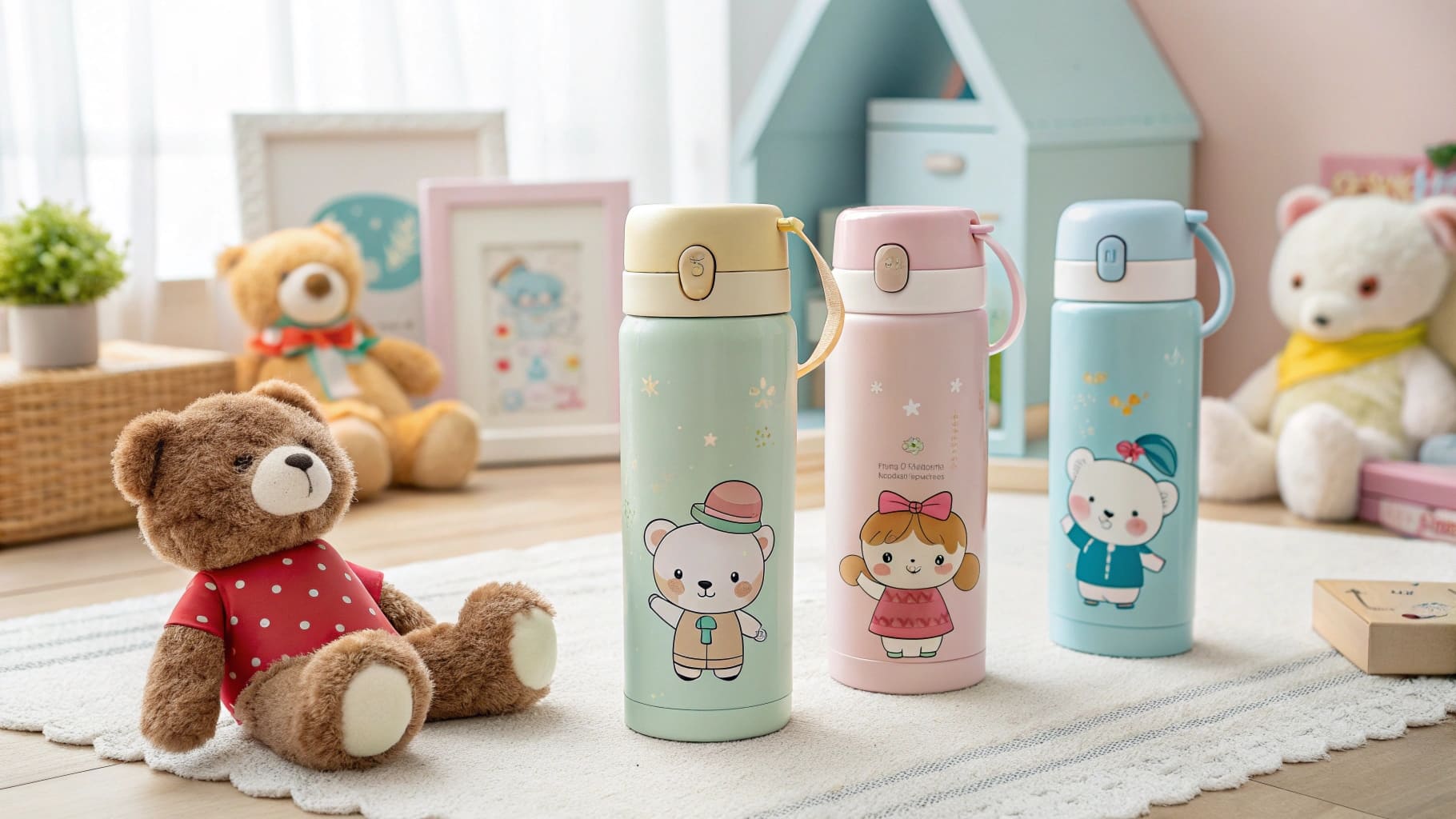
Choosing the right kids' bottle feels simple at first. Then you start looking at lid types, material certifications, age-specific safety tests, and AQL sampling plans — and it gets complicated fast. I have worked through these questions with buyers across North America and Europe. The answers matter more in 2026 than they did even two years ago, because parent expectations and retail standards have both moved up. Let me walk you through the three questions I get asked most.
Is a Stainless Steel Bottle Good for Kids?
Parents are asking harder questions about what touches their child's water. If you source the wrong material, you lose the sale before it starts.
Stainless steel bottles made from food-grade 304 or 316 steel are one of the best choices for kids. The surface does not leach chemicals into drinks. It does not contain BPA or phthalates. It also survives drops better than plastic, which matters in schools and daycares.
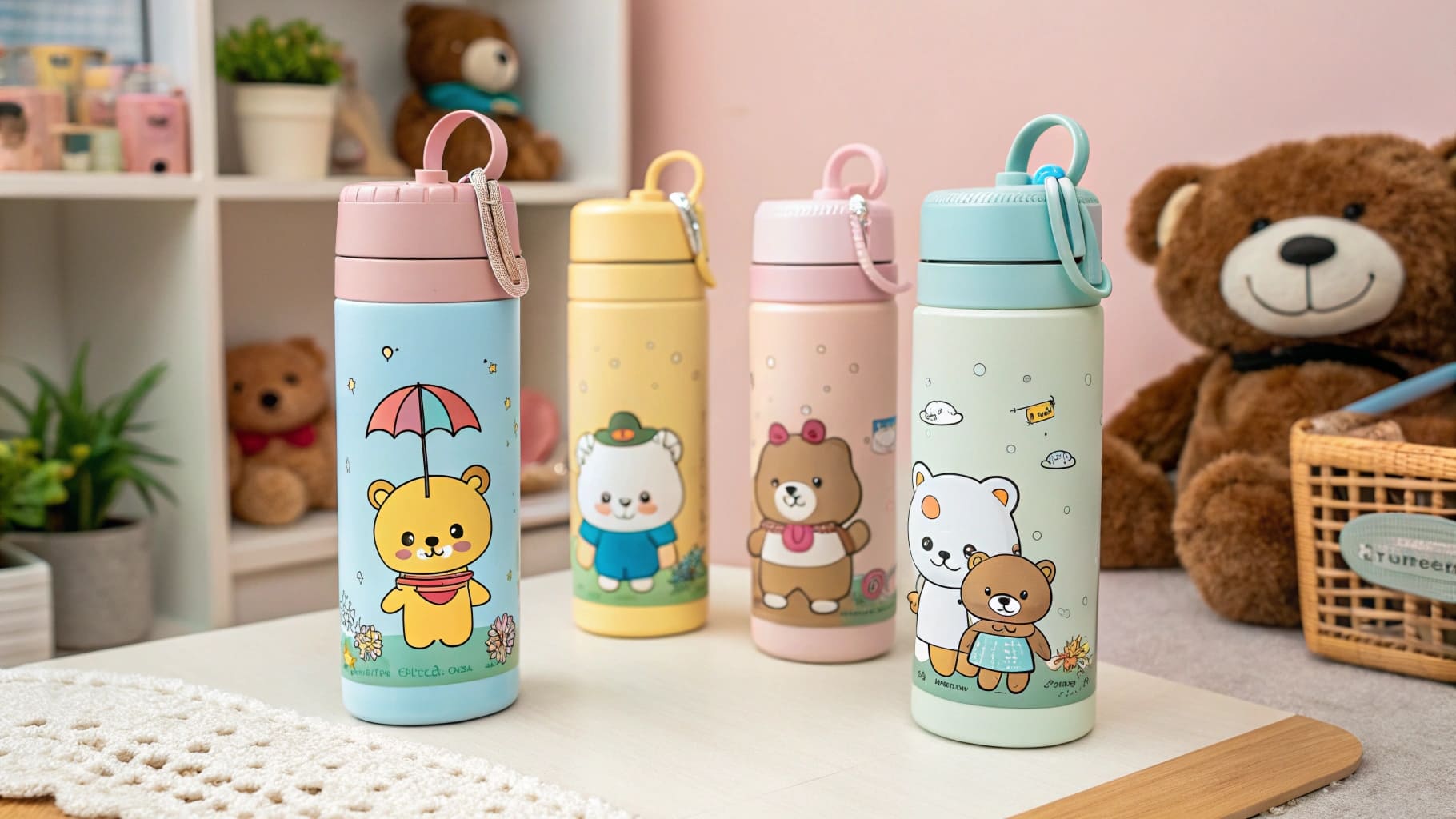
Why does material matter more now?
Plastic bottles have faced growing scrutiny over microplastic particles and endocrine-disrupting chemicals1. Parents in North America and Europe are paying close attention to this. As a B2B buyer, your retail customers feel this pressure from their end consumers every day. Stocking stainless steel bottles puts you ahead of that shift.
The concern is not just about BPA anymore. Research into phthalates and microplastics has moved the conversation further. A parent standing in a store aisle in 2026 is more likely to read the materials label than a parent did five years ago. That behavioral shift changes what your buyers want to stock, and it changes what you need to order.
From a procurement standpoint, the higher unit cost of stainless steel is real. But the total cost of ownership is lower, because replacement frequency drops sharply.
Here is a simple comparison that I often share with buyers who are weighing material options:
| Feature | Stainless Steel (304/316) | Plastic (BPA-Free) | Plastic (Standard) |
|---|---|---|---|
| Chemical leaching risk | Very low | Low to moderate | High |
| Durability in schools | Excellent | Moderate | Poor |
| Replacement frequency | Low | Medium | High |
| Parent acceptance in 2026 | Very high | Mixed | Low |
| Double-wall insulation option | Yes | Rarely | No |
| Microplastic risk | None | Present | Present |
One more thing I always recommend for kids' bottles specifically: double-wall vacuum insulation. It keeps drinks at a safe temperature and stops condensation from forming on the outside. Condensation makes a bottle slippery in small hands. That is a simple design detail that prevents real accidents.
What Is the Healthiest Water Bottle for Kids?
A bottle can be made from safe materials and still make a child sick. The full picture goes beyond what the bottle is made of.
The healthiest kids' bottle combines food-grade stainless steel with BPA-free silicone or Tritan parts for spouts and seals. It should carry third-party certifications like FDA food contact approval, LFGB, or California Proposition 65 compliance2. Migration testing documentation should come with every order.
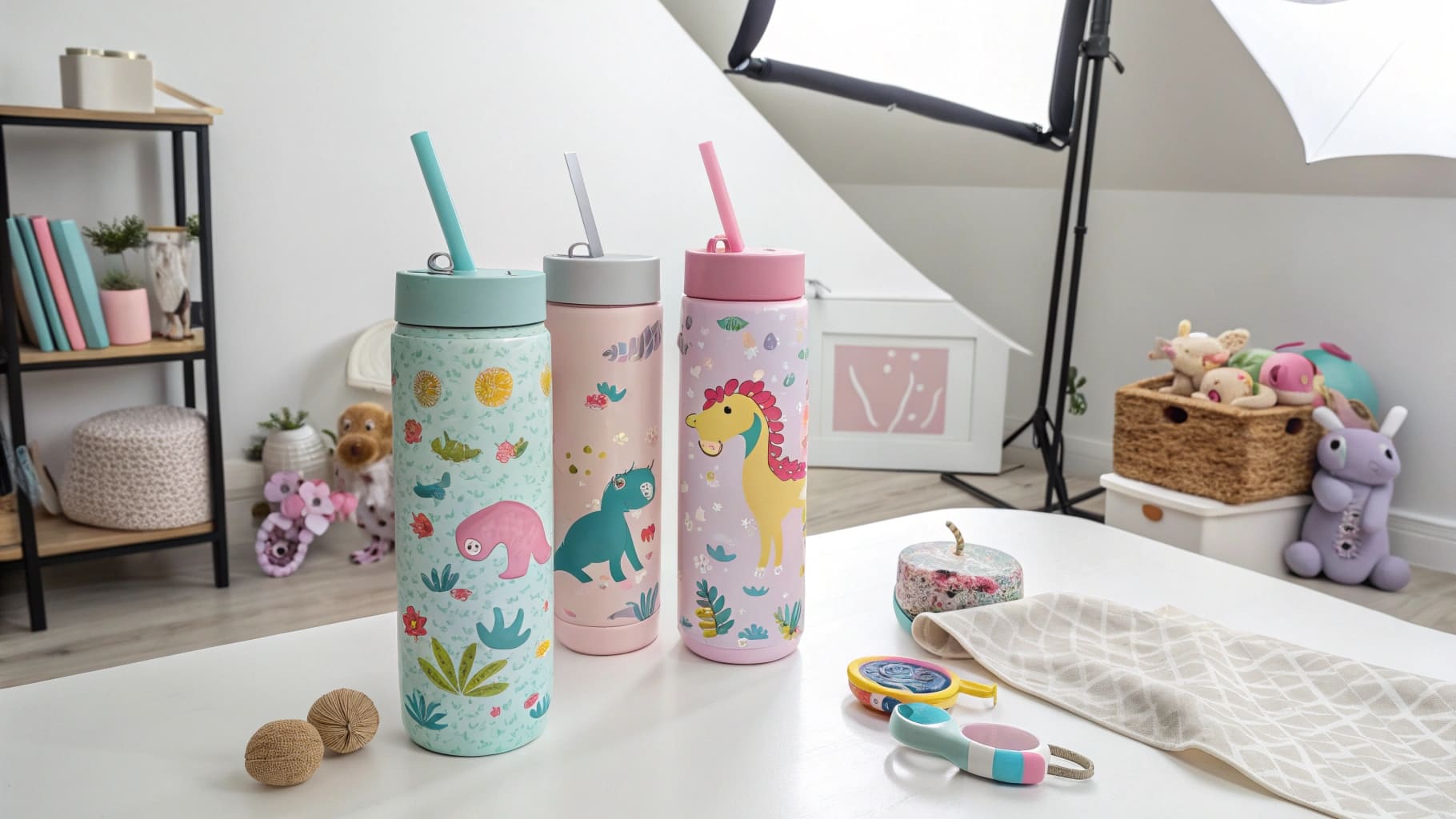
What certifications and design features should you require?
Certifications are the floor, not the ceiling. I have seen suppliers present certificates that do not match the actual production batch. This is a real problem in the kids' category, because the stakes are higher. A fraudulent food-contact certificate on an adult tumbler is a business problem. The same issue on a kids' bottle is a safety problem.
When I place orders for kids' bottles, I ask for migration testing documentation as a standard requirement. Migration testing checks whether any substance moves from the bottle material into the liquid inside, across different temperatures and time periods.3 This is the test that gives you proof, not just a certificate number.
Beyond certifications, healthy design means the bottle gets used consistently. A bottle that sits in a backpack because a child finds it hard to drink from is not doing its job. Here is how I think about design features for the three-to-eight age group:
| Design Feature | Why It Matters for Health |
|---|---|
| Wide-mouth opening | Easy to clean, reduces bacterial build-up |
| Transparent or removable straw | Parents can check cleanliness at a glance |
| Soft silicone spout | Easy flow, encourages regular drinking |
| Smooth interior walls | No grooves where bacteria can hide |
| Antimicrobial powder coat exterior | Reduces surface bacteria between washes |
| Silver-ion interior treatment | Adds a hygiene layer for institutional use |
For 2026 orders, I am seeing more buyers from North America request antimicrobial powder coating on exteriors and silver-ion treatments on interior surfaces. This started as a niche request. It is becoming a standard ask, particularly from buyers supplying schools and sports programs. If your supplier cannot offer this, it is worth finding one who can.
One more point that gets overlooked: ask your supplier for the full Bill of Materials for every component. Spouts, seals, straws, and lid springs all touch the product. Each one needs its own food-contact compliance. A stainless steel body paired with an uncertified silicone spout is not a certified bottle.
Should a 4-Year-Old Be Drinking Out of a Bottle?
This question sounds like a parenting question. For a B2B buyer, it is actually a product category question. Get it wrong and you are selling into the wrong market.
By age four, pediatric guidelines generally recommend moving children away from traditional baby bottles and toward straw cups or open cups.4 This supports oral motor development and prevents dental problems.5 But the demand for transitional bottles for three-to-six-year-olds is strong and growing.
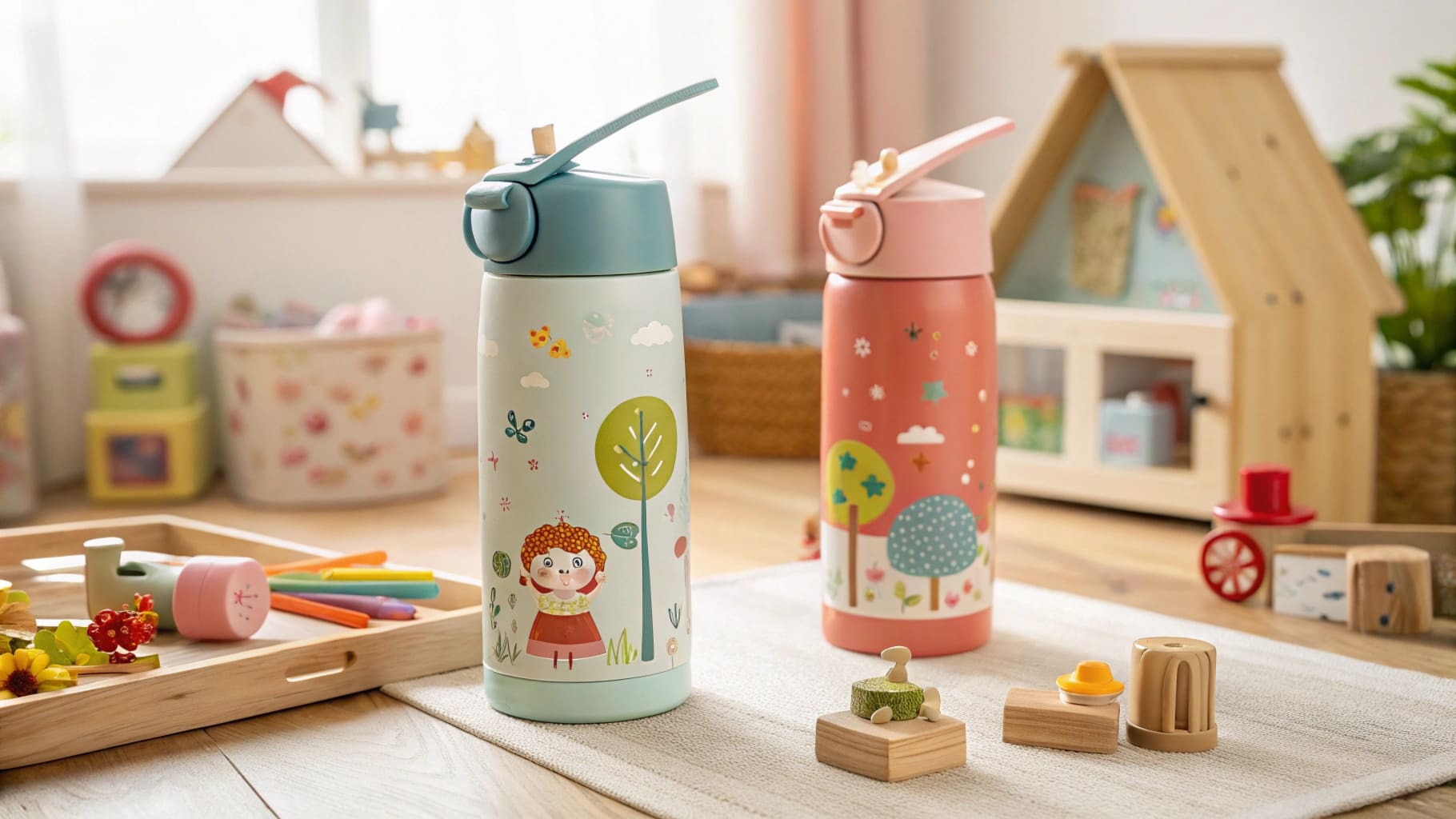
What does this mean for sippy lids vs straw lids, choke tests, and AQL sampling?
The three-to-six age group is its own product category. It sits between toddler sippy cups and adult-style water bottles. Parents want something spill-proof and independent. Pediatric guidance rules out the classic baby bottle design. That leaves flip-top spouts and straw lids as the two main options, and the differences between them matter.
| Feature | Flip-Top Spout Lid | Straw Lid |
|---|---|---|
| Oral motor impact | Low sucking demand, better for dental development | Low sucking demand if valve is well-designed |
| Spill resistance | High when closed | High with bite valve |
| Ease of use for 4-year-olds | Very easy, one-button open | Easy, requires locating straw |
| Cleaning difficulty | Moderate | Higher, straw requires brush |
| Choke risk components | Flip-cap spring, silicone tip | Straw tip, bite valve, straw connector |
| Parent approval rating | High | High |
Both lid types can work well for a four-year-old. The deciding factor for most B2B buyers is what their retail customers' end consumers prefer. In my experience, North American parents lean toward straw lids for everyday school use and flip-top lids for sports and outdoor activity.
Now, here is where choke testing and AQL sampling become critical.
Every component in a kids' lid that can detach is a potential choke hazard. This includes silicone straw tips, bite valves, flip-cap springs, and connector rings. For the three-to-six age group, these parts need to pass small-parts choke testing under ASTM F963 in the US or EN 71 in Europe6. Do not assume your supplier has done this. Ask for the test report, and ask which production batch it covers.
AQL sampling for kids' bottles should be set at a tighter level than standard adult drinkware. I recommend AQL 1.0 for critical safety defects, which includes any small part that detaches under a defined pull force. Standard adult drinkware is often sampled at AQL 2.5. The difference matters when you are dealing with components that a four-year-old will put in their mouth.
Here is how I structure the sampling conversation with suppliers:
| Defect Type | Recommended AQL Level | Examples |
|---|---|---|
| Critical safety defects | 1.0 | Detachable small parts, sharp edges |
| Major functional defects | 1.5 | Leaking lids, broken hinges |
| Minor cosmetic defects | 2.5 | Surface scratches, color variation |
One last thing I tell every buyer sourcing kids' bottles for the first time: request a pre-shipment inspection that specifically covers small-part detachment tests on a sample from the production run. A factory test report from six months ago does not cover the batch you are receiving today. Your inspection needs to happen on your goods, with your lot number.
Conclusion
Stainless steel wins on safety and durability. Straw and flip-top lids both work for four-year-olds, but only if choke tests and AQL 1.0 sampling back up the claim.
-
"Microplastics in drinking-water - World Health Organization (WHO)", https://www.who.int/publications/i/item/9789241516198. A public-health review or peer-reviewed article should establish that microplastics have been detected in drinking water systems and that some plastic-associated chemicals, including BPA or phthalates, have endocrine-disrupting properties; this supports the concern but does not show that every plastic kids' bottle presents the same risk. Evidence role: expert_consensus; source type: research. Supports: Scientific and public-health literature discusses microplastics in drinking water and endocrine-active chemicals associated with some plastic materials.. Scope note: Evidence varies by polymer type, additive package, use conditions, and exposure level. ↩
-
"How FDA Regulates Substances that Come into Contact with Food", https://www.fda.gov/food/food-packaging-other-substances-come-contact-food-information-consumers/understanding-how-fda-regulates-substances-come-contact-food. Official regulatory sources should show that FDA food-contact rules govern materials intended to contact food, the LFGB framework applies to food-contact articles in Germany, and Proposition 65 addresses warnings for listed chemical exposures in California; this supports their relevance as compliance references, not as interchangeable certifications. Evidence role: historical_context; source type: government. Supports: These regulatory regimes address food-contact materials or chemical exposure warnings relevant to consumer drinkware.. Scope note: The frameworks differ in scope, jurisdiction, and testing requirements. ↩
-
"Chemistry Recommendations for Submissions of Food Contact ...", https://www.fda.gov/regulatory-information/search-fda-guidance-documents/guidance-industry-preparation-premarket-submissions-food-contact-substances-chemistry. A food-contact regulatory source should define migration testing as the assessment of substances transferring from a material into food or food simulants under specified time and temperature conditions; this directly supports the article's explanation of the test. Evidence role: definition; source type: government. Supports: Food-contact migration testing measures transfer of substances from materials into food or food simulants under defined conditions.. ↩
-
"[PDF] Weaning From A Bottle - Iowa.gov", https://hhs.iowa.gov/media/7860/download?inline. A pediatric or pediatric-dentistry guideline should state that prolonged baby-bottle use is discouraged and that children should transition to cups during toddlerhood; this supports the article's age-four category distinction, although specific endorsement of straw cups may vary by guideline. Evidence role: expert_consensus; source type: institution. Supports: Pediatric or dental authorities recommend discontinuing baby-bottle use well before age four and encouraging cup drinking.. Scope note: Guidelines may emphasize open cups or general cup use rather than naming every acceptable transitional lid type. ↩
-
"Relationship between breastfeeding duration and the development ...", https://pmc.ncbi.nlm.nih.gov/articles/PMC12122683/. A pediatric-dentistry guideline or review should document that prolonged bottle use is associated with early childhood caries and other oral-health concerns, and that cup transition is recommended; this supports the dental portion of the claim, while oral-motor effects may require separate developmental feeding evidence. Evidence role: expert_consensus; source type: paper. Supports: Prolonged bottle use is associated with dental caries risk and may affect oral habits; cup transition is commonly recommended for oral health.. Scope note: Dental evidence is stronger than direct proof for all oral-motor development outcomes. ↩
-
"Small Parts Ban and Choking Hazard Labeling | CPSC.gov", https://www.cpsc.gov/Business--Manufacturing/Business-Education/Business-Guidance/Small-Parts-for-Toys-and-Childrens-Products. A safety-standard summary or government guidance source should show that ASTM F963 and EN 71 address small-parts hazards through defined test methods for children's products; this supports the use of those standards as references for detachable lid components, though drinkware classification may depend on jurisdiction and product presentation. Evidence role: definition; source type: government. Supports: ASTM F963 and EN 71 include toy-safety requirements addressing small parts and choking hazards for children's products.. Scope note: Applicability can vary if the bottle is regulated as drinkware rather than as a toy or child-care article. ↩