
Are Your Insulated Thermal Coffee Mugs Actually Safe? LFGB, FDA, Prop 65, and BPA-Free Claims Explained
For B2B buyers, one failed safety check can kill a product launch. Certifications like LFGB, FDA, and Prop 65 are no longer optional. They are the entry ticket to North American and European markets.
Insulated thermal coffee mugs must meet specific safety certifications before they can be sold in regulated markets. LFGB covers the EU, FDA covers the US, Prop 65 applies to California, and BPA-free claims address plastic component safety.1 Together, these four requirements form the baseline for any compliant product.

I have spoken with many buyers who assumed a supplier's word was enough. It never is. The real risk is not obvious defects. It is the gap between what a supplier claims and what a lab report actually shows. In this article, I will break down the certifications you need, what they actually mean, and how to verify them before your shipment leaves the factory.
How Do You Tell If a Coffee Mug Has Lead?
Most buyers assume stainless steel means safe. But lead is not always in the steel itself. It hides in other places, and missing it can put your entire brand at risk.
Lead contamination in coffee mugs is most likely found in ceramic glazes, painted decorations, or low-grade sealing materials used in lids.2 The safest way to confirm a mug is lead-free is to request a third-party lab report that tests specifically for heavy metals, including lead and cadmium3.

Where Does Lead Actually Hide in a Coffee Mug?
Most high-quality stainless steel bodies are very unlikely to contain lead.4 The steel alloy itself is not the problem. The risk comes from secondary materials that many buyers overlook during the sourcing process.
Here is a breakdown of the most common sources of lead contamination in coffee mugs:
| Component | Lead Risk Level | What to Check |
|---|---|---|
| Stainless steel body | Low | Verify 304 or 316 food-grade steel grade |
| Ceramic glaze | High | Request heavy metal migration test |
| Painted exterior decoration | Medium-High | Check for lead and cadmium in paint |
| Plastic lid or seal | Medium | Confirm BPA-free and food-grade resin |
| Solder joints or metal fittings | Medium | Check materials used in assembly |
I once reviewed a batch of mugs from a supplier who provided a clean stainless steel certificate. The steel was fine. But the printed logo on the exterior used a paint formula that failed a lead migration test. That discovery happened during inspection, not after the products were on shelves.
The lesson is simple. You cannot test one material and declare the whole product safe. Every component that contacts food or beverage must be tested individually.5 When I qualify a new supplier, I ask for a full product-level test report, not component-level declarations.
For buyers targeting the US market, the relevant standard is FDA 21 CFR. For EU buyers, EN 13428 or LFGB Section 30 and 31 set the limits for heavy metal migration. For California specifically, Prop 65 sets stricter thresholds than federal US standards, particularly for lead and cadmium.6
The practical takeaway is this. Always require a current test report from an accredited third-party lab, such as SGS, Intertek, or Bureau Veritas. A supplier certificate alone is not sufficient. The report must show test results for lead, cadmium, and other heavy metals across all components, not just the metal body.
Is a Bodum Travel Mug Microwave Safe?
This question comes up often, and the answer matters more than most buyers realize. Getting this wrong on a product listing can trigger returns, complaints, and liability issues.
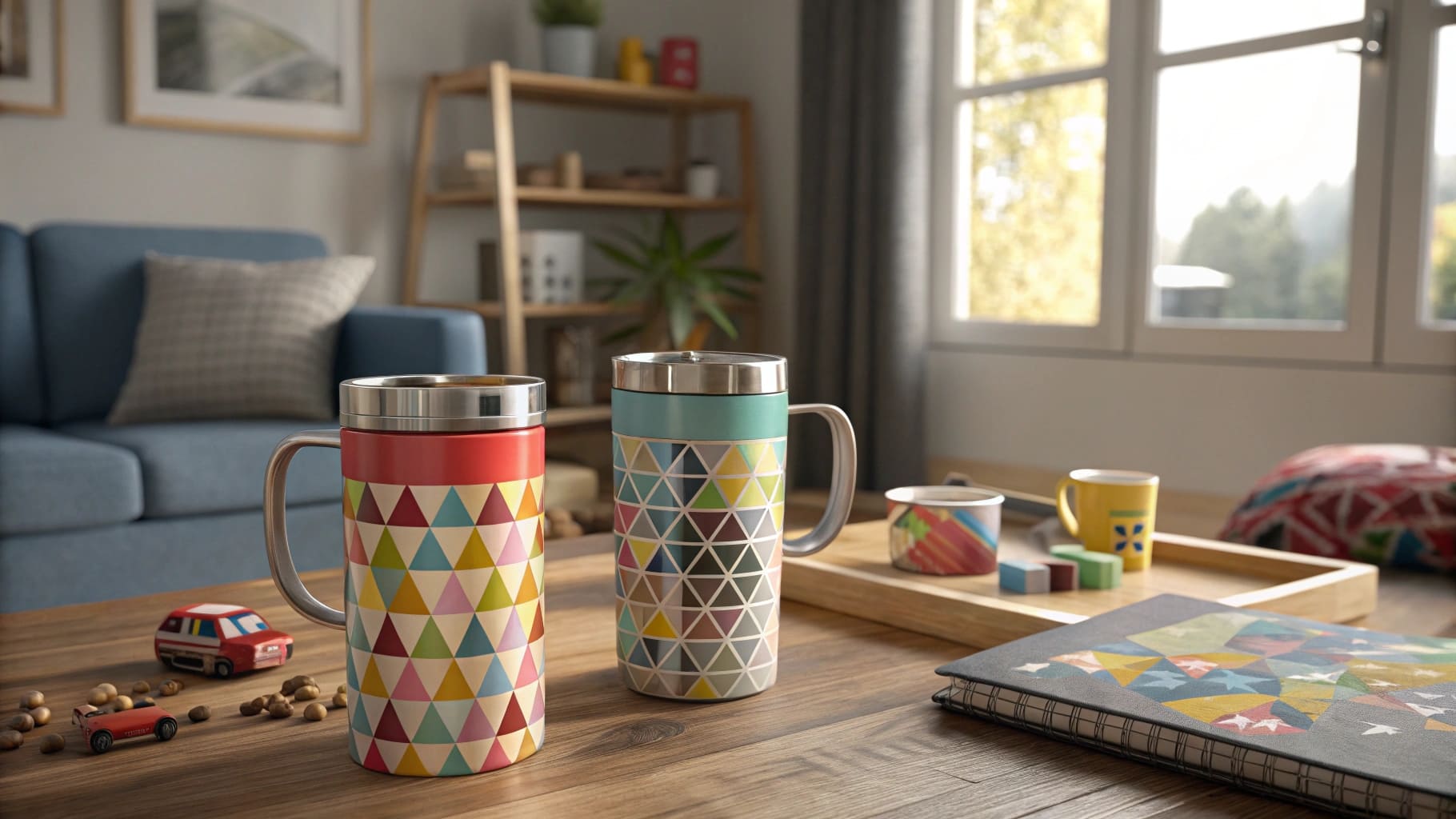
No standard stainless steel travel mug is microwave safe.7 Metal reflects microwaves and creates sparks, which is a fire hazard. Any insulated travel mug with a stainless steel body must be labeled as non-microwave safe, regardless of brand.
What Makes a Travel Mug Microwave Safe or Not?
The material of the body determines microwave compatibility. This is not a gray area. It is a straightforward material science fact that applies to every brand, including Bodum.
Here is a quick comparison of common travel mug materials and their microwave safety status:
| Material | Microwave Safe? | Notes |
|---|---|---|
| Stainless steel | No | Creates sparks, fire hazard |
| Ceramic | Usually yes | Must verify no metallic glaze |
| Glass | Usually yes | Must be borosilicate, check lid material |
| Plastic (BPA-free) | Depends | Check specific resin rating |
| Hybrid (steel + ceramic insert) | No | Metal component disqualifies it |
I have seen buyers get into trouble when they source a mug marketed as a "ceramic travel mug" but it has a stainless steel outer shell. The ceramic interior does not make the whole product microwave safe. If there is any metal in the structure, it cannot go in a microwave.
For B2B buyers, this has a direct impact on how you advise your retail customers and how you write your product descriptions. If your mug is not microwave safe, you must state that clearly on the packaging and in the product listing. In some markets, failing to disclose this is a regulatory issue, not just a customer service problem.
If your customers are asking specifically for microwave-safe travel mugs, the product you need is a fully ceramic mug with no metallic glaze and a ceramic or heat-safe plastic lid. Even then, I would require the supplier to provide a microwave safety test result as part of the compliance package. Claims on a product page are not enough. The test report is what protects you legally.
How Do You Know If a Ceramic Mug Is Safe to Drink From?
Ceramic looks natural and feels premium. But the safety of a ceramic mug depends almost entirely on how it was made and what went into the glaze. The surface you drink from matters more than the shape.
A ceramic mug is safe to drink from when its glaze passes heavy metal migration tests and meets food-contact standards such as FDA or LFGB.8 The key risk is lead and cadmium leaching from glaze materials, especially in lower-quality production processes.

What Certifications Actually Confirm Ceramic Mug Safety?
Ceramic mug safety is not self-declared. It requires specific testing under conditions that simulate actual use. The tests measure how much of a substance migrates from the ceramic surface into a liquid at elevated temperatures.
Here is a summary of the most relevant certifications and what they cover:
| Certification | Region | What It Tests |
|---|---|---|
| FDA 21 CFR 166.110 | USA | Lead and cadmium leaching from ceramics |
| LFGB Section 31 | EU | Overall migration of harmful substances |
| California Prop 65 | USA (California) | Lead, cadmium, and other listed chemicals |
| EN 1388 | EU | Heavy metal migration from ceramic surfaces |
| BPA-free declaration | Global | Applies to any plastic components on the mug |
The distinction between decorative ceramics and food-contact ceramics is important. A mug that is painted with artistic glazes and sold as a collectible may not be tested for food contact. If you are sourcing ceramic mugs for drinking, you need food-grade certification, and you need the test to cover both the interior glaze and the rim area where lips contact the mug.
I have reviewed supplier documentation where the test covered only the interior base of the mug. The rim was not tested. That is not a complete result. Any credible test for a drinking vessel must include the rim.
Another area to watch is firing temperature. Ceramics fired at lower temperatures are more porous and more likely to leach. High-temperature firing produces a denser, more stable glaze. While buyers cannot always verify this directly, a passed migration test from an accredited lab provides indirect confirmation that the production process met the required standard.
For buyers working with me at Icobottle, I always provide full test documentation before any shipment. I do not ask buyers to take my word for it. The lab report speaks for itself.
Conclusion
Safety certifications are not paperwork. They are the difference between a product that sells and one that gets pulled. Verify every certificate, test every component, and never skip the lab report.
-
"Inventory of Food Contact Substances Listed in 21 CFR - FDA", https://www.fda.gov/food/packaging-food-contact-substances-fcs/inventory-food-contact-substances-listed-21-cfr. Official regulatory materials describe FDA authority over U.S. food-contact substances, California Proposition 65 warning obligations, and BPA restrictions or assessments for plastic food-contact materials; LFGB is a German food and feed code that operates alongside harmonized EU food-contact law, so it is contextual rather than a single EU-wide certification. Evidence role: definition; source type: government. Supports: FDA, Prop 65, LFGB, and BPA-related requirements correspond to different jurisdictions or material-safety issues relevant to drinkware.. Scope note: LFGB should be presented as German law within the broader EU food-contact framework, not as the sole EU regime. ↩
-
"Questions and Answers on Lead-Glazed Traditional Pottery | FDA", https://www.fda.gov/food/environmental-contaminants-food/questions-and-answers-lead-glazed-traditional-pottery. Public health and regulatory sources identify lead and cadmium leaching from ceramic glazes and decorations as recognized hazards in food-contact ware; support for sealing materials is more indirect and would require material-specific testing evidence. Evidence role: mechanism; source type: government. Supports: Lead contamination risks in mugs are commonly associated with ceramic glazes and decorative coatings, with other components requiring separate material verification.. Scope note: Evidence is strongest for ceramic glazes and surface decorations, and weaker for the generalized claim about lid sealing materials. ↩
-
"Lead in Food and Foodwares - FDA", https://www.fda.gov/food/environmental-contaminants-food/lead-food-and-foodwares. Food-contact testing standards and regulatory guidance use migration or leaching tests to quantify lead and cadmium release from ceramic and related food-contact surfaces; this supports the role of laboratory test reports, although the need for a third-party laboratory is a quality-assurance practice rather than always a statutory requirement. Evidence role: expert_consensus; source type: institution. Supports: Lead-free or low-leaching claims for mugs are best substantiated by laboratory testing for heavy metals such as lead and cadmium.. Scope note: The source may establish the testing method and contaminant concern, not necessarily mandate third-party testing in every jurisdiction. ↩
-
"SAE 316L stainless steel", https://en.wikipedia.org/wiki/SAE_316L_stainless_steel. Standard compositional references for austenitic stainless steels such as AISI 304 and 316 list iron, chromium, nickel, manganese, silicon, carbon, and related alloying elements, but not lead as a normal intentional constituent; this supports the low likelihood of lead in compliant stainless-steel bodies. Evidence role: mechanism; source type: institution. Supports: Food-grade stainless steel bodies are generally a low-probability source of lead compared with glazes or coatings.. Scope note: Trace contamination or nonstandard alloys are not ruled out without material-specific testing. ↩
-
"How FDA Regulates Substances that Come into Contact with Food", https://www.fda.gov/food/food-packaging-other-substances-come-contact-food-information-consumers/understanding-how-fda-regulates-substances-come-contact-food. Food-contact frameworks regulate materials and articles according to substances that can migrate into food under intended use conditions, supporting component-by-component evaluation where different materials contact the beverage or mouth. Evidence role: mechanism; source type: government. Supports: Food-contact compliance should address each beverage-contacting component rather than only the stainless-steel body.. Scope note: Specific sampling plans vary by regulation, material, and test standard; the source supports the principle rather than a universal identical test procedure. ↩
-
"Proposition 65 No Significant Risk Levels (NSRLs ... - OEHHA", https://oehha.ca.gov/proposition-65/general-info/proposition-65-no-significant-risk-levels-nsrls-and-maximum-allowable-dose-levels-madls. California OEHHA publishes Proposition 65 safe-harbor levels, including very low no-significant-risk or maximum-allowable-dose levels for listed chemicals such as lead and cadmium; comparison with federal limits can support the claim only when the same exposure route and product category are analyzed. Evidence role: statistic; source type: government. Supports: Proposition 65 can impose lower exposure-warning thresholds for lead and cadmium than some federal product standards.. Scope note: “Stricter” depends on the federal comparator and exposure assumptions, so the citation should be used with precise thresholds rather than as a universal statement. ↩
-
"Cooking with Microwave Ovens - Food Safety and Inspection Service", http://www.fsis.usda.gov/food-safety/safe-food-handling-and-preparation/food-safety-basics/cooking-microwave-ovens. Microwave safety guidance from public agencies explains that metal containers and metallic trim should generally not be used in microwave ovens because they can cause arcing and damage; this supports labeling stainless-steel travel mugs as unsuitable for microwave use. Evidence role: expert_consensus; source type: government. Supports: Standard stainless-steel travel mugs should not be considered microwave safe.. Scope note: Some microwave manufacturers allow limited use of specific metal accessories designed for their ovens, but this does not apply to ordinary stainless-steel travel mugs. ↩
-
"Lead in Food and Foodwares - FDA", https://www.fda.gov/food/environmental-contaminants-food/lead-food-and-foodwares. Regulatory guidance for ceramic foodware focuses on testing the release of lead and cadmium from glazed ceramic surfaces into food-simulating media, supporting migration testing as a basis for assessing whether ceramic mugs are suitable for drinking use. Evidence role: expert_consensus; source type: government. Supports: Ceramic mugs intended for drinking should meet applicable food-contact requirements and pass heavy-metal migration or leaching tests.. Scope note: Passing heavy-metal migration tests is necessary for the covered hazards but does not alone address all possible safety issues, such as thermal shock or physical defects. ↩