
Are Stainless Steel Cup Sets Worth It for B2B Buyers?
Buying stainless steel cup sets sounds simple. But if you get the pack counts or palletization wrong, you will pay for it every single shipment.
Stainless steel cup sets are worth it for B2B buyers when you look at the total cost of ownership. The right pack count, carton dimensions, and pallet configuration can improve container cube efficiency by up to 20%, cutting your landed costs significantly.

There is more to this than picking a good-looking product. The decisions you make before the goods leave the factory — pack counts, master carton sizing, pallet patterns — will shape your margins for every order after this one. Let me walk you through what actually matters.
What Is the Best Stainless Steel Measuring Cup Set for B2B Procurement?
Most buyers focus on the number of pieces in the set. That is the wrong place to start.
The best stainless steel measuring cup set for B2B procurement is not about the piece count alone. It is about whether your packaging configuration aligns with your container utilization and warehouse handling costs. A 4-piece set with bad carton dimensions can cost you more than a 8-piece set with smart packaging.
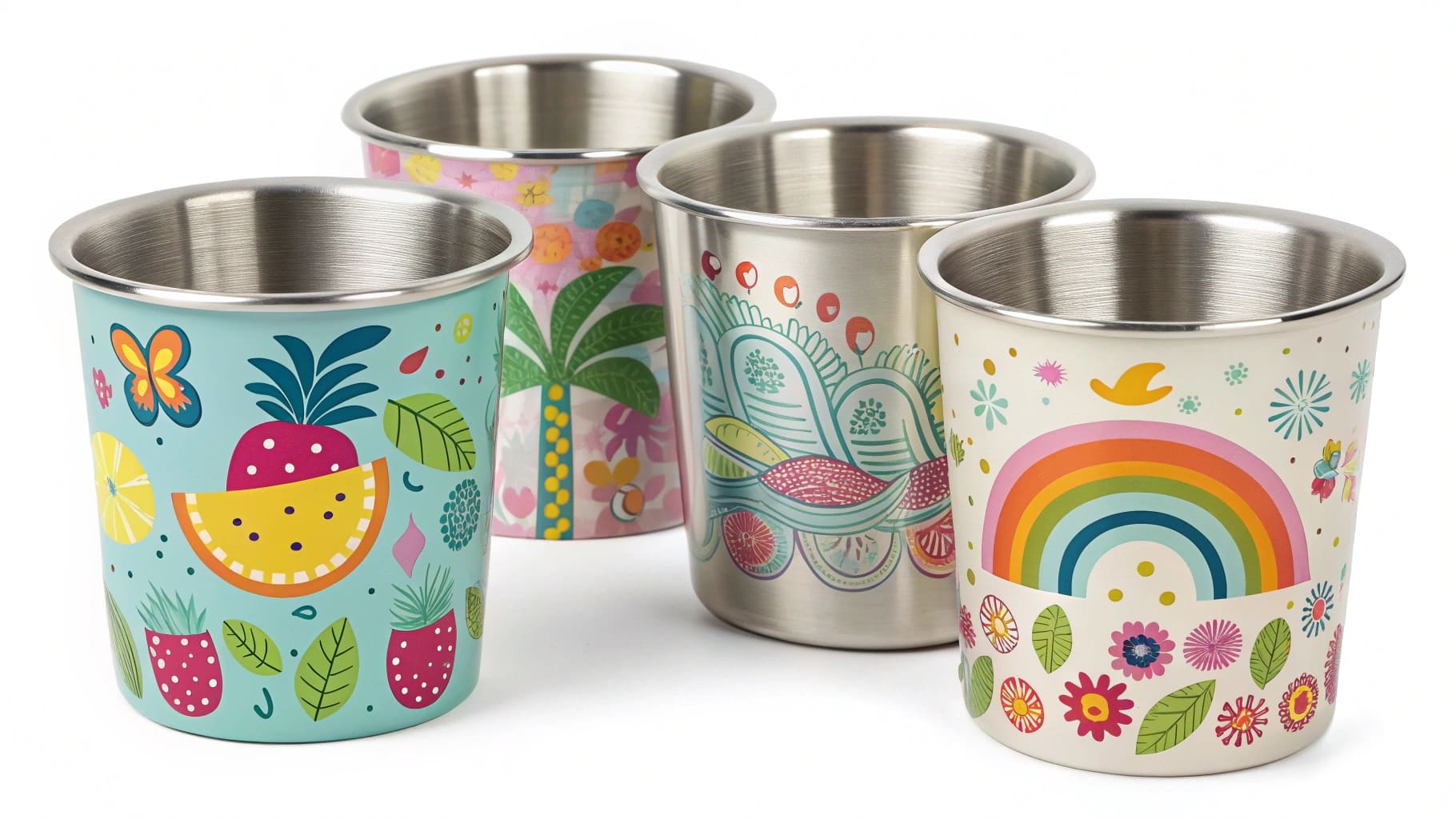
Most suppliers offer cup sets in three standard configurations: 4-piece, 5-piece, or 8-piece. Each has its own footprint, and that footprint determines how efficiently your cartons stack inside a 20ft or 40ft container.
I have seen buyers lock in a SKU based on product quality alone, only to discover that the master carton leaves 18% of their container space empty. That empty space is money you already paid for.
Here is what I recommend: request CAD drawings of the master carton early in your negotiation, not after you confirm the order. With the drawings in hand, you can run a basic cube calculation before committing.
How Pack Count Affects Pallet Stacking
The piece count inside each set determines the individual unit dimensions. Those dimensions control how master cartons stack on a standard pallet. Here is a simple comparison to show how this plays out:
| Set Configuration | Typical Carton Height | Pallet Layers (120cm limit) | Container Fit |
|---|---|---|---|
| 4-piece set | 18–22 cm | 5–6 layers | Moderate efficiency |
| 5-piece set | 20–24 cm | 4–5 layers | Depends on nesting design |
| 8-piece set | 24–30 cm | 3–4 layers | High unit value per layer |
The numbers above are general estimates. Your actual results will depend on whether the cups are nested inside the packaging. Nested designs — where cups sit inside each other — reduce the overall carton height1 and often deliver the best cube efficiency per unit. When you are sourcing from Asian manufacturers, ask specifically whether the set uses nested or flat-packed assembly. That single question can change your container utilization by 10 to 15 percentage points.
Are Stainless Steel Cups Worth It Compared to Ceramic or Plastic?
Ceramic chips. Plastic leaches. Neither of those problems disappears after the sale — they come back to you as returns, complaints, and brand damage.
Stainless steel cups are worth the investment for B2B buyers because the material eliminates the two biggest post-sale cost drivers: fragile goods and chemical safety concerns. Premium 304 stainless steel does not chip, does not crack under normal thermal stress2, and does not leach chemicals into beverages.
When I talk to procurement officers who have switched from ceramic or plastic to stainless steel, the conversation always comes back to the same point: the unit price is higher, but the return rate drops sharply. That change alone often covers the price difference within the first or second reorder.
Total Cost of Ownership vs. Unit Price
Unit price is easy to compare on a spreadsheet. Total cost of ownership is harder to calculate, but it is the number that actually matters.
Here is how the comparison breaks down across materials:
| Cost Factor | Plastic | Ceramic | 304 Stainless Steel | 316 Stainless Steel |
|---|---|---|---|---|
| Unit price | Low | Medium | Medium-High | High |
| Average return rate | Medium | High | Low | Very Low |
| Replacement frequency | High | Medium-High | Low | Low |
| Chemical safety compliance (EU/FDA) | Risk | Low risk | Compliant | Compliant |
| Corrosion resistance | Poor | Medium | Good | Excellent |
For buyers targeting markets with strict food contact regulations — such as EU member states or FDA-governed territories in North America — 304 stainless steel is the baseline standard. If your distribution reaches coastal areas or humid climates, consider 316 stainless steel. The higher nickel and molybdenum content gives 316 grade stronger resistance to salt and corrosion3. This makes it easier to justify a premium retail price in those markets, and it protects your brand from quality complaints tied to surface rust.
The material's non-porous surface is another factor that holds up under regulatory scrutiny. Unlike plastic or ceramic alternatives, stainless steel does not absorb odors or harbor bacteria in surface cracks4. For health-focused brands, that is a direct selling point that your retail buyers can use on the shelf.
What Is the Healthiest Cup to Drink Out of?
Your end customers are asking this question. If your product cannot answer it clearly, your retail buyer will find one that can.
The healthiest cup to drink out of is one made from food-grade stainless steel, specifically 304 or 316 grade. The non-porous surface prevents bacterial growth, the material does not leach chemicals, and it holds up under regular washing without degrading.
This question matters to you as a B2B buyer because health positioning is now a primary purchase driver in North America and Europe5. Brands that can back their health claims with certifications sell faster and command better shelf placement.
How to Use Health Positioning in Your Product Portfolio
Health claims are only as strong as the certifications behind them. If you are distributing stainless steel cup sets in Canada, the US, or EU markets, your supplier needs to provide documentation that holds up to scrutiny.
Here is what to request from your supplier before you place an order:
| Certification | Market | What It Covers |
|---|---|---|
| FDA compliance (21 CFR) | United States | Food contact safety for stainless steel |
| LFGB | Germany / EU | Migration testing for metals and chemicals |
| CA Prop 65 | California, USA | Restrictions on harmful substances |
| NSF/ANSI 51 | North America | Food equipment material safety |
Beyond certifications, the grade of steel communicates quality to educated consumers. Marking your products clearly as 304 or 316 stainless steel gives retail buyers a concrete spec to reference in their product listings. That specificity builds trust in a category where generic labeling is common.
I have worked with buyers who overlooked certificate verification at the sourcing stage, only to face import holds or retailer rejections later. Asking for documentation early costs nothing. Fixing a certification problem after goods arrive at port costs a great deal more.
From a portfolio standpoint, stainless steel cup sets positioned around health and longevity give you a clear story to tell wholesale customers. The material justifies the price point, the certifications reduce buyer risk, and the durability reduces post-sale friction.
Conclusion
Pack counts, cube efficiency, material grade, and certifications all connect. Get these right early, and your stainless steel cup set procurement works harder for your margins.
-
"Optimizing distribution center packing operations to reduce ...", https://dspace.mit.edu/handle/1721.1/128405. A packaging-engineering source on nesting and stacking should support that nesting similarly shaped hollow products reduces occupied volume and can lower package height compared with non-nested arrangements. Evidence role: mechanism; source type: research. Supports: Nested cup designs reduce overall carton height compared with flat-packed or non-nested configurations.. Scope note: The source may establish the packaging principle but may not quantify the effect for stainless steel measuring cups. ↩
-
"Superior Strength and Ductility of 304 Austenitic Stainless Steel with ...", https://pmc.ncbi.nlm.nih.gov/articles/PMC8538548/. A materials reference should support that austenitic stainless steels such as 304 have high toughness and thermal-shock resistance relative to brittle ceramic materials, explaining why they are less likely to chip or crack in ordinary cup use. Evidence role: mechanism; source type: education. Supports: 304 stainless steel resists chipping and cracking under normal use better than brittle materials such as ceramic.. Scope note: This supports ordinary-use durability, not immunity to denting, deformation, or failure under extreme impact or temperature conditions. ↩
-
"[PDF] Studies Related to Microbially Induced Corrosion of Stainless Steel ...", https://openprairie.sdstate.edu/cgi/viewcontent.cgi?article=2758&context=etd. A corrosion or materials-engineering source should support that Type 316 stainless steel contains molybdenum and generally provides better pitting and crevice-corrosion resistance in chloride-containing environments than Type 304 stainless steel. Evidence role: mechanism; source type: education. Supports: 316 stainless steel has stronger resistance to salt-related corrosion than 304 because of its alloy composition, especially molybdenum.. Scope note: Corrosion resistance also depends on surface finish, cleaning practices, temperature, chloride concentration, and exposure time. ↩
-
"Antibacterial Effect of Stainless Steel Surfaces Treated with a ... - PMC", https://pmc.ncbi.nlm.nih.gov/articles/PMC7910924/. A food-safety or hygienic-design source should support that smooth, non-porous stainless steel surfaces are widely used in food-contact applications because they are cleanable and resistant to microbial retention when properly finished and maintained. Evidence role: mechanism; source type: institution. Supports: Stainless steel’s non-porous surface supports hygiene by reducing odor absorption and microbial retention compared with cracked or porous surfaces.. Scope note: The evidence supports cleanability of intact smooth stainless steel; damaged, rough, or poorly cleaned surfaces can still retain soils or microorganisms. ↩
-
"Sustainable consumption - OECD", https://www.oecd.org/en/topics/sub-issues/sustainable-consumption.html. A consumer-behavior survey from a government, academic, or international institution should support that health and safety considerations influence food and household product purchasing in North America and Europe; the source would contextualize the market trend rather than prove shelf performance for stainless steel cups specifically. Evidence role: statistic; source type: institution. Supports: Health positioning is an important purchase driver for consumers in North American and European markets.. Scope note: Consumer health priorities vary by product category, demographic group, and country, and may not directly measure stainless steel cup purchases. ↩