
Tumbler cartonization for FBA: pack counts, inserts, ECT, vibration tests?
I see many tumbler sellers lose profit after FBA delivery, because weak cartons create dents, returns, bad reviews, and late replacement stock.
I cartonize stainless steel tumblers for FBA by choosing a stable pack count, a snug retail box, strong corrugated, protective inserts, and basic vibration and drop checks before mass shipment.
I treat cartonization as part of the product, not just a shipping task. When I prepare stainless steel tumblers for Amazon FBA, I think about the full path from my factory floor to the final buyer’s hand. A small dent on a powder-coated tumbler1 can turn into a refund. A crushed master carton can turn into a delayed check-in. A wrong pack count can turn into high storage cost. I have seen buyers focus only on unit price, then pay more later through damage claims and missed selling seasons. I prefer to settle the carton plan before production starts, because the box size, insert type, ECT grade, and test method all affect the real landed cost.
What is the purpose of a tumbler?
I often see buyers treat a tumbler as a simple cup, but that view creates weak packaging choices and unclear quality checks.
I see a tumbler as a portable drink container that keeps drinks hot or cold, protects the user from spills, supports daily branding, and needs packaging that preserves its finish.
Why the product purpose changes the carton plan
I start every carton discussion with the use case. A tumbler is not only a container. It is a daily carry item. It sits in a car cup holder. It travels in a backpack. It appears on an office desk. It also carries a logo, a color, and a brand promise. This is why surface protection matters so much. A stainless steel tumbler may still work after a small scratch, but the buyer may see that scratch before he tests the insulation.
I also think about the weight of the product. A double-wall vacuum insulated tumbler2 has more mass than a thin plastic cup. During transport, that mass creates force during vibration and drops. If I let tumblers touch each other inside a master carton, the cartons may arrive with chipped coating or small dents near the rim. I do not want my customer to open a carton and start sorting good units from bad units.
| Product purpose | Packaging risk I watch | My common control method |
|---|---|---|
| Daily drink use | Lid damage and rim dents | I add lid protection and top clearance |
| Gift or retail sale | Scratched coating | I use a retail box or sleeve |
| Corporate branding | Logo scuffing | I separate printed surfaces |
| Amazon FBA sale | Return and bad review risk | I test carton strength and inserts |
How I connect the purpose with inserts
I usually choose inserts based on what the tumbler must protect. If the finish is matte powder coating, I avoid loose contact inside the box. If the lid has a slider or straw hole, I check whether the lid can press against the carton during stacking. If the tumbler is sold as a premium item, I prefer molded pulp, paperboard dividers, or foam corner protection instead of only bubble wrap. Bubble wrap can help, but it can shift during vibration. I want fixed spacing, because fixed spacing keeps each unit in its own safe area.
For Amazon FBA, I also review the product insert carefully. I keep the insert simple and compliant. I use care instructions, warranty registration wording, and brand story content. I do not use review pressure. I do not add external web addresses. I want the buyer to feel trust without creating a platform problem for my customer.
What size box to ship a 20oz tumbler?
I see carton costs rise fast when buyers choose a box by guesswork, because small size errors affect freight, storage, and damage rates.
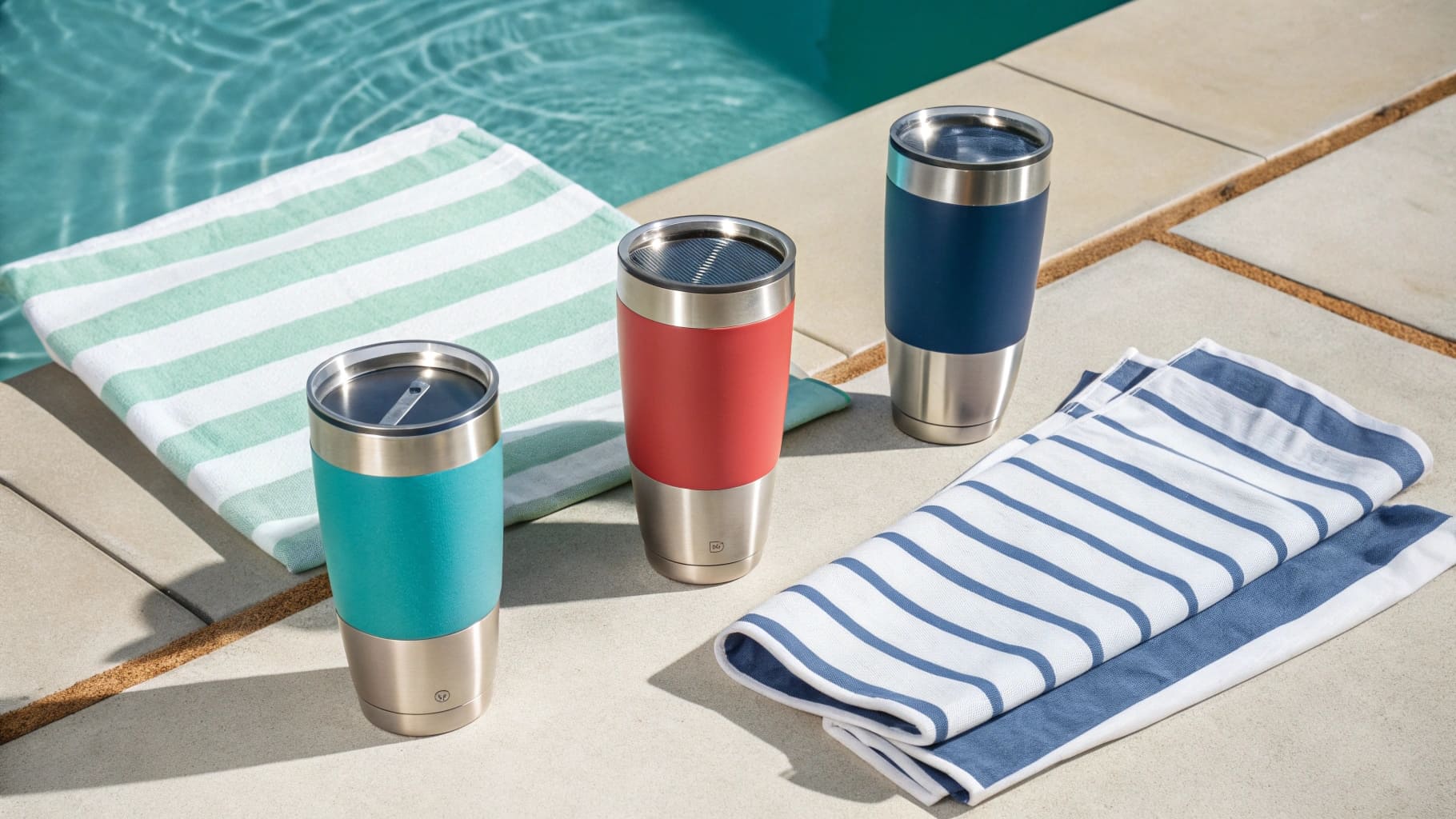
I usually pack a standard 20oz tumbler in an individual retail box near 3.5 x 3.5 x 7.5 inches, then use a 12-count or 24-count master carton based on weight and protection needs.
How I size the retail box and master carton
I begin with the actual tumbler drawing, not a rough photo. A common 20oz stainless steel tumbler is about 3 inches in diameter and about 6.5 to 7 inches high. A retail box near 3.5 x 3.5 x 7.5 inches often gives enough space for the tumbler, lid, straw if included, and a small insert. I do not make the box too tight, because a tight box transfers impact straight to the product. I also do not make it too loose, because the tumbler can move inside and damage the coating.
For a master carton, I often compare 12-count and 24-count plans. A 12-count carton is easier to lift, inspect, and protect. A 24-count carton can reduce carton material cost per unit, but it can become heavy. Amazon handling and warehouse stacking can be rough. I prefer a carton that can survive the real path, not only look good in a cost sheet.
| Packing plan | Typical use | Main benefit | Main risk I check |
|---|---|---|---|
| 12 units per master carton | Heavy double-wall tumblers | Lower damage risk | Higher carton cost per unit |
| 24 units per master carton | Lighter tumblers or strong inserts | Better freight use | Higher crush and handling risk |
| Individual retail box | FBA and retail display | Better buyer experience | Extra material cost |
| Divider-only bulk pack | Some B2B rebrand orders | Lower packing cost | More surface damage risk |
How I check ECT, inserts, and FBA handling
I treat ECT as a safety factor, not a decoration on the carton mark. For cartons under 65 pounds, 32 ECT is often used as a basic level. For heavier cartons, 44 ECT is a safer starting point. For stainless steel tumblers, I often recommend 48 ECT or higher when the carton will face long sea shipping, inland trucking, and FBA warehouse stacking. A tumbler carton may not look large, but the product weight is dense. Dense products can break weak walls during drops or compression.
I also check the flute and board quality. B-flute is common for strength and print quality. If the master carton holds many retail boxes, I want the carton walls to resist puncture from corners. I also want enough edge strength so the box does not collapse when another carton sits on top.
Before mass production, I like to run vibration and drop checks. I do not only shake one carton by hand. I check whether retail boxes rub against each other. I check whether the lid presses into the tumbler body. I check whether the bottom layer shows more damage than the top layer. If the carton passes a basic lab test or an internal test, I feel much safer approving the pack count.
Which two materials can be used to make a tumbler?
I see material choice create hidden packaging issues, because a heavier or softer tumbler body changes the carton strength needed for safe FBA delivery.
I usually compare 304 stainless steel and 316 stainless steel for premium tumblers, because both support food contact, but 316 gives stronger corrosion resistance for higher-positioned products.
How I compare 304 and 316 stainless steel
I mainly work with stainless steel drinkware, so I focus on the grades that matter most for serious B2B buyers. For many commercial tumblers, 304 stainless steel, also called 18/8 stainless steel3, is the common choice. It gives good rust resistance, good forming ability, and a strong cost balance. It works well for water, coffee, tea, and most daily drinks. This is why many importers use it for branded tumbler projects.
For higher-end projects, I may discuss 316 stainless steel. It has stronger corrosion resistance4, especially when the product may face salty air, acidic drinks, or a more demanding customer group. It also helps the buyer position the product as premium. The challenge is cost. A buyer must decide whether the market will pay for that upgrade.
| Material | Common name | My view on use | Packaging effect |
|---|---|---|---|
| 304 stainless steel | 18/8 stainless steel | Best balance for most tumblers | Standard strong carton works well |
| 316 stainless steel | Marine-grade stainless steel | Premium choice for tougher use | Similar carton, higher protection value |
| Thicker gauge steel | Heavy body design | Stronger feel and higher weight | Stronger ECT and inserts needed |
| Powder-coated surface | Colored outside finish | Better branding and shelf appeal | More scratch protection needed |
Why material affects testing and shipment risk
I do not separate material selection from cartonization. A tumbler made with thicker stainless steel feels better in the hand, but it also increases carton weight. More weight means more drop energy. More drop energy means stronger inserts and stronger corrugated are needed. If the tumbler has a painted, plated, or powder-coated finish, I add another concern. The body may not dent easily, but the surface can chip if it rubs against another hard part.
I also care about certificates. Some buyers have faced fake certificates from suppliers, so I prefer clear material reports and food-contact documents before shipment. I want my customer to inspect the goods with confidence. I also want the carton label, product label, and order documents to match. If the product is sold as 304 stainless steel, the report should support that claim. If the product is sold as 316 stainless steel, I want stronger proof because the cost is higher and the claim is more important.
For Amazon FBA, material claims also connect with reviews. A buyer may not test the steel grade in a lab, but he will notice rust, odor, dents, and chipped coating. I want the packaging and material to work together. Good steel with weak packaging still creates bad results. Strong packaging with poor material still creates returns. I try to control both sides before the shipment leaves my factory.
Conclusion
I treat cartonization as part of the tumbler product, because strong boxes, clear inserts, and real tests protect margin, timing, and brand trust.
-
"The Process For Powder Coating Stainless Steel", https://www.reidsupply.com/en-us/industry-news/process-for-powder-coating-stainless-steel-. Powder coating applies dry polymer powder electrostatically to metal surfaces, then cures it under heat to form a durable finish that resists scratches and corrosion better than conventional liquid paints. Evidence role: mechanism; source type: encyclopedia. Supports: The application method and properties of powder coating on metal surfaces. Scope note: While generally durable, powder coating can still chip from sharp impacts, particularly on edges and high-contact areas ↩
-
"Thermal Performance of Exterior Insulation and Finish Systems ...", https://web.ornl.gov/sci/buildings/conf-archive/2013%20B12%20papers/083-Childs.pdf. Vacuum insulation reduces heat transfer by creating a near-vacuum space between two walls, minimizing conduction and convection while the reflective surfaces limit radiation. Evidence role: mechanism; source type: encyclopedia. Supports: The basic principle and construction method of vacuum insulation in drinkware. ↩
-
"Stainless Steel Leaches Nickel and Chromium into Foods During Cooking", https://pmc.ncbi.nlm.nih.gov/articles/PMC4284091/. AISI 304 stainless steel contains approximately 18% chromium and 8% nickel, hence the common designation 18/8, and is widely used in food-contact applications. Evidence role: definition; source type: encyclopedia. Supports: The chemical composition and naming convention for 304 stainless steel. ↩
-
"Marine grade stainless", https://en.wikipedia.org/wiki/Marine_grade_stainless. Type 316 stainless steel includes 2-3% molybdenum in addition to chromium and nickel, which significantly improves resistance to chloride corrosion and acidic environments compared to 304. Evidence role: mechanism; source type: encyclopedia. Supports: The compositional basis for 316 stainless steel's enhanced corrosion resistance. ↩