
Which Insulated Bottle Diameters Actually Fit US/EU Car Holders in RFQs?
You spec a bottle. You confirm the order. Then your customer calls to say it doesn't fit their cup holder. That one detail kills repeat business fast.
The safest bottom diameter for fitting most US and EU car cup holders is 75mm (2.95 inches) or below. Bottles in the 18–32 oz range that stay within this width cover roughly 85% of vehicles in the US market and a strong majority in Europe.

Car cup holder compatibility sounds like a small detail. But for B2B buyers sourcing commuter bottles, it is one of the first things that determines whether a product sells through or gets returned. The diameter spec in your RFQ is not just a measurement. It is a market access decision. Get it wrong and your whole production run is solving the wrong problem. Get it right and your product fits the daily routine of millions of drivers before they even open the lid.
Does a 40 oz Hydro Flask Fit in a Car Cup Holder?
A 40 oz bottle sounds like a great value sell. More capacity, higher perceived value. But there is a wall you will hit the moment your customer tries to set it in their car.
A standard 40 oz bottle has a base diameter of around 3.5 to 3.9 inches (89–99mm).1 Most US car cup holders max out at 3.15 inches (80mm). That means a 40 oz bottle does not fit the majority of vehicles on the road.

This is not a niche problem. The Ford F-150 is the best-selling vehicle in the US. The Toyota Camry and Honda CR-V are among the top-selling sedans and SUVs. None of these come with cup holders wide enough to hold a standard 40 oz bottle without an adapter. European vehicles run even tighter, with holders typically sitting between 65–75mm in width.2
Here is what this means for procurement decisions:
| Bottle Size | Typical Base Diameter | Fits US Holders? | Fits EU Holders? |
|---|---|---|---|
| 40 oz | 89–99mm (3.5–3.9 in) | No (most vehicles) | No |
| 32 oz | 80–88mm (3.15–3.5 in) | Borderline | No |
| 24 oz | 71–76mm (2.8–3.0 in) | Yes (~85% vehicles) | Yes (most vehicles) |
| 18 oz | 67–72mm (2.6–2.8 in) | Yes | Yes |
I work with buyers who come to me specifically asking for 40 oz bottles because they sell well on shelf. My first question back to them is always: where will the end consumer use this bottle? If the answer includes driving to work, you need to address the holder problem before production starts.
There are two ways around it. One is to design the bottle with a tapered base that narrows below 75mm, even if the body is wider above. The other is to be upfront with your retail customers that this size requires a cup holder adapter, and bundle one in the packaging. Either way, this has to be a decision made before tooling, not after.
If you are sourcing a 40 oz bottle from us, we can review the base geometry and tell you exactly what fits and what does not. I would rather flag it early than have you deal with complaints after the first shipment lands.
What Is the Diameter of a Car Cup Holder?
Buyers ask me this question more often than I expected when I first started getting RFQs with cup holder specs attached. The short answer is that there is no single standard. But there is a safe range.
US vehicles typically have cup holders between 70–80mm (2.75–3.15 inches) in diameter.3 EU vehicles tend to sit slightly narrower, at 65–75mm (2.5–2.95 inches). The overlap between the two markets lands at 75mm or below.

Understanding this range is not just useful for product design. It is directly relevant to your RFQ process. When you write a spec that says "cup holder compatible," without a number attached, a supplier has no way to confirm compliance. Worse, two suppliers might interpret that phrase completely differently and quote you on two different diameter ranges.
Here is how I break down the dimensional landscape for buyers writing RFQs:
| Market | Typical Holder Diameter | Recommended Max Bottle Base |
|---|---|---|
| United States | 70–80mm | 75mm |
| European Union | 65–75mm | 72mm |
| Universal / Safe Zone | — | 72mm or below |
There are a few specific vehicle models worth knowing, because they show up in consumer research repeatedly. The Ford F-150 has a cup holder depth of around 85mm and a width of about 82mm at the widest point, but the base narrows.4 The Toyota Camry sits at roughly 74mm across. The Honda CR-V runs about 76mm. If your product fits all three, you have covered a huge slice of the US consumer market.
From a tooling perspective, adjusting the base diameter by even 5mm can change material usage per unit. That affects unit cost. It also affects how the bottle feels in hand, since a narrower base usually means a taller, more cylindrical profile. These are tradeoffs worth discussing with your supplier before you lock a mold.
I always recommend asking for a sample before confirming production. When the sample arrives, take it to a car and test it. Not just in one vehicle. Test it in the vehicles your target customer actually drives. That physical test takes five minutes and can save you from a very expensive mistake.
Does a 24 oz Owala Fit in a Cup Holder?
The Owala FreeSip has become one of the most talked-about consumer bottles in North America. Buyers ask me about it because they want to source something similar, or they want to understand why it sells so well.
The 24 oz Owala measures roughly 2.95–3.0 inches (75–76mm) at the base. That puts it right at the edge of the US safe zone. It fits approximately 85% of US vehicles.
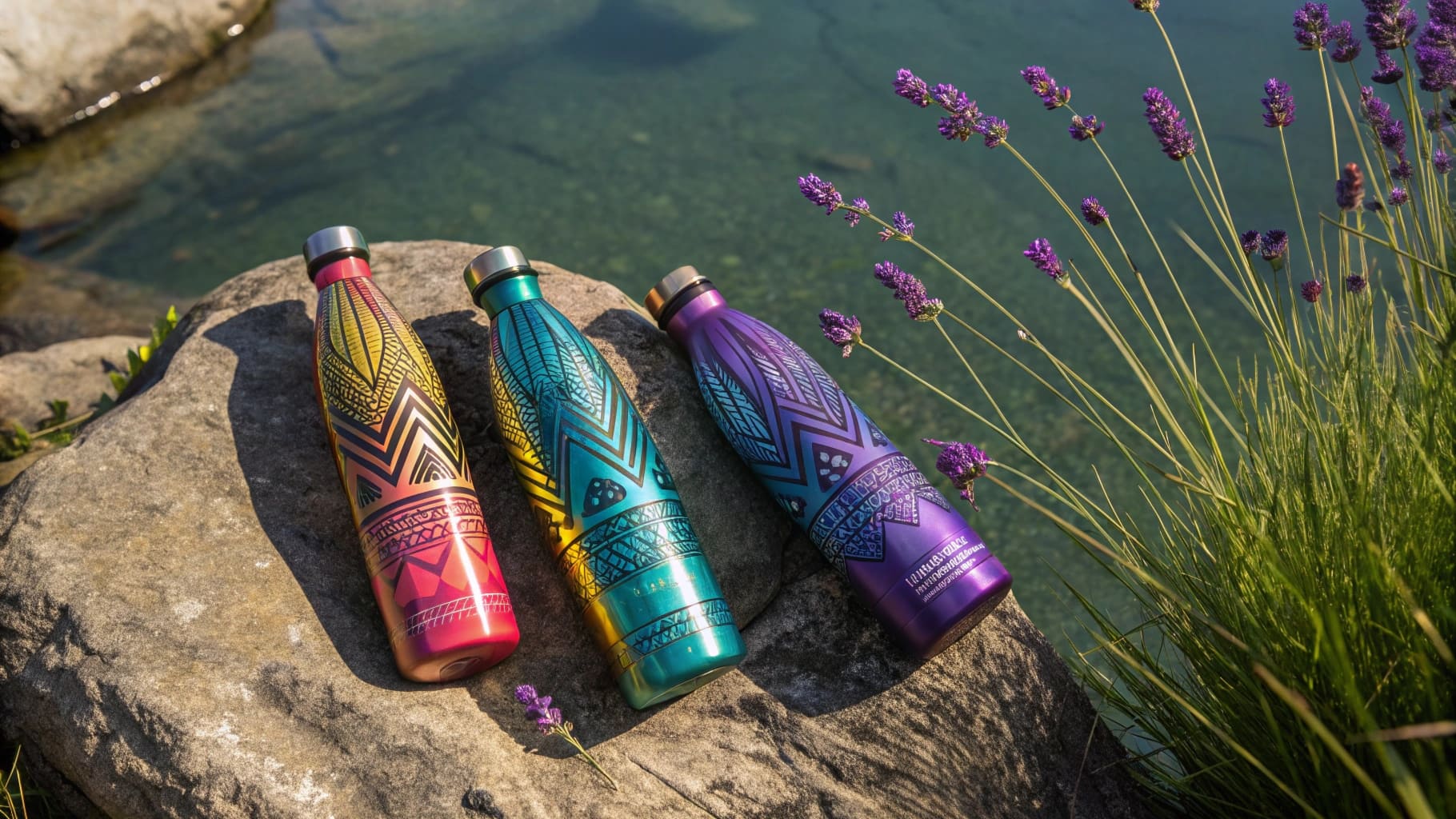
That fit rate is not a coincidence. It is the result of deliberate engineering choices that consumer brands make when they are targeting the commuter market. The 24 oz size is large enough to feel useful for a full commute, and narrow enough at the base to sit in most standard holders without forcing the user to adapt.
Here is how the 24 oz category sits relative to other common sizes:
| Capacity | Typical Base Diameter | Cup Holder Fit Rate (US) | Target Use Case |
|---|---|---|---|
| 18 oz | 67–72mm | ~95% | Short commutes, kids |
| 24 oz | 73–76mm | ~85% | Daily commuter, gym |
| 32 oz | 80–88mm | ~40% | Desk use, outdoor |
| 40 oz | 89–99mm | ~10% | Outdoor, camping |
For B2B buyers, the 18–32 oz range is where the commuter opportunity lives. Within that range, 24 oz is the sweet spot for maximum holder compatibility without sacrificing capacity. If you are building a private label line and cup holder compatibility is on your feature list, I would start the design conversation with a 24 oz target and work out from there.
One thing I tell buyers who come to me with Owala-style specs: the design influence is fine to reference, but the tooling and material decisions are what actually deliver the result. A bottle that looks like it should fit at 75mm but has a slight base flare due to poor mold tolerances will still fail the cup holder test. Tighter manufacturing tolerances cost more per unit.5 But they also reduce your return rate and protect your brand.
When we produce bottles targeting cup holder compatibility, I pull a dimension template based on the Ford F-150, Toyota Camry, and Honda CR-V as reference vehicles. If a bottle base clears all three, it goes on the "compatible" list. That is a simple, testable standard I can put in writing and stand behind.
Conclusion
Cup holder compatibility starts with one number: your bottle's base diameter. Keep it at or below 75mm, test it in real vehicles, and include that spec clearly in every RFQ you write.
-
"40 oz Wide Mouth: 40 oz Insulated Water Bottle - Hydro Flask", https://www.hydroflask.com/40-oz-wide-mouth?srsltid=AfmBOoqulc7apCrD0Tk03WXBwaK1BequGnbINSdOwfSvLeKX0RBHq7DW. Published product-dimension specifications for common 40 oz insulated bottles support the stated approximate base-diameter range. Evidence role: statistic; source type: other. Supports: A standard 40 oz bottle has a base diameter of around 3.5 to 3.9 inches (89–99mm).. Scope note: Brand specifications may report overall width rather than contact-base diameter, so the source may only approximate the exact fit dimension. ↩
-
"What is the normal car cup holder height? - Quora", https://www.quora.com/What-is-the-normal-car-cup-holder-height. Comparative measurements of European-market vehicle cup holders would support the assertion that European holders commonly fall in the 65–75 mm range. Evidence role: statistic; source type: research. Supports: European vehicles typically have cup holders between 65 and 75 mm in width.. Scope note: This is likely an observed design range rather than a regulatory standard; support should be framed as sample-based unless a representative dataset is available. ↩
-
"Are wide-mouth insulated bottles compatible with most car holders ...", https://icobottle.com/are-wide-mouth-insulated-bottles-compatible-with-most-car-holders-for-us-eu/. A survey of cup-holder openings in US-market passenger vehicles would support the stated typical 70–80 mm diameter range. Evidence role: statistic; source type: research. Supports: US vehicles typically have cup holders between 70 and 80 mm in diameter.. Scope note: The range would be descriptive rather than universal, because individual holders may be tapered, oval, removable, or model-specific. ↩
-
"What is a good cup holder expander for Ford F150? - Facebook", https://www.facebook.com/groups/297713615877787/posts/880632704252539/. A model-specific interior measurement source for the Ford F-150 would support the stated cup-holder depth, upper width, and tapered-base qualification. Evidence role: case_reference; source type: other. Supports: The Ford F-150 cup holder is about 85 mm deep and about 82 mm wide at its widest point, with a narrower base.. Scope note: Measurements can vary by model year, trim, front versus rear holder location, and removable inserts. ↩
-
"A cost-tolerance analytical approach for design and manufacturing", https://www.academia.edu/67337346/A_cost_tolerance_analytical_approach_for_design_and_manufacturing. Manufacturing engineering literature supports that narrower dimensional tolerances generally increase production cost because they require more precise tooling, process control, inspection, and scrap management. Evidence role: mechanism; source type: education. Supports: Tighter manufacturing tolerances cost more per unit.. Scope note: The magnitude of the cost increase depends on material, process, production volume, and the specific tolerance requirement. ↩